Roza Book · companion card
Thunberg's barberry beside roses
Practical compatibility, planting, care and climate limits, without exaggerated promises.
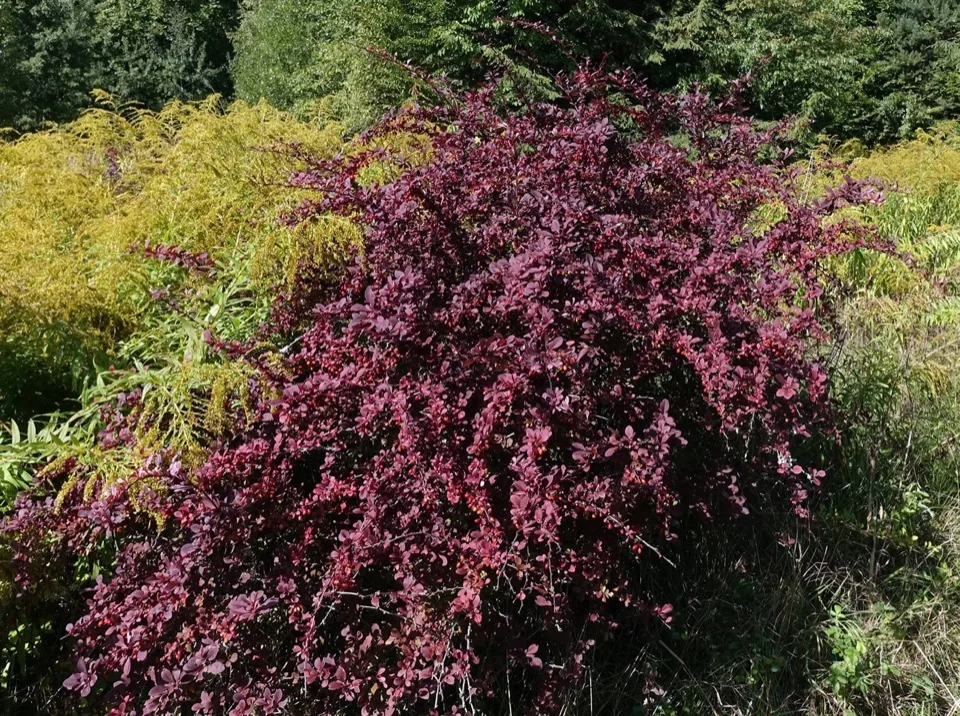
Why it makes a good neighbour
This compact, thorny shrub adds clear form to the composition, with small coloured leaves and autumn berries. Beside the dark Black Magic, a variety whose foliage does not blend with the colour of the rose works better.
How to plant it beside a rose
Thunberg's barberry is hardy and grows in most well-drained soils. For strong leaf and berry colour, a sunny spot is better, but without standing water.
Choose the variety first
Check the mature height, width and leaf colour; do not rely on a small young plant alone.
Place it at the side or at the back
Do not plant the thorny shrub in front of a path, and do not block access for pruning Black Magic.
Leave room
Set the distance by the mature width of the variety, so that the crowns do not meet and there is air around the rose.
Work in gloves
The shoots have sharp thorns; carry out formative pruning after flowering.
For Ukraine and Europe
Short care calendar
Spring
Remove damaged and crossing branches, working in thick gloves.
Summer
Water young and mature bushes during prolonged drought; watch for aphids and sawflies.
Autumn and winter
Leave the berries for decoration and for birds; remove unwanted seedlings if they appear.
Roses in Roza Book's agreed schemes
For Thunberg's barberry, 1 variety is shown where this companion is already part of an agreed scheme. The caption repeats the actual palette from the rose card.
Harmony and contrastThe contrast depends on the barberry variety chosen.
Growing conditionsFirst choose the exact variety by size and leaf colour; do not place the thorny shrub next to a path.
Why these varietiesEach pair repeats a scheme already agreed in the rose card; random varieties were not added.

Source for verification
Basic requirements were checked against materials from the Royal Horticultural Society. The practical placement next to a rose is formulated separately and is not presented as a universal strict rule.