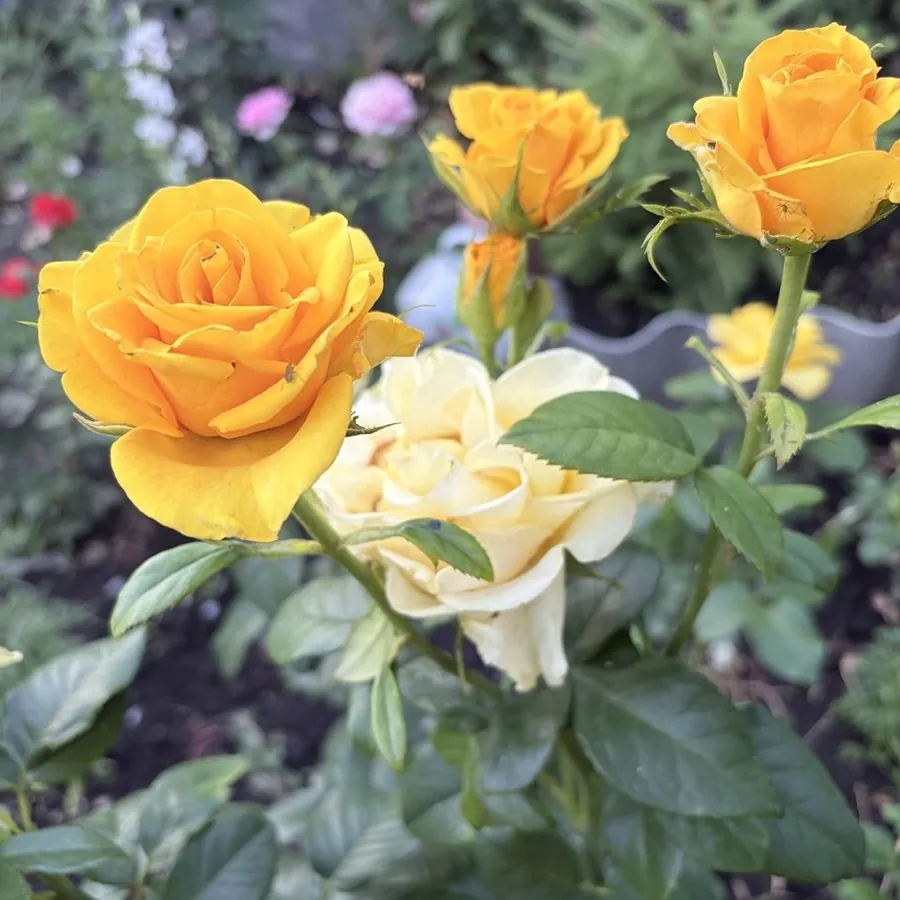
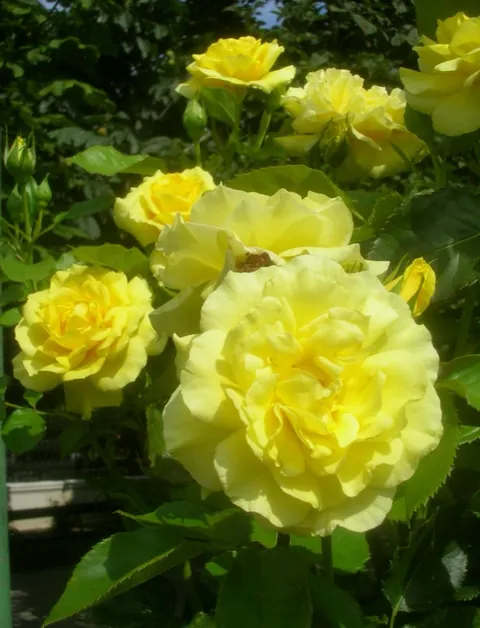
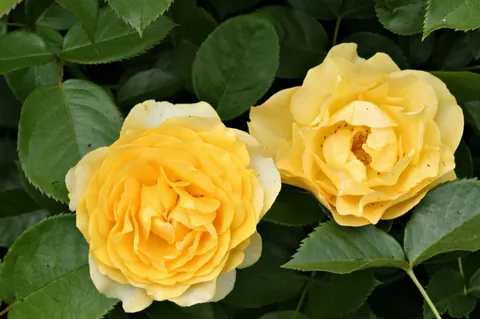
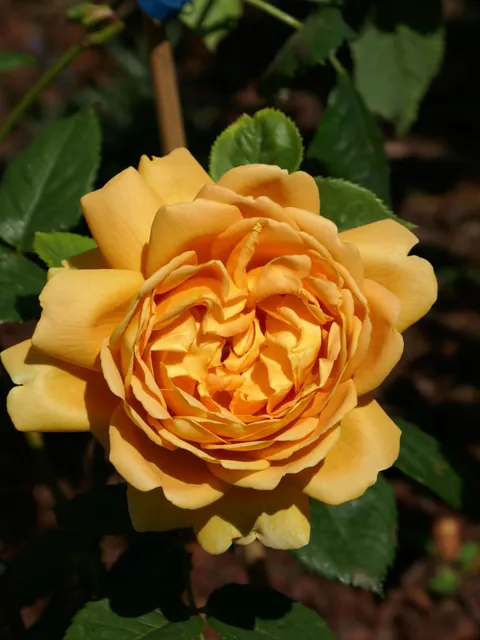
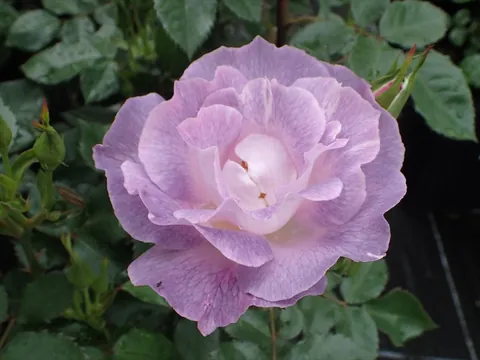

Kerio, close-up of the flower
Photo: Nataliia (own garden)
Back to catalogue
Hybrid Tea; florist's cut roseLex Voorn; Lex+ Roses, 2002Yellow

Kerio

A greenhouse cut-flower variety for wedding floristry; clean, rich yellow that fades to cream; stem 70–100 cm; bred for cutting, but it also grows in the garden.

'Kerio' spelled backwards · a cut-flower variety

Variety profile

Flowering

Continuous under glass; vase life 8–12 days

Purpose

Florist's Rose

For wedding floristry · competes with Mohana, Skyline, Penny Lane

Plant size

80–120 × 50–70 cm
person 170 cm80–120 cm
Habit
Upright, with long thin stems — typical of greenhouse varieties
Dimensions
Bush 80–120 × 50–70 cm; stem 70–100 cm
Support
Greenhouse staking — support for the long stem
Shoots
Long thin stems 70–100 cm — favoured in greenhouse growing for wedding floristry
Branching
Medium

Flower

12–15 cm
Bud shape
Elongated, high-centred, rich yellow; in cool weather the petal edges are dark orange
Open flower
A benchmark of the classic high-centred HT form — specially bred for a show-quality look in bouquets; 12–15 cm when fully open
Centre
Rich yellow, fully closed — no visible stamens
Fullness
17–25 petals — optimal for a long vase life
Flower carriage
Singly on a long stem — typical for cut flowers

Fragrance

Faint; citrus-honey

Faint — light citrus-honey notes. Cut-flower varieties are usually deliberately bred without a strong fragrance for longer vase life (a scented flower ages faster).

Disease resistance

4 out of 5

3–4/5 under glass; in open ground in Ukraine — moderate.

Sun

Warmth

Greenhouse lighting; controlled conditions.

Thorns

Few
thornlessfewmoderatemanyvery many

Few thorns — a feature of cut-flower varieties, convenient for florists to work with.

Foliage

Dark green, glossy, leathery — an extra decorative effect in a bouquet.

All characteristics in a table
Group
Hybrid Tea; florist's cut rose
Breeder
Lex Voorn; Lex+ Roses, Netherlands, 2002
Bud shape
Elongated, high-centred, rich yellow; in cool weather the petal edges are dark orange
Open flower
A benchmark of the classic high-centred HT form — specially bred for a show-quality look in bouquets; 12–15 cm when fully open
Centre
Rich yellow, fully closed — no visible stamens
Colour
Rich yellow ('deep yellow'), pure, with no pink; in cool weather the edge of the outer petals is often dark orange. With age the edge of the flowers pales to a dark yellow, and at the end of flowering the whole bloom fades to light yellow and cream — fresh and faded flowers on the bush look almost like different varieties
Fullness
17–25 petals — optimal for a long vase life
Flower carriage
Singly on a long stem — typical for cut flowers
Flowering
Continuous under glass; vase life 8–12 days
Fragrance
Faint — light citrus-honey notes. Cut-flower varieties are usually deliberately bred without a strong fragrance for longer vase life (a scented flower ages faster)
Hips
Not documented — under glass it does not produce hips
Habit
Upright, with long thin stems — typical of greenhouse varieties
Branching
Medium
Shoots
Long thin stems 70–100 cm — favoured in greenhouse growing for wedding floristry
Thorns
Few thorns — a feature of cut-flower varieties, convenient for florists to work with.
Dimensions
Bush 80–120 × 50–70 cm; stem 70–100 cm
Support
Greenhouse staking — support for the long stem
Foliage
Dark green, glossy, leathery — an extra decorative effect in a bouquet
Resistance
3–4/5 under glass; in open ground in Ukraine — moderate
Variations of the variety
Code LEXoirek — 'Kerio' backwards (a signature Voorn tradition for variety names); parentage not published (trade secret)

Colour scheme

Rich yellow ('deep yellow'), pure, with no pink; in cool weather the edge of the outer petals is often dark orange. With age the edge of the flowers pales to a dark yellow, and at the end of flowering the whole bloom fades to light yellow and cream — fresh and faded flowers on the bush look almost like different varieties

Rose neighbours

Perennials to plant nearby

Neighbouring roses

Cut-flower and warm yellow varieties — a florist's family:

Companion perennials

A classic wedding-florist family for bouquets:

gypsophilacinerariacraspedialisianthus

Availability worldwide

One of the leading Dutch yellow cut-flower roses of the 2000s:

  • 🇳🇱 Netherlands: high · Royal FloraHolland
  • 🇪🇨 Ecuador/🇰🇪 Kenya: high · greenhouse production
  • 🇺🇸 USA: high · GlobalRose, Sierra Flower
  • 🇺🇦 Ukraine: high · sold as cut flowers through florist wholesalers

More about the variety

Hips
Not documented — under glass it does not produce hips
Variations of the variety
Code LEXoirek — 'Kerio' backwards (a signature Voorn tradition for variety names); parentage not published (trade secret)

How to grow

Where to plant. First and foremost a cut-flower florist's rose — bred for greenhouses and wedding floristry. But it also grows well in the garden: in the Forest-Steppe and Steppe of Ukraine — in open ground; in the north — with cover. A sunny spot and fertile soil — as for an ordinary Hybrid Tea. Also excellent for cutting from your own bush.

Climate. USDA 6+. Bred for greenhouses, but it also overwinters in open ground: in the Forest-Steppe and Steppe usually with light cover, in the north (zone 5) with full cover. No two winters are alike — in severe, snowless years some winter dieback is possible (as with many cut-flower roses, e.g. Fire Flash, High Magic).

Care. Under glass — control of light and temperature; vase life 8–12 days with proper stem treatment.

About the name

Name. 'Kerio' is 'LEXoirek' without the prefix and written backwards (a signature Lex+ Voorn tradition for variety names). No specific 'in honour of' is documented — it is a purely marketing combination of letters.

Breeding. Bred by Lex Voorn at the house of Lex+ Roses (Netherlands), introduced in 2002 (per HelpMeFind; some sources give 2004 — probably the year of its wider market entry for cut flowers). Code LEXoirek. Parentage not published (a trade secret, typical of Dutch cut-flower breeding). Lex+ Roses specialises precisely in greenhouse cut flowers — not the garden.

Significance. One of the leading Dutch yellow cut-flower varieties of the 2000s; competes with Mohana, Skyline and Penny Lane in the category 'yellow HT for wedding floristry'. The third greenhouse cut-flower variety in our catalogue (alongside Fire Flash and High Magic) — a separate group in the handbook. No official major awards (AARS/ADR/AGM) — it is not an 'award' type of variety, but a commercial florist's one. By origin it is a florist's rose (cut, greenhouse), but it grows quite well in the garden — gardeners successfully grow it in open ground. Not to be confused with 'Kerio Sunbeam' (a different variety).

Frequently asked questions about Kerio

How many times a season does Kerio flower?

Continuous under glass; vase life 8–12 days.

How big does Kerio grow?

80–120 cm tall, 50–70 cm wide.

Which diseases affect Kerio?

Overall resistance: 4 out of 5. 3–4 / 5; good under glass; moderate in open ground.

How much sun does Kerio need?

Warmth; greenhouse lighting; controlled conditions.

What does Kerio smell like?

Faint — light citrus-honey notes. Cut-flower varieties are usually deliberately bred without a strong fragrance for longer vase life (a scented flower ages faster).

Gardeners' photos and reviews

My climate

Choose a reference temperature to compare with the cultivar’s data. This is not an overwintering forecast or advice on winter protection; consider wind, moisture and the duration of frost.

Regional data are generalised. USDA describes average annual extreme minima, not a forecast; the values in the list are rounded. Check the conditions at your site. More information: Roses in Ukraine's climate.