


Back to catalogue
English ShrubDavid C.H. Austin, 1992Yellow

Golden Celebration

RHS AGM 2001; parentage 'Charles Austin' × 'Abraham Darby'; one of the largest and most golden of the Austin English Roses.

'Golden Jubilees' · David Austin

Variety profile

Flowering

Repeat flowering

Repeat-flowering, in flushes through the season — from June to the first frosts. Months are approximate, for the climate of Ukraine.

Awards

RHS AGM

2001 · Award of Garden Merit

Winter hardiness

−29 °C

USDA zone 5–11. All of Ukraine with minimal cover.

Compare reference temperatures

Plant size

120–150 × 90–120 cm
person 170 cm120–150 cm
Habit
A vigorous shrub with long arching canes; in warm regions it can be grown as a small climber up to 180 cm
Dimensions
120–150 cm high × 90–120 cm wide; up to 180 cm in hot climates
Support
Not essential; a light support (a low obelisk) helps hold the heavy flowers; as a climber — an arch or trellis
Shoots
Long, arching, bending over time under the weight of the large flowers
Branching
Good, even

Flower

10–13 cm
Bud shape
Round, deep orange-red bud — a dramatic contrast with the golden open flower
Open flower
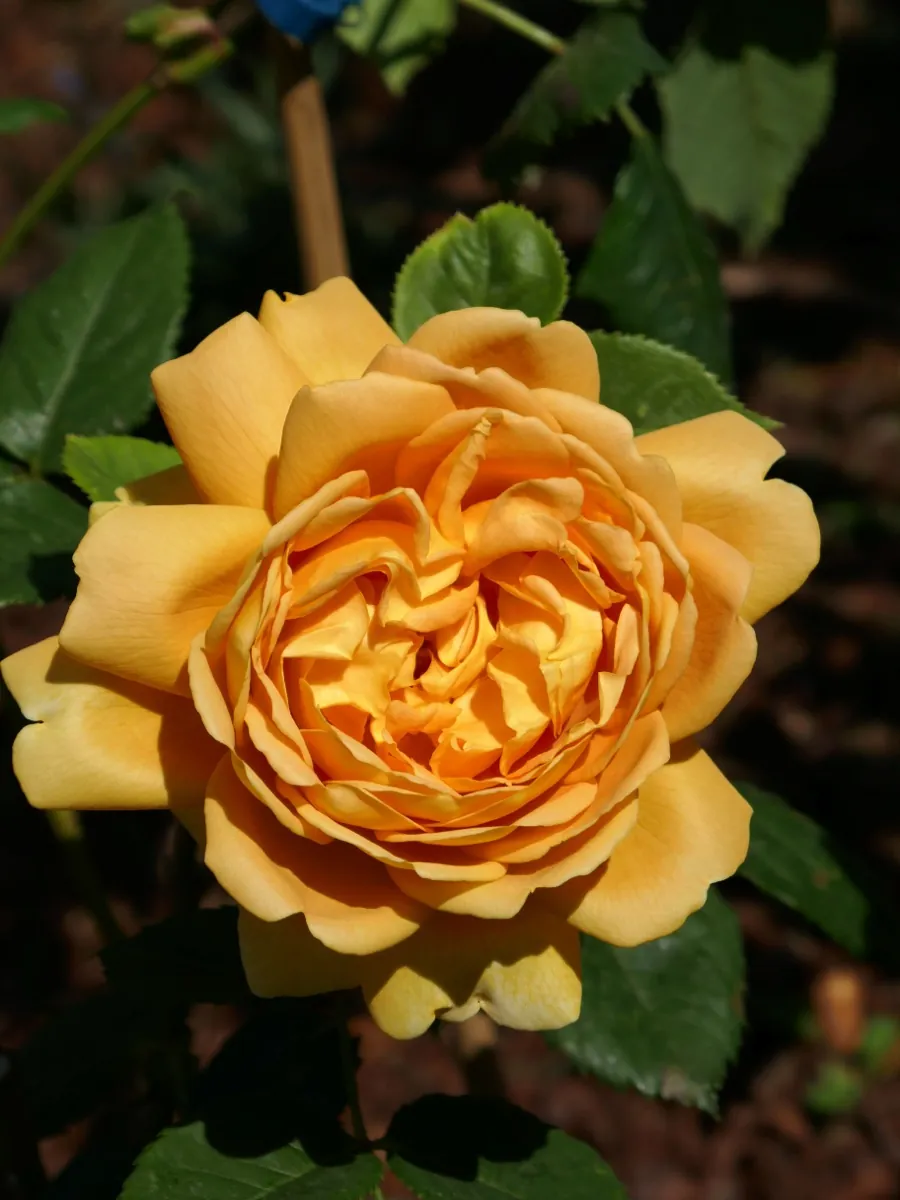
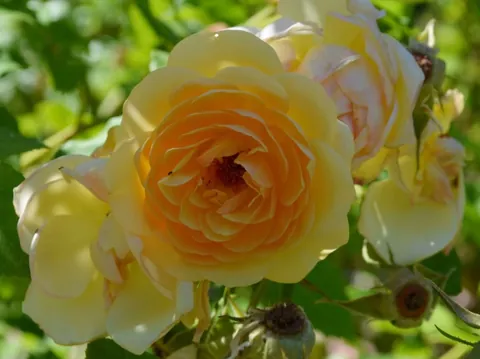
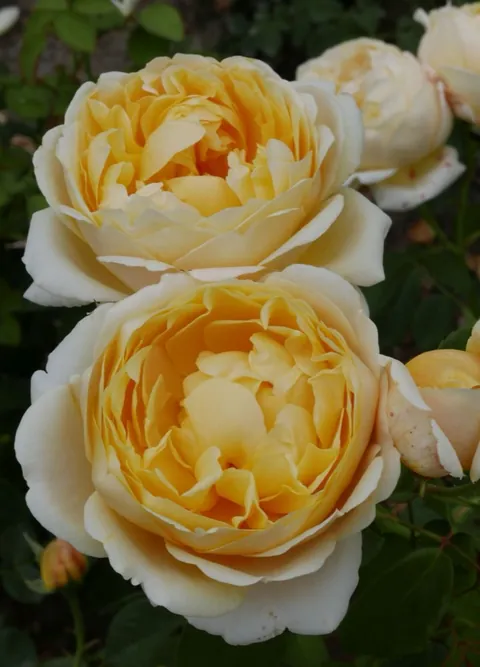
Deep cup-shaped 'giant cup' — one of the largest English Roses; diameter 10–13 cm
Centre
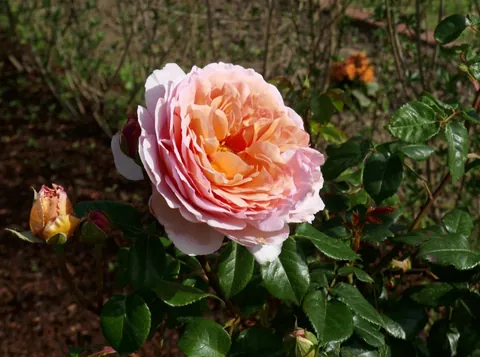
Apricot tone near the centre, lightening towards the edge
Fullness
Very double, 40–75 petals
Flower carriage
Singly or in small clusters of 2–3

Fragrance

Strong

Strong fruity — David Austin's official description: 'notes of Sauvignon/Sauternes and strawberry', with fine tea notes. One of the most complex fragrances among Austin English Roses.

Disease resistance

3 out of 5
Black spotsusceptible

Moderate — prone to black spot (blackspot) — the variety's weak point; needs preventive treatment 2-3 times per season.

Sun

Full sun for the richest golden colour

Thorns

Moderate
thornlessfewmoderatemanyvery many

Moderate number, typical of Austin English Roses.

Foliage

Medium green, semi-glossy.

All characteristics in a table
Group
English Shrub
Breeder
David C.H. Austin, United Kingdom, 1992
Bud shape
Round, deep orange-red bud — a dramatic contrast with the golden open flower
Open flower
Deep cup-shaped 'giant cup' — one of the largest English Roses; diameter 10–13 cm
Centre
Apricot tone near the centre, lightening towards the edge
Colour
Rich golden yellow ('rich yellow'); David Austin officially describes it as 'deep yellow with an apricot tinge'; the tone stays stable in the sun (does not fade to white)
Fullness
Very double, 40–75 petals
Flower carriage
Singly or in small clusters of 2–3
Flowering
Repeat-flowering, in flushes through the season — from June to the first frosts
Fragrance
Strong fruity — David Austin's official description: 'notes of Sauvignon/Sauternes and strawberry', with fine tea notes. One of the most complex fragrances among Austin English Roses
Hips
Possible ornamental hips in autumn
Habit
A vigorous shrub with long arching canes; in warm regions it can be grown as a small climber up to 180 cm
Branching
Good, even
Shoots
Long, arching, bending over time under the weight of the large flowers
Thorns
Moderate number, typical of Austin English Roses.
Dimensions
120–150 cm high × 90–120 cm wide; up to 180 cm in hot climates
Support
Not essential; a light support (a low obelisk) helps hold the heavy flowers; as a climber — an arch or trellis
Foliage
Medium green, semi-glossy
Resistance
Moderate — prone to black spot (blackspot) — the variety's weak point; needs preventive treatment 2-3 times per season
Variations of the variety
Code AUSgold; parentage 'Charles Austin' × 'Abraham Darby'; no renamings — sold only as Golden Celebration

Colour scheme

Rich golden yellow ('rich yellow'); David Austin officially describes it as 'deep yellow with an apricot tinge'; the tone is stable in the sun (does not fade to white)

Rose neighbours

Perennials to plant nearby

Neighbouring roses

Yellow Austin family, Abraham Darby as parent, and a classic yellow companion:

Companion perennials

Purple-blue accents — a classic contrast to golden yellow:

lavender 'Hidcote'delphinium 'Pacific Giant'catmint 'Walker's Low'salvia 'Caradonna'

Availability worldwide

One of the best-known Austin English Roses — a worldwide bestseller:

  • 🇪🇺 Europe: VERY HIGH · David Austin Roses · everywhere
  • 🇺🇸 USA: VERY HIGH · David Austin USA
  • 🇯🇵 Asia: VERY HIGH · Japan loves Austin
  • 🇺🇦 Ukraine: high · a top Austin rose at garden centres

More about the variety

Hips
Possible ornamental hips in autumn
Variations of the variety
Code AUSgold; parentage 'Charles Austin' × 'Abraham Darby'; no renamings — sold only as Golden Celebration

How to grow

Where to plant. Sunny borders, the centre of a romantic yellow garden, as a single bush; the large flowers look good with a low support (a light obelisk 100–120 cm); in warm regions — on a south-facing wall as a small climber; lovely paired with blue delphinium — the classic 'flame and sky' pairing.

Climate. To −29 °C — all of Ukraine with minimal cover; the south — no cover; holds its colour in the sun.

Care. Classic Austin English — spring pruning by a third; preventive treatment against black spot is essential (2–3 fungicide sprays per season); deadheading stimulates new flushes; copes well with watering in the heat.

About the name

Name. 'Golden Celebration' means 'a golden celebration'. It is not dedicated to a specific person — David Austin recommends it as the ideal rose for a 'Golden Wedding' (50th wedding anniversary) and other golden jubilees. It is a 'gift rose' for important family dates.

Breeding. Bred by David C.H. Austin, Albrighton, UK, 1992. Code AUSgold. Parentage: 'Charles Austin' (AUSfather, 1973) × 'Abraham Darby' (AUScot, 1985). Both parents are also Austin English Roses: 'Charles Austin' — a golden-apricot shrub (named after David Austin's father), 'Abraham Darby' — a fruity apricot legendary variety. So Golden Celebration is the 'genetic queen of the yellow Austins'.

Significance. RHS AGM 2001 (Award of Garden Merit of the Royal Horticultural Society) — Britain's main award for garden plants. One of the best-known Austin English Roses, among the top 10 sellers of David Austin Roses. A special trait — the fragrance: the official description includes 'notes of Sauternes wine and strawberry' — a complex combination, rare even among Austins. In world perfumery, Golden Celebration and Gertrude Jekyll are regarded as two model Austin-bred roses for perfume. Its weak point is susceptibility to black spot; this must be known and prevented against.

Frequently asked questions about Golden Celebration

Does Golden Celebration need winter protection?

The cultivar’s reference temperature is −29 °C (USDA zone 5–11). Overwintering depends on the conditions. All of Ukraine with minimal cover.

How many times a season does Golden Celebration flower?

Repeat-flowering, in flushes through the season — from June to the first frosts.

How big does Golden Celebration grow?

120–150 cm tall, 90–120 cm wide.

Which diseases affect Golden Celebration?

Overall resistance: 3 out of 5. Moderate; prone to black spot; needs preventive care.

How much sun does Golden Celebration need?

Sun; full sun for the richest golden colour.

What does Golden Celebration smell like?

Strong fruity — David Austin's official description: 'notes of Sauvignon/Sauternes and strawberry', with fine tea notes. One of the most complex fragrances among Austin English Roses.

Gardeners' photos and reviews

My climate

Choose a reference temperature to compare with the cultivar’s data. This is not an overwintering forecast or advice on winter protection; consider wind, moisture and the duration of frost.

Regional data are generalised. USDA describes average annual extreme minima, not a forecast; the values in the list are rounded. Check the conditions at your site. More information: Roses in Ukraine's climate.