



Back to catalogue
English rose; Leander GroupDavid Austin, 1996Apricot and orange

A Shropshire Lad

English rose with a fruity-tea scent, almost thornless.

Shrub or short climber

Variety profile

Flowering

Repeat, in flushes

Repeat flowering in flushes: late spring – first frosts. Months are approximate, for the climate of Ukraine.

Awards

RHS AGM

2012

Winter hardiness

−26 °C

USDA zone 5–9. Forest-Steppe · Steppe · northern Polissia — with light winter protection.

Compare reference temperatures

Plant size

120–180 × 90–150 cm
person 170 cmon a supportup to 3 m120–180 cm
Habit
A strong, tall shrub with long arching canes; can be trained as a short climber
Dimensions
As a shrub: 120–180 cm × 90–150 cm. On a support: up to 300 cm tall
Support
Optional: as a shrub no support is needed; as a short climber it needs support (arch, obelisk, wall, pergola up to 2 m)
Shoots
Long, semi-stiff or stiff; work well on an arch, pergola or wall
Branching
Medium to strong; density depends on training

Flower

9–12 cm
Bud shape
Long, egg-shaped English bud; soft peach, tightly folded
Open flower
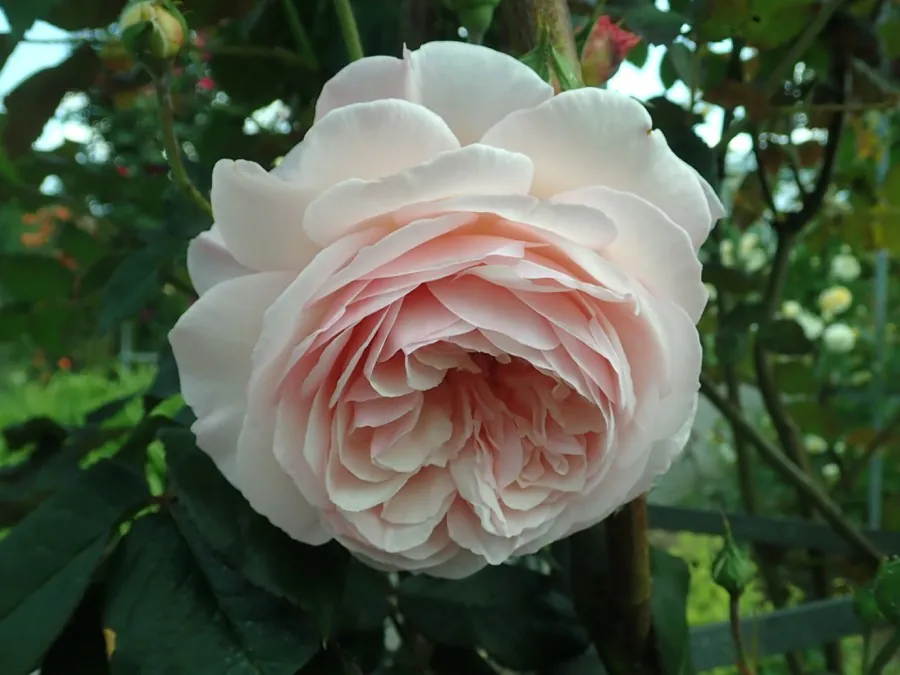
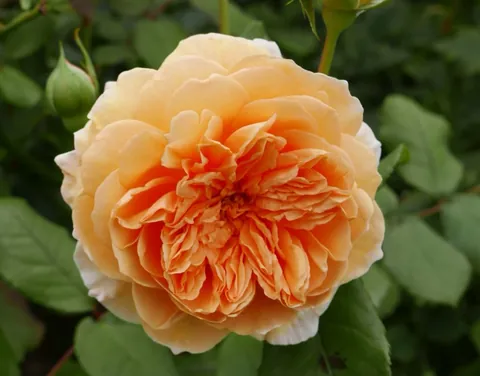
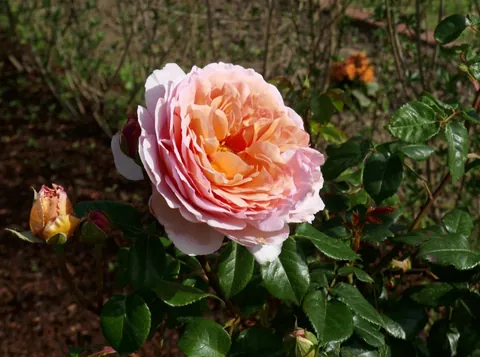
Large cupped rosette; petals layer down into the cup and do not open flat; diameter 9–12 cm
Centre
Dense rosette centre; many layers of petals create a 'quilled' structure
Fullness
Very double, about 90 petals
Flower carriage
Mostly singly or in small clusters of 1–3 on a stem

Fragrance

Strong

Moderate to strong, fruity-tea, with notes of ripe apple and fresh pear.

Disease resistance

4.5 out of 5
Black spotresistantPowdery mildewresistantRustresistant

High resistance to black spot, powdery mildew and rust.

Sun

6 hours

Full sun; at least 6 hours of direct light; tolerates east and west exposure well.

Thorns

Thornless
thornlessfewmoderatemanyvery many

Almost thornless – a characteristic trait of the Leander line; the bush can be handled without gloves.

Foliage

Large, dark green, glossy, healthy; leaves with 5–7 leaflets.

Other names

Breeder's code AUSled.

All characteristics in a table
Group
English rose; Leander Group
Breeder
David Austin, 1996
Bud shape
Long, egg-shaped English bud; soft peach, tightly folded
Open flower
Large cupped rosette; petals layer down into the cup and do not open flat; diameter 9–12 cm
Centre
Dense rosette centre; many layers of petals create a 'quilled' structure
Colour
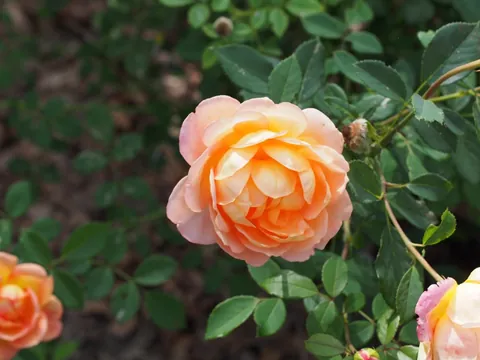
Soft peach-pink, fading towards the edge to a pearly pale; the reverse of the petal is darker, a pinkish red
Fullness
Very double, about 90 petals
Flower carriage
Mostly singly or in small clusters of 1–3 on a stem
Flowering
Repeat flowering in flushes: late spring – first frosts
Fragrance
Moderate to strong, fruity-tea, with notes of ripe apple and fresh pear
In the sun
Fades slightly to a pale pearly tone
Habit
A strong, tall shrub with long arching canes; can be trained as a short climber
Branching
Medium to strong; density depends on training
Shoots
Long, semi-stiff or stiff; work well on an arch, pergola or wall
Thorns
Almost thornless – a characteristic trait of the Leander line; the bush can be handled without gloves.
Dimensions
As a shrub: 120–180 cm × 90–150 cm. On a support: up to 300 cm tall
Support
Optional: as a shrub no support is needed; as a short climber it needs support (arch, obelisk, wall, pergola up to 2 m)
Foliage
Large, dark green, glossy, healthy; leaves with 5–7 leaflets
Resistance
High resistance to black spot, powdery mildew and rust
Variations of the variety
'Climbing' form in the David Austin catalogue — the same variety, recommended as a short climber

Colour scheme

Soft peach-pink, fading towards the edge to a pearly pale; the reverse of the petal is darker, a pinkish red

Rose neighbours

Perennials to plant nearby

Neighbouring roses

Warm peach-apricot English roses keep one golden mood around A Shropshire Lad:

Perennial companions

A cool lavender-purple frame and chartreuse foam at the base contrast with the warm peach:

catmint (Nepeta) Walker's Lowsalvia Caradonnalady's mantle (Alchemilla)geranium RozanneStachys (silver foliage)

Contrasting accents

For depth and height, cool blue and purple accents:

Blue delphiniumAllium «Purple Sensation»Verbena bonariensisMunstead Wood (rose)

More about the variety

In the sun
Fades slightly to a pale pearly tone
Variations of the variety
'Climbing' form in the David Austin catalogue — the same variety, recommended as a short climber

How to grow

Where to plant. Arches, obelisks, walls, pergolas up to 2 m, and a group accent in a mixed border. As a shrub, it works well as a specimen or in a group of 3 bushes. As a short climber, it creates a romantic vertical accent.

Climate. Hardy to −26 °C; in USDA zone 5 (northern Polissia, Ukraine) light winter protection is advisable. In the Forest-Steppe and Steppe it overwinters without protection.

Care. A vigorous, healthy variety; almost thornless, so pruning is comfortable. When trained as a climber, tie the canes in horizontally for abundant flowering along their full length.

About the name

Name. A Shropshire Lad is the title of a poetry collection published in 1896 by the English poet Alfred Edward Housman. David Austin released the variety in 1996, for the 100th anniversary of the collection. It is a tribute to Shropshire, the English county where the poet was born and where the David Austin Roses nursery is located.

Breeding. Bred by David C. H. Austin in 1996. Parentage: 'Heritage' (AUSblush) × an unnamed seedling; according to the breeder, the line descends from 'Leander', which explains its outstanding health, vigour and almost complete absence of thorns. Breeder's code: AUSled.

Significance. It belongs to Leander Group David Austin, a line of large shrubs that can be trained as short climbers. In 2012 it received the prestigious RHS Award of Garden Merit, a mark of excellent garden performance. One of the most loved English roses for arches and vertical planting.

Frequently asked questions about A Shropshire Lad

Does A Shropshire Lad need winter protection?

The cultivar’s reference temperature is −26 °C (USDA zone 5–9). Overwintering depends on the conditions.

How many times a season does A Shropshire Lad flower?

Repeat flowering in flushes: late spring – first frosts.

How big does A Shropshire Lad grow?

120–180 cm tall, 90–150 cm wide. On a support — up to 300 cm.

Which diseases affect A Shropshire Lad?

Overall resistance: 4.5 out of 5. 4.5 / 5; high; good resistance to black spot, powdery mildew and rust.

How much sun does A Shropshire Lad need?

Full sun; at least 6 hours of direct light; tolerates east and west exposure well.

What does A Shropshire Lad smell like?

Moderate to strong, fruity-tea, with notes of ripe apple and fresh pear.

Gardeners' photos and reviews

My climate

Choose a reference temperature to compare with the cultivar’s data. This is not an overwintering forecast or advice on winter protection; consider wind, moisture and the duration of frost.

Regional data are generalised. USDA describes average annual extreme minima, not a forecast; the values in the list are rounded. Check the conditions at your site. More information: Roses in Ukraine's climate.