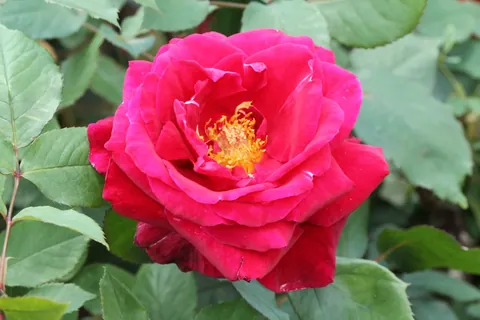
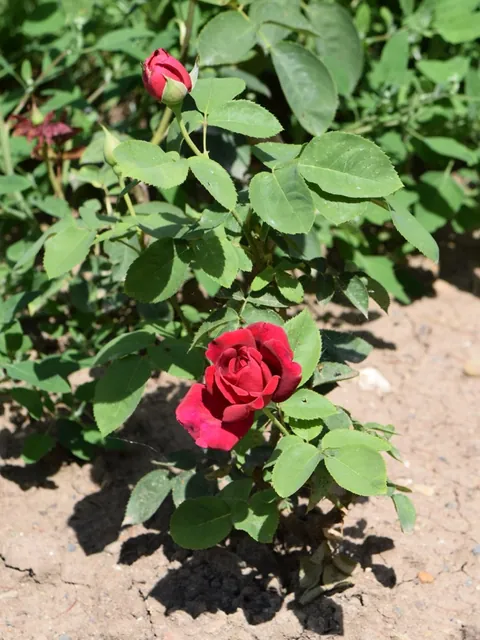
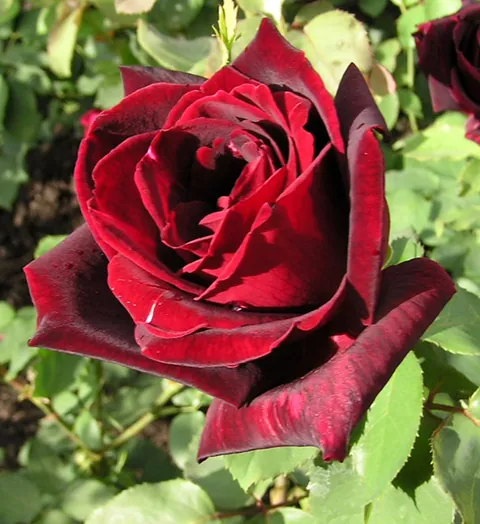
Étoile de Hollande, close-up of the flower
Photo: Stan Shebs, CC BY-SA 3.0
Back to catalogue
Hybrid Tea; bush formVerschuren, 1919Red

Étoile de Hollande

One of the most fragrant varieties at all — the benchmark of rose scent of the XX century; deep red velvety-crimson flower; can be smelled from a distance, fuller in warm weather; compact bush 0.5–1 m.

'Star of Holland' · General MacArthur × Hadley

Variety profile

Flowering

Repeat flowering

Repeat, almost continuous through summer and autumn. Months are approximate, for the climate of Ukraine.

Plant size

50–100 × 50–100 cm
person 170 cm50–100 cm
Habit
Compact, spreading bush
Dimensions
0.5–1 × 0.5–1 m — a compact, spreading bush
Support
Not needed — bush form
Shoots
Moderate length; the bush is 0.5–1 m high
Branching
Even; the bush form holds its shape without support

Flower

40 petals
Bud shape
Classic elongated dark red bud
Open flower
Large cupped, velvety crimson-red; exact diameter in cm — no data (large)
Centre
Deep, saturated dark red tone
Fullness
~40 petals
Flower carriage
Mostly flowers borne singly

Fragrance

Very strong; a deep old garden rose scent

THE MAIN FEATURE of the variety. One of the most fragrant varieties at all — a very strong, rich old garden rose scent, warm and deep. It can be smelled from a distance and opens fuller in warm weather. Historically Étoile de Hollande is considered one of the benchmarks of rose scent of the XX century.

Disease resistance

3 out of 5
Black spotsusceptiblePowdery mildewsusceptible

Moderate (≈3/5): prone to black spot and powdery mildew — needs sun, air circulation and prevention.

Sun

Needs sun and good air circulation

The fragrance is fuller in warm weather.

Thorns

Moderate
thornlessfewmoderatemanyvery many

Moderate number of prickles — typical for old hybrid teas.

Foliage

Green; good air circulation matters for health.

All characteristics in a table
Group
Hybrid Tea; bush form
Breeder
Verschuren, Netherlands, 1919
Bud shape
Classic elongated dark red bud
Open flower
Large cupped, velvety crimson-red; exact diameter in cm — no data (large)
Centre
Deep, saturated dark red tone
Colour
Dark red, velvety crimson-red — one of the reference 'classic red' shades. No data on fading
Fullness
~40 petals
Flower carriage
Mostly flowers borne singly
Flowering
Repeat, almost continuous through summer and autumn
Fragrance
THE MAIN FEATURE of the variety. One of the most fragrant varieties at all — a very strong, rich old garden rose scent, warm and deep. It can be smelled from a distance and opens fuller in warm weather. Historically Étoile de Hollande is considered one of the benchmarks of rose scent of the XX century.
Hips
No data
Habit
Compact, spreading bush
Branching
Even; the bush form holds its shape without support
Shoots
Moderate length; the bush is 0.5–1 m high
Thorns
Moderate number of prickles — typical for old hybrid teas.
Dimensions
0.5–1 × 0.5–1 m — a compact, spreading bush
Support
Not needed — bush form
Foliage
Green; good air circulation matters for health
Resistance
Moderate (≈3/5): prone to black spot and powdery mildew — needs sun, air circulation and prevention
Variations of the variety
A separate climbing sport exists — Climbing Étoile de Hollande, which is now more common than the bush form
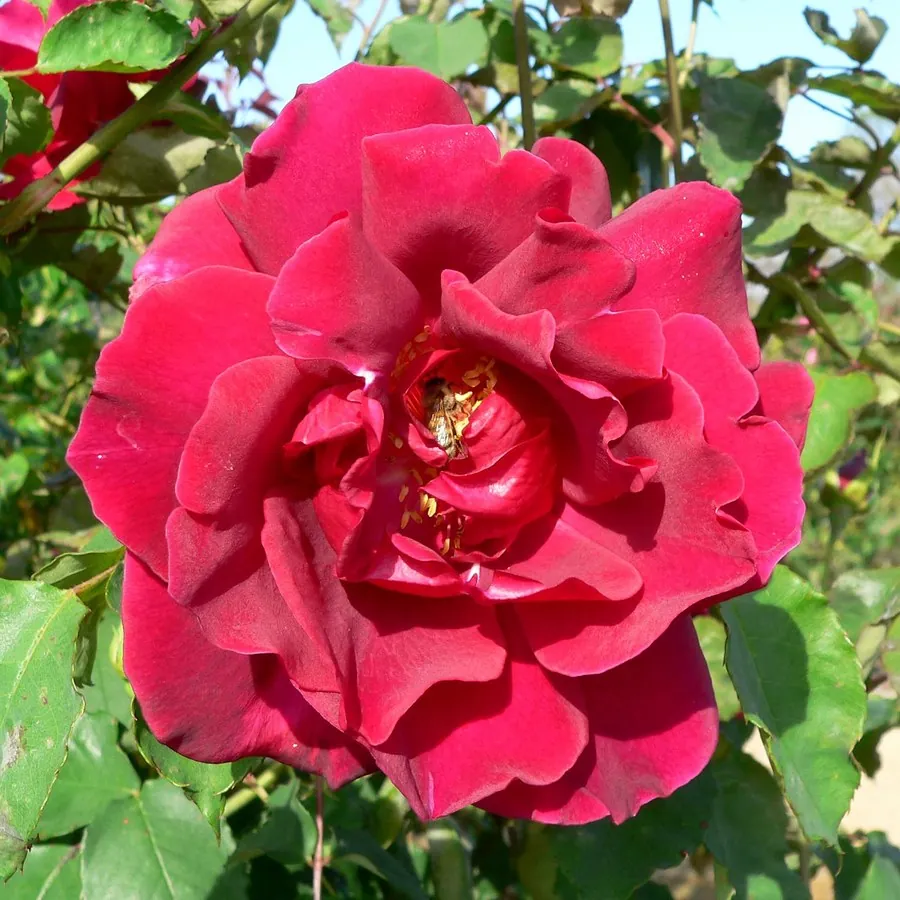
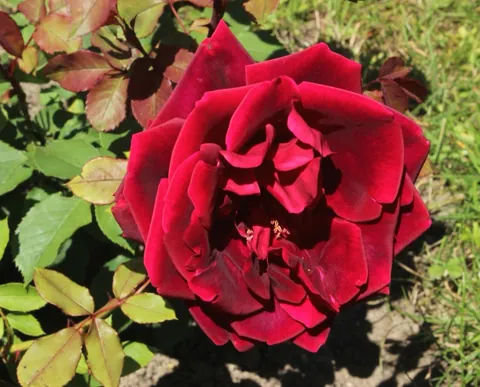
Colour scheme

Deep red, velvety crimson-red — one of the reference 'classic red' shades. No data on fading

Rose neighbours

Perennials to plant nearby

Rose neighbours

Classic fragrant dark red Hybrid Teas — the family of the benchmark rose scent:

Companion perennials

Silver-lavender palette that brings out the deep red:

lavendercatmintStachysgypsophila

Forms of the variety

Besides the bush Hybrid Tea, there is a separate climbing sport:

  • 🌹 Bush HT · now rare
  • 🧗 Climbing Étoile de Hollande · climber · more common

More about the variety

Hips
No data
Variations of the variety
A separate climbing sport exists — Climbing Étoile de Hollande, which is now more common than the bush form
How to grow

Where to plant. A compact, spreading bush 0.5–1 m — for the front and middle of a flower bed and for fragrant corners beside paths and resting areas, where the strong scent can be smelled from a distance. Needs no support. A sunny, well-ventilated spot is essential — this reduces the risk of disease.

Climate. RHS H5 (≈ −15…−10 °C), USDA ≈ 7. Needs winter protection.

Care. As for old hybrid teas — sun, air circulation and preventive treatments against black spot and powdery mildew, to which the variety is moderately prone. The fragrance opens fuller in warm weather.

About the name

Name. 'Étoile de Hollande' means 'Star of Holland' — after the variety's homeland, the Netherlands.

Breeding. Bred by Verschuren (Netherlands), introduced in 1919. Parents — General MacArthur × Hadley. A separate climbing sport, Climbing Étoile de Hollande, comes from this variety.

Significance. One of the most famous red roses of the XX century and a benchmark of rose fragrance. The bush form is now rare — the climbing version is much more common in gardens. In depth of scent it belongs to the same classic family of fragrant dark red hybrid teas as 'Crimson Glory', 'Papa Meilland' and 'Mister Lincoln'.

Frequently asked questions about Étoile de Hollande

How many times a season does Étoile de Hollande flower?

Repeat, almost continuous through summer and autumn.

How big does Étoile de Hollande grow?

50–100 cm tall, 50–100 cm wide.

Which diseases affect Étoile de Hollande?

Overall resistance: 3 out of 5. Moderate; typical of old HTs — prone to black spot and powdery mildew.

How much sun does Étoile de Hollande need?

Sun; needs sun and good air circulation; the fragrance is fuller in warm weather.

What does Étoile de Hollande smell like?

THE MAIN FEATURE of the variety. One of the most fragrant varieties at all — a very strong, rich old garden rose scent, warm and deep. It can be smelled from a distance and opens fuller in warm weather. Historically Étoile de Hollande is considered one of the benchmarks of rose scent of the XX century.

Gardeners' photos and reviews

My climate

Choose a reference temperature to compare with the cultivar’s data. This is not an overwintering forecast or advice on winter protection; consider wind, moisture and the duration of frost.

Regional data are generalised. USDA describes average annual extreme minima, not a forecast; the values in the list are rounded. Check the conditions at your site. More information: Roses in Ukraine's climate.