


Back to catalogue
English Shrub RoseDavid Austin, 1994Yellow

Charlotte

US Patent PP 9008; a family dedication to the granddaughter of David Austin Sr.

English Roses collection

Variety profile

Flowering

Repeat, in flushes

Repeat-flowering in flushes all season until the first frosts; a rich first flush and a moderate repeat. Months are approximate, for the climate of Ukraine.

Awards

English Roses

David Austin collection

Winter hardiness

−29 °C

USDA zone 5–10. Trouble-free in open ground across all of Ukraine.

Compare reference temperatures

Plant size

90–185 × 120–150 cm
person 170 cm90–185 cm
Habit
Compact, bushy, upright — one of the neatest among the English Roses
Dimensions
90–185 cm tall × 120–150 cm wide; in practice mostly 120 × 100 cm
Support
No support needed — a compact shrub, holds its shape well on its own
Shoots
Medium stiffness, holding the double flowers well
Branching
Dense; the bush looks rounded without formative pruning

Flower

8–9 cm
Bud shape
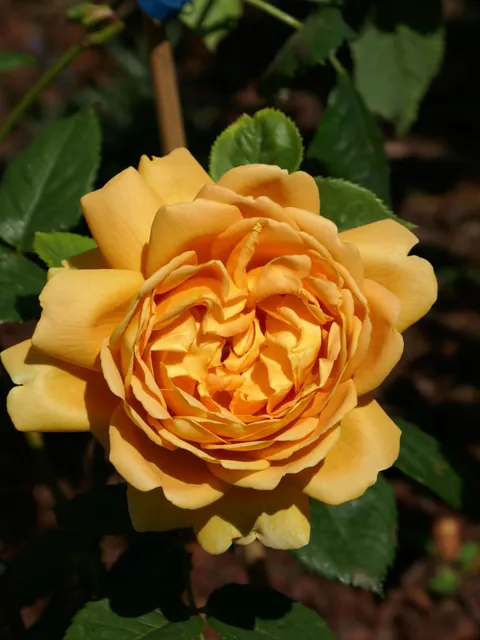
Rounded-conical, with orange highlights
Open flower
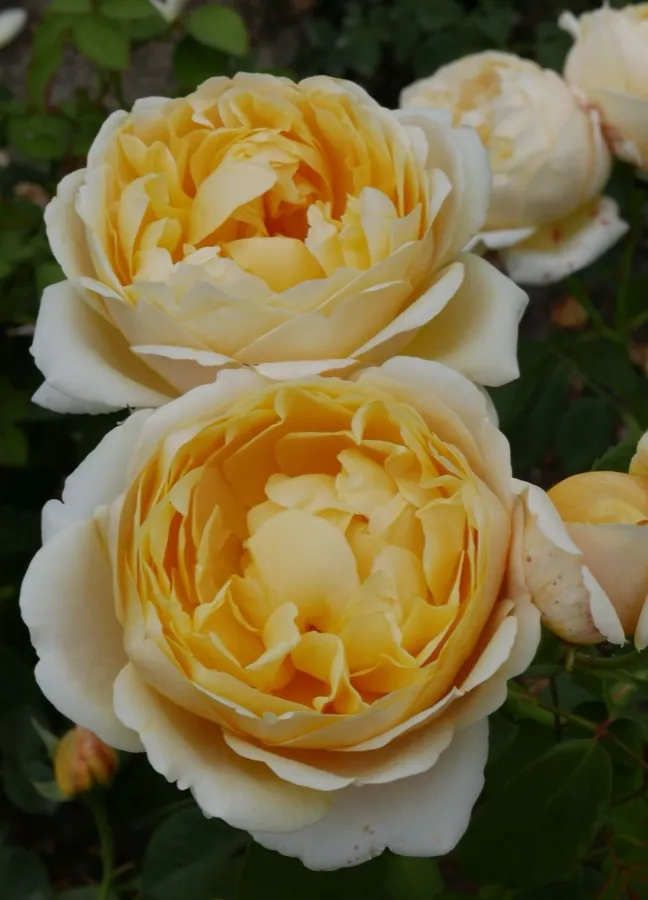
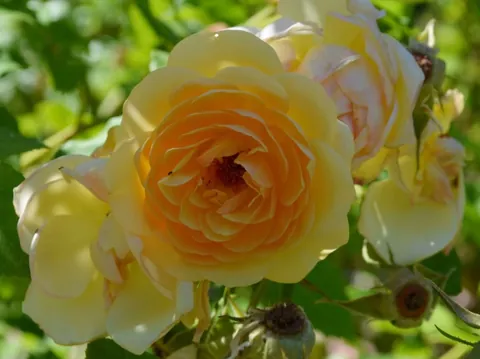
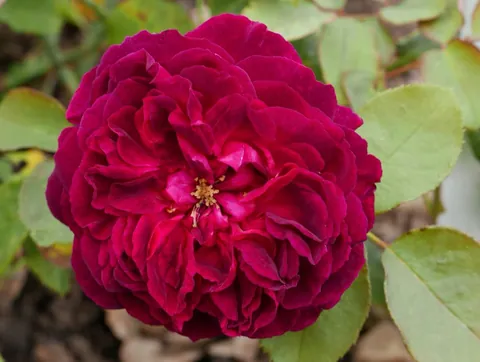
Starts as a deep cup, opening into a classic rosette with a 'button eye'; diameter 8–9 cm
Centre
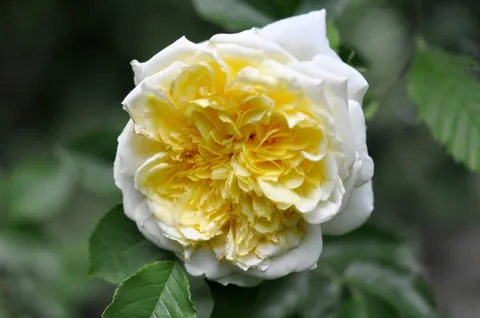
'button eye' — petals folded into a dense centre in tight curls
Fullness
Very double — about 100 petals
Flower carriage
In small clusters of 1–3 flowers per stem

Fragrance

Moderate

Moderate, soft tea-rose fragrance with lemon notes.

Disease resistance

3 out of 5
Black spotsusceptiblePowdery mildewsusceptible

Moderate; according to HelpMeFind, susceptible to black spot and powdery mildew ('susceptible to blackspot and mildew'); needs preventive treatments.

Sun

Sun or light shade

In full sun the colour quickly fades to cream; to keep the yellow tone, light shade in southern heat.

Thorns

Moderate
thornlessfewmoderatemanyvery many

Moderate number of thorns.

Foliage

Medium green, matt, with a slight sheen.

Other names

Charlotte Austin, Elgin Festival

Breeder's code AUSpoly.

All characteristics in a table
Group
English Shrub Rose
Breeder
David Austin, 1994
Bud shape
Rounded-conical, with orange highlights
Open flower
Starts as a deep cup, opening into a classic rosette with a 'button eye'; diameter 8–9 cm
Centre
'button eye' — petals folded into a dense centre in tight curls
Colour
Soft lemon-yellow ('soft butter yellow') at the centre, paling to cream at the edges; sometimes with faint orange highlights on the buds
Fullness
Very double — about 100 petals
Flower carriage
In small clusters of 1–3 flowers per stem
Flowering
Repeat-flowering in flushes all season until the first frosts; a rich first flush and a moderate repeat
Fragrance
Moderate, soft tea-rose fragrance with lemon notes
Hips
Rarely
Habit
Compact, bushy, upright — one of the neatest among the English Roses
Branching
Dense; the bush looks rounded without formative pruning
Shoots
Medium stiffness, holding the double flowers well
Thorns
Moderate number of thorns.
Dimensions
90–185 cm tall × 120–150 cm wide; in practice mostly 120 × 100 cm
Support
No support needed — a compact shrub, holds its shape well on its own
Foliage
Medium green, matt, with a slight sheen
Resistance
Moderate; according to HelpMeFind, susceptible to black spot and powdery mildew ('susceptible to blackspot and mildew'); needs preventive treatments
Variations of the variety
Trade synonyms: Charlotte Austin; Elgin Festival

Colour scheme

Soft lemon-yellow ('soft butter yellow') at the centre, paling to cream at the edges; sometimes with faint orange highlights on the buds

Rose neighbours

Perennials to plant nearby

Neighbouring roses

Other English Roses in a yellow-cream palette — and Charlotte's parent, Graham Thomas, up front:

Companion perennials

A blue-violet 'cloud' of catmint and lavender — a classic contrast to yellow English Roses:

catmint 'Six Hills Giant'lavender 'Munstead'woodland sagecream foxgloveshining coneflower

Contrasting accents

For dramatic contrast — cool blues and silvers:

blue delphiniumagastache 'Black Adder'artemisia 'Powis Castle'purple heliotrope

More about the variety

Hips
Rarely
Variations of the variety
Trade synonyms: Charlotte Austin; Elgin Festival

How to grow

Where to plant. Mixed borders in the English style, the front of English Roses displays, formal flower beds; looks good in groups of 3–5 bushes.

Climate. Tolerates −29 °C — suitable for all of Ukraine in open ground without protection, including the northern regions.

Care. Because of its moderate disease resistance, it needs regular preventive treatments (fungicides spring to autumn), especially in damp climates. Moderate formative pruning in spring encourages abundant flowering.

About the name

Name. A family dedication — named after one of the granddaughters of David Austin Sr., founder of the David Austin Roses house. A personal, warm name typical of the Austin family tradition.

Breeding. Bred by David C. H. Austin Sr. at David Austin Roses Ltd. (UK) before 1992; introduced in 1993 (UK), listed in the catalogue from 1994. Parentage: Chaucer × (Conrad Ferdinand Meyer × Graham Thomas) — inherited from the legendary yellow English Rose Graham Thomas. Patent code AUSpoly; US Patent PP 9008.

Significance. A popular 'reliable yellow' in the English Roses David Austin collection. The heir of Graham Thomas, one of the best-known yellow English roses of all time. Especially valued for its compact, neat bush and classic rosette with a 'button eye'.

Frequently asked questions about Charlotte

Does Charlotte need winter protection?

The cultivar’s reference temperature is −29 °C (USDA zone 5–10). Overwintering depends on the conditions.

How many times a season does Charlotte flower?

Repeat-flowering in flushes all season until the first frosts; a rich first flush and a moderate repeat.

How big does Charlotte grow?

90–185 cm tall, 120–150 cm wide.

Which diseases affect Charlotte?

Overall resistance: 3 out of 5. A weak point of the variety — susceptible to black spot and powdery mildew; needs preventive treatments.

How much sun does Charlotte need?

Sun or light shade; in full sun the colour quickly fades to cream; to keep the yellow tone, light shade in southern heat.

What does Charlotte smell like?

Moderate, soft tea-rose fragrance with lemon notes.

Gardeners' photos and reviews

My climate

Choose a reference temperature to compare with the cultivar’s data. This is not an overwintering forecast or advice on winter protection; consider wind, moisture and the duration of frost.

Regional data are generalised. USDA describes average annual extreme minima, not a forecast; the values in the list are rounded. Check the conditions at your site. More information: Roses in Ukraine's climate.