


Back to catalogue
English ShrubDavid C.H. Austin, 1983Yellow

Graham Thomas

WFRS Rose Hall of Fame 2009; RHS AGM 1993; parentage Charles Austin × (Iceberg × seedling); one of three varieties with which Austin made a breakthrough at Chelsea 1983.

Climbing form too · David Austin

Variety profile

Flowering

Repeat-flowering, in flushes through the season

Awards

WFRS HoF

2009 · World's Favourite · RHS AGM 1993

Winter hardiness

−29 °C

USDA zone 5–10. All of Ukraine with minimal cover.

Compare reference temperatures

Plant size

120–150 × 90–120 cm
person 170 cm120–150 cm
Habit
A wide shrub with arching canes; in warm regions (USDA 8+) it behaves like a small climber up to 4 m
Dimensions
120–150 cm high × 90–120 cm wide in Britain; in warm regions up to 4 m as a small climber
Support
Not essential as a shrub; for the climbing form — arch, pergola, trellis
Shoots
Long, flexible, bending over time
Branching
Good, even

Flower

≈ 10 cm

75+ petals.

Bud shape
Round-conical, deep yellow
Open flower
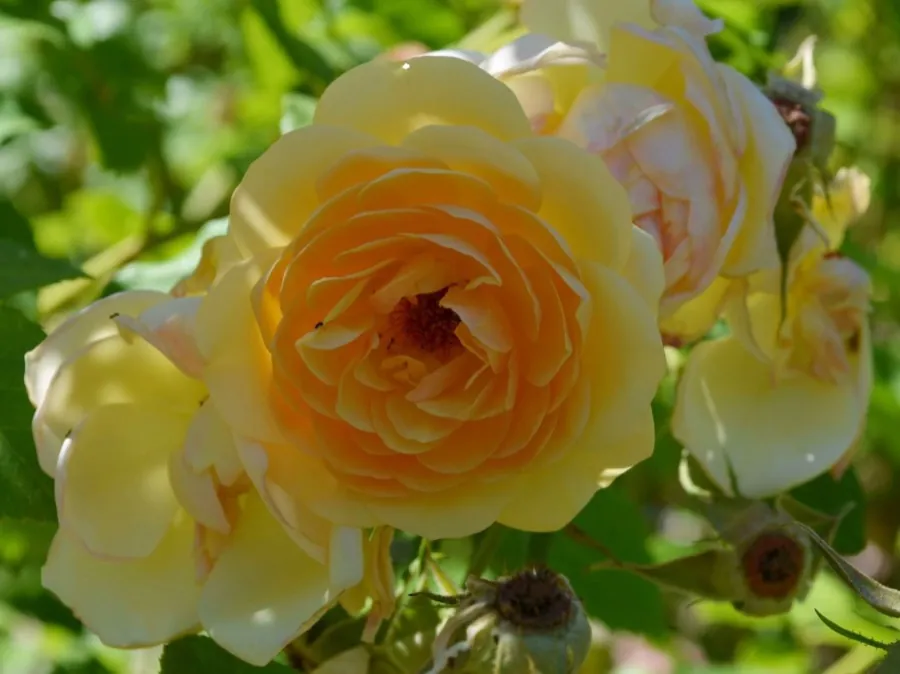
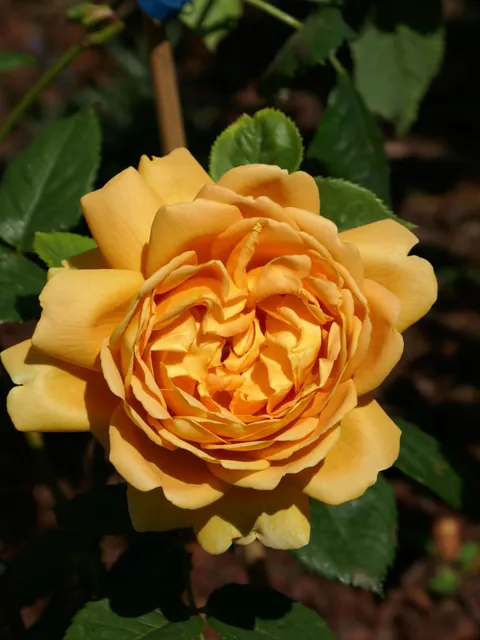
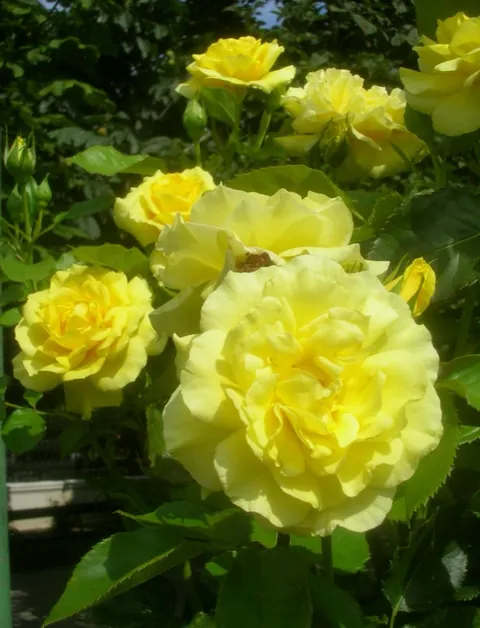
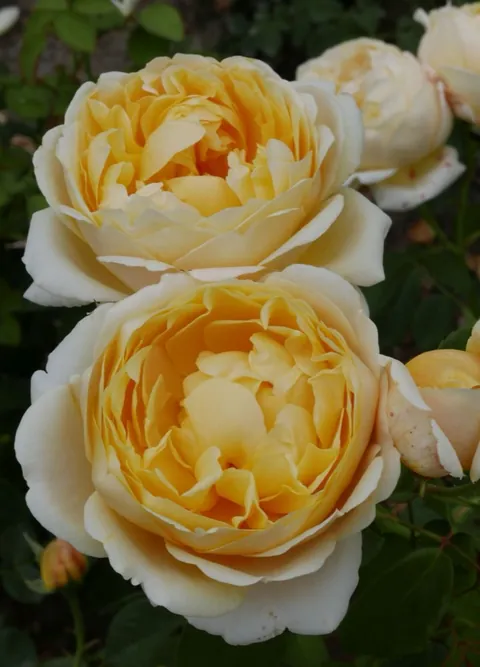
Classic cup-shaped 'English Cup' with delicate 'boxes' of petals at the centre; diameter ~10 cm
Centre
Dense bright yellow centre; when fully open, golden amber
Fullness
Very double, 75+ petals
Flower carriage
Singly or in small clusters of 2–3

Fragrance

Moderate

Medium-strong tea scent with a characteristic violet note — David Austin officially describes it as 'light Tea fragrance with a cool violet character'.

Disease resistance

4 out of 5
Black spotsusceptible

Officially 'very resistant', but in damp climates, like other yellow roses, prone to black spot — needs preventive treatment 2 times per season.

Sun

Full sun for abundant flowering and stable colour

Thorns

Moderate
thornlessfewmoderatemanyvery many

Moderate number, typical of Austin English Roses.

Foliage

Medium green, semi-glossy.

All characteristics in a table
Group
English Shrub
Breeder
David C.H. Austin, United Kingdom, 1983
Bud shape
Round-conical, deep yellow
Open flower
Classic cup-shaped 'English Cup' with delicate 'boxes' of petals at the centre; diameter ~10 cm
Centre
Dense bright yellow centre; when fully open, golden amber
Colour
Clear, rich yellow — without orange, pink or apricot tones (which sets Graham Thomas apart from other yellow Austins); fades to pale lemon when fully open
Fullness
Very double, 75+ petals
Flower carriage
Singly or in small clusters of 2–3
Flowering
Repeat-flowering, in flushes through the season
Fragrance
Medium-strong tea scent with a characteristic violet note — David Austin officially describes it as 'light Tea fragrance with a cool violet character'
Hips
Not documented as ornamental
Habit
A wide shrub with arching canes; in warm regions (USDA 8+) it behaves like a small climber up to 4 m
Branching
Good, even
Shoots
Long, flexible, bending over time
Thorns
Moderate number, typical of Austin English Roses.
Dimensions
120–150 cm high × 90–120 cm wide in Britain; in warm regions up to 4 m as a small climber
Support
Not essential as a shrub; for the climbing form — arch, pergola, trellis
Foliage
Medium green, semi-glossy
Resistance
Officially 'very resistant', but in damp climates, like other yellow roses, prone to black spot — needs preventive treatment 2 times per season
Variations of the variety
Code AUSmas (also 'Ausmas'); trade name 'Lemon Parody'; parentage 'Charles Austin' × ('Iceberg' × seedling); Iceberg (Kordes 1958) — also in the WFRS Hall of Fame

Colour scheme

Clear, rich yellow — without orange, pink or apricot tones (which sets Graham Thomas apart from other yellow Austins); fades to pale lemon when fully open

Rose neighbours

Perennials to plant nearby

Neighbouring roses

Yellow family — Austin + Kordes classic:

Companion perennials

Purple-blue accents — a classic contrast to pure yellow:

lavender 'Hidcote'delphinium 'Pacific Giant'catmint 'Walker's Low'salvia 'Caradonna'

Availability worldwide

One of the best-known Austin English Roses of all time:

  • 🇪🇺 Europe: VERY HIGH · David Austin Roses · everywhere
  • 🇺🇸 USA: VERY HIGH · David Austin USA
  • 🇯🇵 Asia: VERY HIGH · Japan loves Austin
  • 🇺🇦 Ukraine: HIGH · a top Austin rose at garden centres

More about the variety

Hips
Not documented as ornamental
Variations of the variety
Code AUSmas (also 'Ausmas'); trade name 'Lemon Parody'; parentage 'Charles Austin' × ('Iceberg' × seedling); Iceberg (Kordes 1958) — also in the WFRS Hall of Fame

How to grow

Where to plant. Classic English borders, the centre of a sunny yellow garden, as a single bush on a lawn; in warm regions — as a small climber on a south-facing wall; lovely paired with lavender and delphinium (the classic 'sun and sky' combination).

Climate. To −29 °C — all of Ukraine with minimal cover; the south — no cover; holds its colour in the sun.

Care. Classic Austin English — spring pruning by a third; in damp climates preventive treatment against black spot is essential, 2 times per season; deadheading stimulates new flushes of bloom.

About the name

Name. The variety is dedicated to Graham Stuart Thomas (1909–2003), a British gardener and historian, curator of National Trust gardens 1955–1974, author of the famous book 'The Old Shrub Roses' (1955), which saved dozens of old varieties from oblivion (including Cardinal de Richelieu, Charles de Mills and other Gallicas). Graham Thomas was a friend and mentor of David Austin and personally chose this rose to carry his name.

Breeding. Bred by David C.H. Austin, Albrighton, UK, presented at the Chelsea Flower Show 1983. Code AUSmas, trade name 'Lemon Parody'. Parentage: 'Charles Austin' (AUSfather, 1973) × ('Iceberg' × unnamed seedling). One of three varieties with which Austin made a breakthrough at Chelsea 1983 (together with Mary Rose and Wife of Bath) — the year the world finally recognised English Roses as a separate important class.

Significance. WFRS Rose Hall of Fame 2009 — the rose entered the Hall of Fame of the World Federation of Rose Societies; this is the highest international award in the rose world (given once every 3 years). The same Hall of Fame includes Peace, Iceberg, Fragrant Cloud, Double Delight, Pierre de Ronsard, Friesia, Gertrude Jekyll (WFR 2025). Besides the WFRS HoF, Graham Thomas holds the RHS Award of Garden Merit (1993) and is among the top 5 best-selling David Austin Roses of all time. Its pure yellow colour is a special feature; other yellow Austins often have orange (Golden Celebration), cream (Charlotte) or apricot (Crown Princess Margareta) tones; Graham Thomas is the benchmark for 'a true yellow English rose'.

Frequently asked questions about Graham Thomas

Does Graham Thomas need winter protection?

The cultivar’s reference temperature is −29 °C (USDA zone 5–10). Overwintering depends on the conditions. All of Ukraine with minimal cover.

How many times a season does Graham Thomas flower?

Repeat-flowering, in flushes through the season.

How big does Graham Thomas grow?

120–150 cm tall, 90–120 cm wide.

Which diseases affect Graham Thomas?

Overall resistance: 4 out of 5. Officially 'very resistant'; in wet conditions prone to black spot.

How much sun does Graham Thomas need?

Sun; full sun for abundant flowering and stable colour.

What does Graham Thomas smell like?

Medium-strong tea scent with a characteristic violet note — David Austin officially describes it as 'light Tea fragrance with a cool violet character'.

Gardeners' photos and reviews

My climate

Choose a reference temperature to compare with the cultivar’s data. This is not an overwintering forecast or advice on winter protection; consider wind, moisture and the duration of frost.

Regional data are generalised. USDA describes average annual extreme minima, not a forecast; the values in the list are rounded. Check the conditions at your site. More information: Roses in Ukraine's climate.