


Back to catalogue
Hybrid MuskLouis Lens; Lens Roses, 1993White and cream

Guirlande d'Amour

ADR 2012 + Gold Kortrijk 1994; parentage 'Seagull' × ('R. multiflora Nana' × 'Moonlight'); giant pyramidal clusters of up to 80 flowers.

Park rambler · Lens Roses

Variety profile

Flowering

Repeat, in flushes through the season

Awards

ADR 2012

+ Gold Kortrijk 1994 · benchmark Lens musk

Winter hardiness

−29 °C

USDA zone 5b–9b. All of Ukraine with minimal cover.

Compare reference temperatures

Plant size

180–300 × 150–250 cm
person 170 cm180–300 cm
Habit
A broad park shrub with arching canes; it can also be trained as a small rambler on a low support, if preferred
Dimensions
180–300 cm tall × 150–250 cm wide
Support
Not required for a park shrub; for the rambler form — a low trellis or a fence
Shoots
Long, flexible, arching; they droop under the weight of the clusters
Branching
Very good — it forms a powerful green wall beneath the crown of flowers

Flower

≈ 3 cm

9–16 petals.

Bud shape
Small, round, creamy white
Open flower
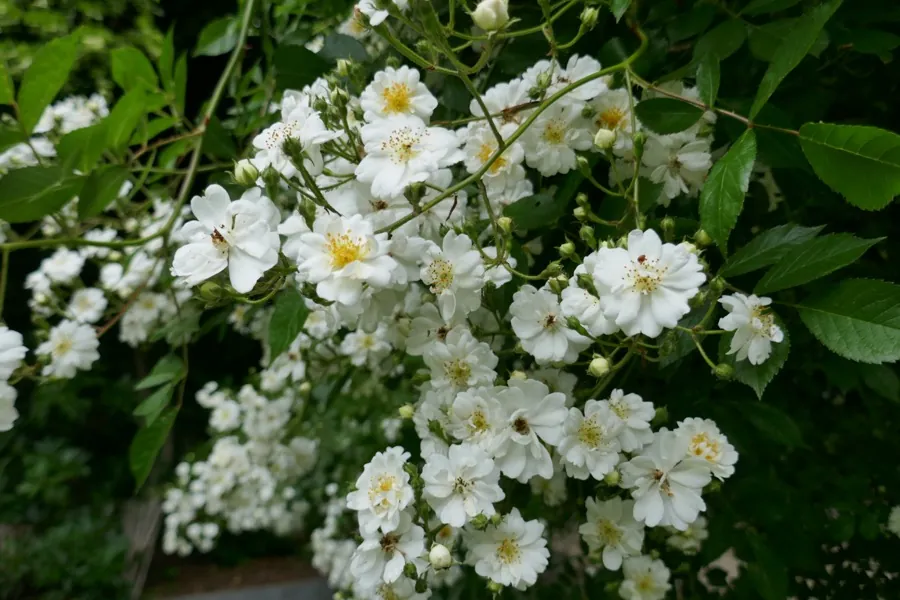
Semi-double, with a conspicuous yellow centre of stamens; small diameter ~3 cm — made up for by the numbers
Centre
Bright yellow centre of stamens, visible when the flower is fully open
Fullness
Semi-double, 9–16 petals
Flower carriage
Giant pyramidal clusters of up to 80 flowers — the main decorative feature; true 'garlands' hanging down like lace

Fragrance

Strong

Strong musk scent — typical Lens-quality; an excellent source of nectar, attracting bees and bumblebees.

Disease resistance

5 out of 5

Excellent — ADR 2012 (confirmed by 3 years of rigorous testing) + Belgian Gold Medal Kortrijk 1994.

Sun

Sun or partial shade

Tolerates some shade — typical of Hybrid Musks.

Thorns

Few
thornlessfewmoderatemanyvery many

Few prickles — typical of Hybrid Musks.

Foliage

Dark green, leathery, very healthy.

Other names

Garland of Love
All characteristics in a table
Group
Hybrid Musk
Breeder
Louis Lens; Lens Roses, Belgium, 1993
Bud shape
Small, round, creamy white
Open flower
Semi-double, with a conspicuous yellow centre of stamens; small diameter ~3 cm — made up for by the numbers
Centre
Bright yellow centre of stamens, visible when the flower is fully open
Colour
Pure white with a faint yellowish tint on opening, then pure white — creating the effect of 'snow on a branch'
Fullness
Semi-double, 9–16 petals
Flower carriage
Giant pyramidal clusters of up to 80 flowers — the main decorative feature; true 'garlands' hanging down like lace
Flowering
Repeat, in flushes through the season
Fragrance
Strong musk scent — typical Lens-quality; an excellent source of nectar, attracting bees and bumblebees
Hips
Decorative small rose hips in autumn
Habit
A broad park shrub with arching canes; it can also be trained as a small rambler on a low support, if preferred
Branching
Very good — it forms a powerful green wall beneath the crown of flowers
Shoots
Long, flexible, arching; they droop under the weight of the clusters
Thorns
Few prickles — typical of Hybrid Musks.
Dimensions
180–300 cm tall × 150–250 cm wide
Support
Not required for a park shrub; for the rambler form — a low trellis or a fence
Foliage
Dark green, leathery, very healthy
Resistance
Excellent — ADR 2012 (confirmed by 3 years of rigorous testing) + Belgian Gold Medal Kortrijk 1994
Variations of the variety
Code LENalbi; synonym Garland of Love; parentage 'Seagull' (Pritchard 1907) × ('R. multiflora Nana' × 'Moonlight' Pemberton 1913); HMF ID 20053

Colour scheme

Pure white with a faint yellowish tint on opening, then pure white — creating the effect of 'snow on a branch'

Rose neighbours

Perennials to plant nearby

Neighbouring roses

The Lens family + classic Hybrid Musks:

Companion perennials

Violet-blue accents — they set off the pure white:

lavender 'Munstead'delphinium 'Pacific Giant'Stachys byzantina (lamb's ear)lady's mantle (Alchemilla)

Availability worldwide

One of the benchmark Belgian Hybrid Musks, widely available in Europe:

  • 🇪🇺 Europe: HIGH · Lens Roses + other Hybrid Musk nurseries
  • 🇺🇸 USA: moderate · Antique Rose Emporium, specialist nurseries
  • 🇯🇵 Asia: low
  • 🇺🇦 Ukraine: moderate · found in rambler collections

More about the variety

Hips
Decorative small rose hips in autumn
Variations of the variety
Code LENalbi; synonym Garland of Love; parentage 'Seagull' (Pritchard 1907) × ('R. multiflora Nana' × 'Moonlight' Pemberton 1913); HMF ID 20053

How to grow

Where to plant. Broad shrub plantings, natural flower gardens, along fences and trellises; it looks lovely on the south or east walls of houses as a delicate 'living wall'; paired with Grand-Duc Jean (also Lens), it makes a dramatic contrast of white and dark carmine; as a source of nectar, it is worth planting near an apiary or in a garden with a beekeeper.

Climate. Down to −29 °C — all of Ukraine with minimal cover; in the south, no cover needed; one of the hardiest white Hybrid Musks.

Care. Minimal — Hybrid Musks Lens have stood in gardens for 30+ years without chemicals; the ADR-certificate guarantees good health; prune only for hygiene, after the first flush or in winter; do not prune yearly like a HT.

About the name

Name. 'Guirlande d'Amour' — French for 'Garland of Love'. The name describes the giant pyramidal clusters of up to 80 flowers that hang like delicate lace garlands, creating the effect of 'snowfall on a branch'. In English-speaking countries the variety is sold as Garland of Love.

Breeding. Bred by Louis Lens (1924–2001), the legendary Belgian breeder, at Lens Roses (Louvier, Belgium). Introduced in 1993, code LENalbi. Parentage: 'Seagull' (Pritchard 1907, a historic rambler) × ('R. multiflora Nana' × 'Moonlight' Pemberton 1913). Lens specialised in modern Hybrid Musks — a continuation of the Pemberton line, but with better disease resistance and a wider colour range.

Significance. One of the benchmark Hybrid Musk shrubs in the Lens collection, essential in European rambler collections. ADR 2012, the highest award for robustness in Germany (4 years of independent testing), plus Gold Medal Kortrijk 1994. A special feature is the giant pyramidal clusters of up to 80 small flowers, which create the unique visual effect of a 'garland'. It is an excellent source of nectar, attracting bees and bumblebees, and useful in permaculture gardens and next to apiaries. In our catalogue it belongs to the Lens-family alongside Grand-Duc Jean (Lens 2010) and Bouquet Parfait (Lens 1989): three classics from the same house.

Frequently asked questions about Guirlande d'Amour

Does Guirlande d'Amour need winter protection?

The cultivar’s reference temperature is −29 °C (USDA zone 5b–9b). Overwintering depends on the conditions. All of Ukraine with minimal cover.

How many times a season does Guirlande d'Amour flower?

Repeat, in flushes through the season.

How big does Guirlande d'Amour grow?

180–300 cm tall, 150–250 cm wide.

Which diseases affect Guirlande d'Amour?

Overall resistance: 5 out of 5. Excellent; confirmed by an ADR-certificate.

How much sun does Guirlande d'Amour need?

Sun or partial shade; tolerates some shade — typical of Hybrid Musks.

What does Guirlande d'Amour smell like?

Strong musk scent — typical Lens-quality; an excellent source of nectar, attracting bees and bumblebees.

Gardeners' photos and reviews

My climate

Choose a reference temperature to compare with the cultivar’s data. This is not an overwintering forecast or advice on winter protection; consider wind, moisture and the duration of frost.

Regional data are generalised. USDA describes average annual extreme minima, not a forecast; the values in the list are rounded. Check the conditions at your site. More information: Roses in Ukraine's climate.