




Back to catalogue
Hybrid MuskAnn Velle-Boudolf; Lens Roses, 2010Red

Grand-Duc Jean

Named after Jean, Grand-Duc de Luxembourg (ruled 1964–2000, †2019); christened in the 'Gaard um Titzebierg' garden in the presence of the Grand Duke; parentage not disclosed.

Lens Roses · the 'royal' series from Luxembourg

Variety profile

Flowering

Repeat-flowering, in flushes through the season

Awards

Lens

2010 · 4th-generation family breeding

Winter hardiness

−24 °C

USDA zone 6. In Ukraine with moderate cover.

Compare reference temperatures

Plant size

100–150 × 80 cm
person 170 cm100–150 cm
Habit
Upright shrub, forming a dense green mass under a profuse crown of flowers
Dimensions
100–150 cm high × ~80 cm wide
Support
No support needed
Shoots
Strong, straight, hold the heavy globular clusters well
Branching
Good, even

Flower

5–12 petals
Bud shape
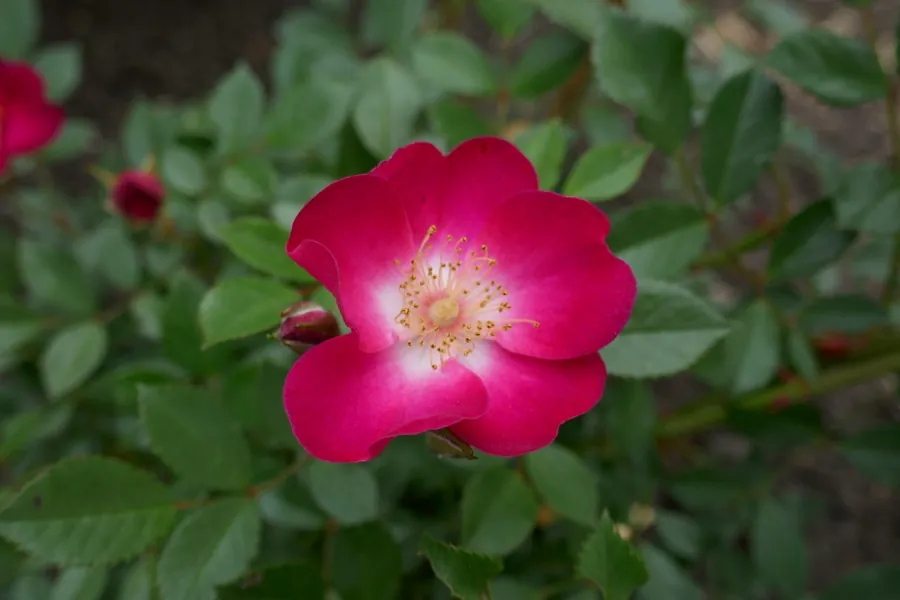
Round-oval, deep crimson
Open flower
Open semi-double with a prominent white centre and yellow stamens; daisy-like character
Centre
White, in sharp contrast with the deep crimson petal edges
Fullness
Semi-double, 5–12 petals
Flower carriage
Gathered in round globular clusters, like hydrangea — the variety's main ornamental feature

Fragrance

Light

Light musk — typical of descendants of Rosa multiflora (the parent line of Hybrid Musks).

Disease resistance

4 out of 5

Good — typical of modern Lens-varieties.

Sun

Sun or partial shade

Tolerates some shade; typical of Hybrid Musks.

Thorns

Few
thornlessfewmoderatemanyvery many

Few thorns — typical of Hybrid Musks.

Foliage

Dark green, healthy.

All characteristics in a table
Group
Hybrid Musk
Breeder
Ann Velle-Boudolf; Lens Roses, Belgium, 2010
Bud shape
Round-oval, deep crimson
Open flower
Open semi-double with a prominent white centre and yellow stamens; daisy-like character
Centre
White, in sharp contrast with the deep crimson petal edges
Colour
Deep crimson to deep pink, with a characteristic white centre and yellow stamens; the flowers age to a softer purple-pink
Fullness
Semi-double, 5–12 petals
Flower carriage
Gathered in round globular clusters, like hydrangea — the variety's main ornamental feature
Flowering
Repeat-flowering, in flushes through the season
Fragrance
Light musk — typical of descendants of Rosa multiflora (the parent line of Hybrid Musks)
Hips
Possible ornamental hips in autumn
Habit
Upright shrub, forming a dense green mass under a profuse crown of flowers
Branching
Good, even
Shoots
Strong, straight, hold the heavy globular clusters well
Thorns
Few thorns — typical of Hybrid Musks.
Dimensions
100–150 cm high × ~80 cm wide
Support
No support needed
Foliage
Dark green, healthy
Resistance
Good — typical of modern Lens-varieties
Variations of the variety
Parentage not disclosed (HMF: 'If you know the parentage…'); not to be confused with Grand-Duc Henri (Lens 2001) — another variety from the same house, named after the currently reigning Grand Duke Henri

Colour scheme

Deep crimson to deep pink, with a characteristic white centre and yellow stamens; the flowers age to a softer purple-pink

Rose neighbours

Perennials to plant nearby

Neighbouring roses

Hybrid Musk family + another Lens variety in the catalogue:

Companion perennials

Purple-silver accents for dramatic crimson:

lavender 'Hidcote'lamb's ear (Stachys)lady's mantle (Alchemilla)catmint 'Walker's Low'

Availability worldwide

A Belgian 'royal' variety — mainly in Europe:

  • 🇪🇺 Europe: moderate · Lens Roses · Benelux + France
  • 🇺🇸 USA: very low · Lens is poorly represented there
  • 🇯🇵 Asia: low
  • 🇺🇦 Ukraine: very low · rare, only in specialist collections

More about the variety

Hips
Possible ornamental hips in autumn
Variations of the variety
Parentage not disclosed (HMF: 'If you know the parentage…'); not to be confused with Grand-Duc Henri (Lens 2001) — another variety from the same house, named after the currently reigning Grand Duke Henri

How to grow

Where to plant. Natural romantic gardens, historical 'royal' themed groups, beside old walls and fences; the round 'hydrangea-like' flower clusters look good in partial shade — a rare quality in roses; lovely paired with pastel Hybrid Musks (Felicia, Penelope, Cornelia).

Climate. To −24 °C — in northern and central Ukraine with winter cover; the south — no cover; resistant to wind and rain.

Care. Minimal — Hybrid Musks of the Lens type have stood in gardens for 100+ years with little intervention. Sanitary pruning after the first flush of bloom is enough to encourage the next flushes.

About the name

Name. The variety is dedicated to Jean, Grand-Duc de Luxembourg (1921–2019). Jean ruled from 1964 to 2000 (36 years!), then abdicated in favour of his son Henri. A wartime hero — during the Second World War he took part in the liberation of Europe as part of the Irish Guards. He died in 2019 at the age of 98.

Breeding. Bred by Ann Velle-Boudolf — granddaughter of Louis Lens (1924–2001), the legendary Belgian breeder. This is the fourth generation of the Lens Roses house (Louvain, Belgium, founded in 1870 by Gustave Lens). Bred in 2010, christened in the 'Gaard um Titzebierg' garden in the presence of Grand Duke Jean himself — a symbolic family story.

Significance. It belongs to the Lens 'Luxembourg royal' series; its companion variety is 'Grand-Duc Henri' (Lens 2001), dedicated to Jean's son, the current ruler of Luxembourg. This makes a complete dynastic themed group: father and son Grand Dukes, each with a rose of their own. Lens Roses also breeds varieties named after outstanding European women (Marie Curie, Audrey Hepburn) and places (Bruges, Antwerpen). The variety is especially valued among Hybrid Musks collectors for its unique 'hydrangea-like' mass of deep crimson flowers with white centres — a rare combination in the class.

Frequently asked questions about Grand-Duc Jean

Does Grand-Duc Jean need winter protection?

The cultivar’s reference temperature is −24 °C (USDA zone 6). Overwintering depends on the conditions. In Ukraine with moderate cover.

How many times a season does Grand-Duc Jean flower?

Repeat-flowering, in flushes through the season.

How big does Grand-Duc Jean grow?

100–150 cm tall, about 80 cm wide.

Which diseases affect Grand-Duc Jean?

Overall resistance: 4 out of 5. Good; a typical quality of Lens-varieties.

How much sun does Grand-Duc Jean need?

Sun or partial shade; tolerates some shade; typical of Hybrid Musks.

What does Grand-Duc Jean smell like?

Light musk — typical of descendants of Rosa multiflora (the parent line of Hybrid Musks).

Gardeners' photos and reviews

My climate

Choose a reference temperature to compare with the cultivar’s data. This is not an overwintering forecast or advice on winter protection; consider wind, moisture and the duration of frost.

Regional data are generalised. USDA describes average annual extreme minima, not a forecast; the values in the list are rounded. Check the conditions at your site. More information: Roses in Ukraine's climate.