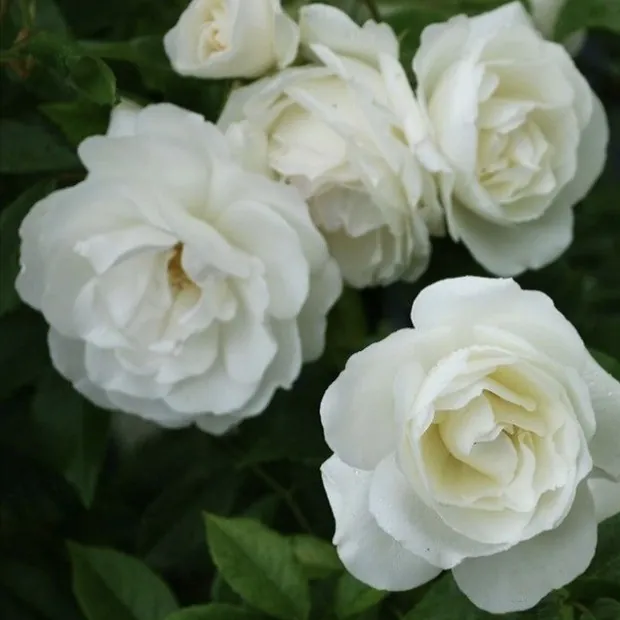
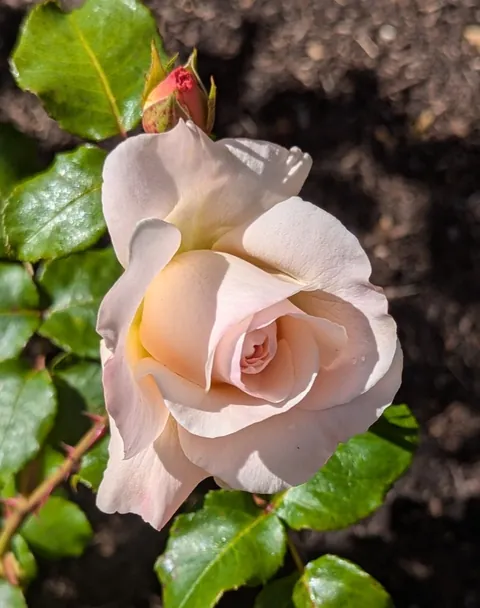
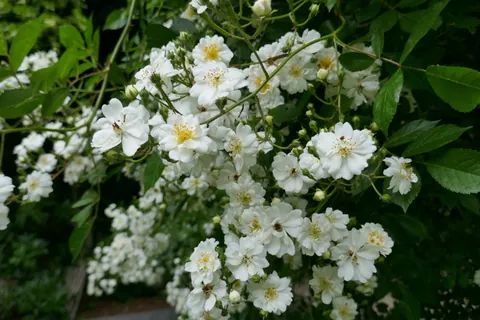
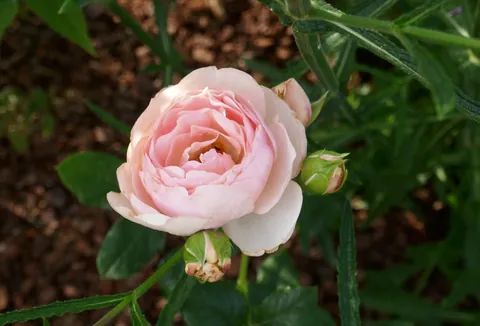
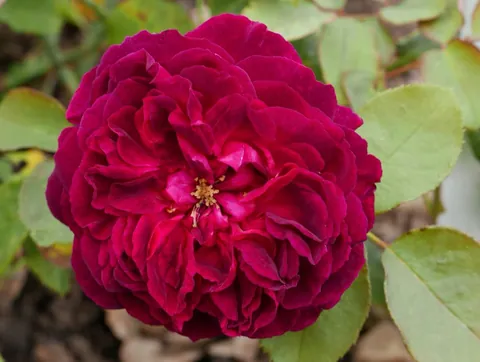



Iceberg, close-up of the flower
Back to catalogue
FloribundaReimer Kordes; W. Kordes' Söhne, 1958White and cream

Iceberg

🏆 WFRS Rose Hall of Fame 1983 (one of the very first!) · RNRS Gold 1958 · RHS AGM 1993 · parentage Robin Hood × Virgo.

Variety profile

Flowering

Repeat-flowering, in flushes all season. One of the most continuously flowering varieties

Winter hardiness

−29 °C

USDA zone 4b+. All of Ukraine with minimal winter protection.

Compare reference temperatures

Plant size

120 × 100 cm
person 170 cm120 cm
Habit
A spreading bush with arching canes; in warm climates it can grow much taller
Dimensions
1.2 m × 1.0 m in Europe; up to 2 m in hot climates
Support
Not required as a shrub; the climbing form (1968) suits an arch or trellis
Shoots
Sturdy, flexible, hold heavy clusters well
Branching
Dense; flowering canes form a broad, rounded bush

Flower

≈ 5 cm

25–35 petals.

Bud shape
Rounded-conical, creamy white with a faintly greenish tinge
Open flower
Semi-double, cupped; about 5 cm across
Centre
Bright yellow stamens contrast with the pure white petals
Fullness
Semi-double, 25–35 petals
Flower carriage
In clusters of 5–10 per stem, typical floribunda; in hot weather clusters can carry up to 20 flowers

Fragrance

Light

Light, honey-sweet. Fragrance is not the variety's strong point; its main value is the number and purity of its flowers.

Disease resistance

4 out of 5
Black spotresistant

Important nuance: the variety held ADR 1960, but ADR was withdrawn in 2004 due to reduced resistance to black spot (after more than 40 years in cultivation the variety had accumulated problems). Even so, it remains one of the most robust classic floribundas.

Sun

Sun or light shade

Tolerates partial shade.

Thorns

Many
thornlessfewmoderatemanyvery many

Few. Few prickles on the canes, so the bush is relatively easy to work with

Foliage

Medium green, slightly glossy, healthy.

Other names

Schneewittchen, Fée des Neiges, Sneeuwwitje
All characteristics in a table
Group
Floribunda
Breeder
Reimer Kordes; W. Kordes' Söhne, Germany, 1958
Bud shape
Rounded-conical, creamy white with a faintly greenish tinge
Open flower
Semi-double, cupped; about 5 cm across
Centre
Bright yellow stamens contrast with the pure white petals
Colour
The reference pure white, with no orange, pink or cream tones. In hot weather a faint pink flush may appear on the edges
Fullness
Semi-double, 25–35 petals
Flower carriage
In clusters of 5–10 per stem, typical floribunda; in hot weather clusters can carry up to 20 flowers
Flowering
Repeat-flowering, in flushes all season. One of the most continuously flowering varieties
Fragrance
Light, honey-sweet. Fragrance is not the variety's strong point; its main value is the number and purity of its flowers
Hips
Not documented (continuous flowering overlaps)
Habit
A spreading bush with arching canes; in warm climates it can grow much taller
Branching
Dense; flowering canes form a broad, rounded bush
Shoots
Sturdy, flexible, hold heavy clusters well
Number of thorns
Few. Few prickles on the canes, so the bush is relatively easy to work with
Dimensions
1.2 m × 1.0 m in Europe; up to 2 m in hot climates
Support
Not required as a shrub; the climbing form (1968) suits an arch or trellis
Foliage
Medium green, slightly glossy, healthy
Resistance
Important nuance: the variety held ADR 1960, but ADR was withdrawn in 2004 due to reduced resistance to black spot (after more than 40 years in cultivation the variety had accumulated problems). Even so, it remains one of the most robust classic floribundas
Variations of the variety
KORbin code; parentage 'Robin Hood' × 'Virgo'; climbing form (1968), a sport from Cants of Colchester (England); synonyms (important!): Schneewittchen® (original German), Fée des Neiges (French), Sneeuwwitje (Dutch). In different countries it is sold under different names, 'Snowflake' or 'Snow White'

Colour scheme

The reference pure white, with no orange, pink or cream tones. In hot weather a faint pink flush may appear on the edges

Rose neighbours

Perennials to plant nearby

Rose neighbours

Pink shrub roses, a cream Floribunda and a small-flowered white climber differ from Iceberg in flower form and growth habit.

Companion perennials

Blue spires, silver foliage and lime-green flower heads do not blend into Iceberg's white clusters.

  • Lavender 'Munstead'. Colour accent: lavender.
  • Delphinium 'Pacific Giant'. Colour accent: blue.
  • Stachys byzantina (lamb's ear). Colour accent: silver.
  • Lady's mantle (Alchemilla mollis). Colour accent: lime-green.

More about the variety

Hips
Not documented (continuous flowering overlaps)
Variations of the variety
KORbin code; parentage 'Robin Hood' × 'Virgo'; climbing form (1968), a sport from Cants of Colchester (England); synonyms (important!): Schneewittchen® (original German), Fée des Neiges (French), Sneeuwwitje (Dutch). In different countries it is sold under different names, 'Snowflake' or 'Snow White'

How to grow

Where to plant. An almost UNIVERSAL variety, suitable for any design: all-white wedding beds, contrast to bright varieties, parks, borders, hedges; in warm regions, as a small climber on a south wall. Tolerates partial shade well.

Climate. Down to −29 °C. All of Ukraine with minimal protection; in the south, no protection needed. One of the hardiest floribundas.

Care. As a classic floribunda, prune in spring by about one third; since 2004 (loss of ADR) it needs seasonal black spot prevention 2 times a season in humid climates; removing spent blooms encourages new flushes.

About the name

Name. 'Iceberg' means 'iceberg' in English. A descriptive name that conveys the cool whiteness and the continuous, abundant flowering (like an iceberg made of blooms). In other languages the variety is sold under different 'snow' names: Schneewittchen® (German, 'Snow White'), Fée des Neiges (French, 'Snow Fairy'), Sneeuwwitje (Dutch, 'Snow White').

Breeding. Bred by Reimer Kordes (W. Kordes' Söhne, Sparrieshoop, Germany), 1958. Code KORbin. Parentage: 'Robin Hood' (Hybrid Musk, Pemberton 1927) × 'Virgo' (Hybrid Tea, Mallerin 1947). The Climbing-type form was found as a spontaneous sport by Cants of Colchester (England) in 1968; it is a separate variety with the same name. Reimer Kordes was the son of Wilhelm Kordes II and the father of Reimer-junior; he later bred 'Friesia' (1973), also a WFRS Hall of Fame variety.

Significance. One of the earliest varieties in the WFRS Rose Hall of Fame (WFRS HoF, 1983), third after Peace (Meilland 1945) and Queen Elizabeth (Lammerts 1954). Other honours: RNRS Gold Medal 1958, ADR 1960 (withdrawn 2004, a nuance), RHS Award of Garden Merit 1993. One of the best-known white varieties of the twentieth century and still a top seller worldwide. In our catalogue it is an important parent line: Iceberg is the parent (through the Wife of Bath line) of several legendary Austin English Roses: Heritage (1984), Mary Rose (1983), Wife of Bath (1969), Gertrude Jekyll (1986). Without Iceberg, English Roses would not look the way we know them.

Frequently asked questions about Iceberg

Does Iceberg need winter protection?

The cultivar’s reference temperature is −29 °C (USDA zone 4b+). Overwintering depends on the conditions. All of Ukraine with minimal winter protection.

How many times a season does Iceberg flower?

Repeat-flowering, in flushes all season. One of the most continuously flowering varieties.

How big does Iceberg grow?

About 120 cm tall, about 100 cm wide.

Which diseases affect Iceberg?

Overall resistance: 4 out of 5. Good overall; ADR 1960 withdrawn in 2004 (reduced resistance).

How much sun does Iceberg need?

Sun or light shade; tolerates partial shade.

What does Iceberg smell like?

Light, honey-sweet. Fragrance is not the variety's strong point; its main value is the number and purity of its flowers.

Gardeners' photos and reviews

My climate

Choose a reference temperature to compare with the cultivar’s data. This is not an overwintering forecast or advice on winter protection; consider wind, moisture and the duration of frost.

Regional data are generalised. USDA describes average annual extreme minima, not a forecast; the values in the list are rounded. Check the conditions at your site. More information: Roses in Ukraine's climate.