

Back to catalogue
Hybrid MuskRev. Joseph Hardwick Pemberton, 1913White and cream

Moonlight

RNRS Gold Medal 1913; THE BIRTH MOMENT OF THE HYBRID MUSK CLASS: introduced together with Danaë in 1913; cream white with a lemon centre; parentage: Trier × Sulphurea.

One of the FIRST Hybrid Musks, 1913 (together with Danaë)

Variety profile

Flowering

Repeat-flowering

Awards

RNRS 1913

Gold Medal Pemberton archive

Winter hardiness

−20 °C

USDA zone 6b. In Ukraine with moderate winter protection.

Compare reference temperatures

Plant size

120–245 × 245–365 cm
person 170 cm120–245 cm
Habit
A spreading large shrub or a small climber: the typical Hybrid Musk 'fountain' form
Dimensions
120–245 × 245–365 cm (often grown as a small climber, 4–8 ft; can reach 6–8 ft)
Support
A support is advisable if it is trained as a climber
Shoots
Long, flexible
Branching
Strong, from the base

Flower

≈ 5 cm

5-14 petals.

Bud shape
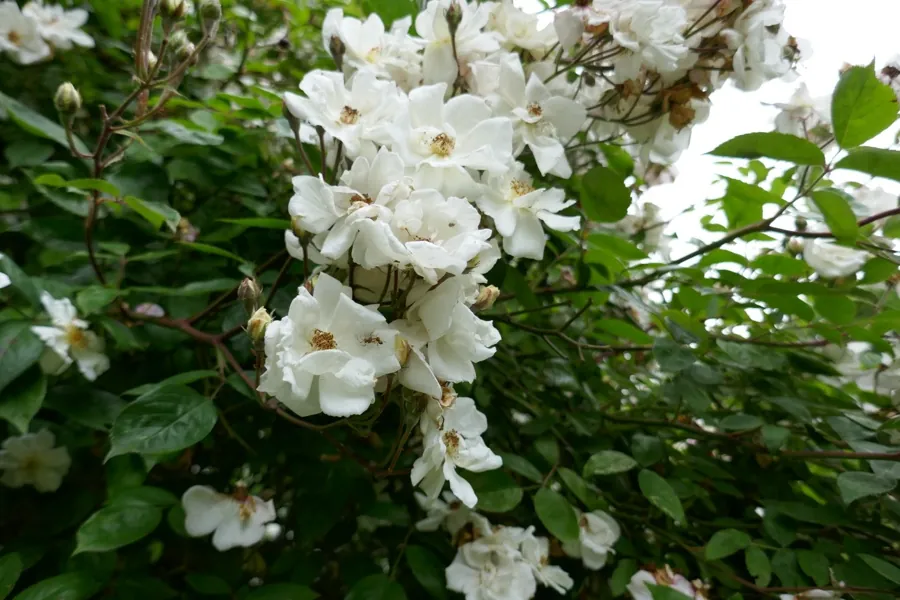
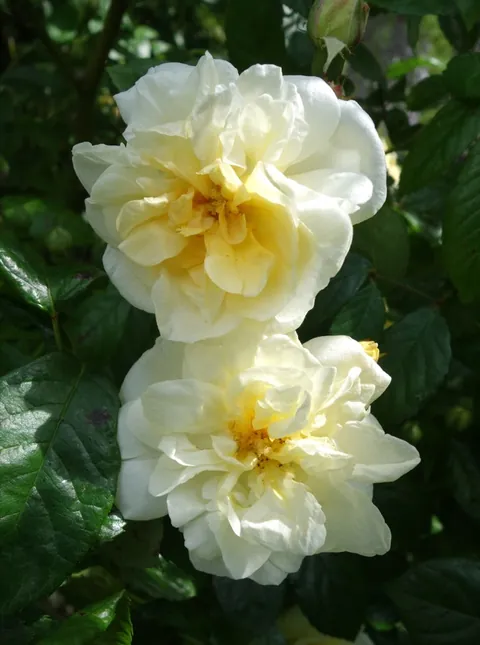
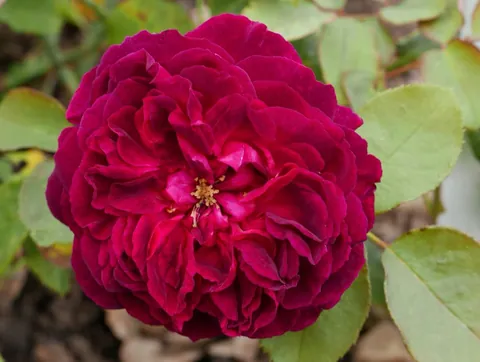
Round, cream-white with a lemon tint
Open flower
Semi-double, with visible stamens
Centre
Bright yellow stamens on a lemon-yellow background
Fullness
Semi-double, about 5–14 petals
Flower carriage
In clusters

Fragrance

Strong; musky

4/5. Strong musk fragrance, the benchmark musk scent after which the whole Hybrid Musk class is named.

Disease resistance

4 out of 5

4/5. Good, typical of Pemberton Hybrid Musks.

Sun

Sun + shade

One of the most shade-tolerant old roses.

Thorns

Moderate
thornlessfewmoderatemanyvery many

Medium number, typical of Hybrid Musks.

Foliage

Young foliage bronze-red, mature foliage dark green.

All characteristics in a table
Group
Hybrid Musk
Breeder
Rev. Joseph Hardwick Pemberton, United Kingdom, 1913
Bud shape
Round, cream-white with a lemon tint
Open flower
Semi-double, with visible stamens
Centre
Bright yellow stamens on a lemon-yellow background
Colour
Cream-white with a lemon-yellow tint in the centre; bright yellow stamens. Young foliage is bronze-red, an extra decorative effect.
Fullness
Semi-double, about 5–14 petals
Flower carriage
In clusters
Flowering
Repeat-flowering
Fragrance
4/5. Strong musk fragrance, the benchmark musk scent after which the whole Hybrid Musk class is named.
Hips
Small hips
Habit
A spreading large shrub or a small climber: the typical Hybrid Musk 'fountain' form
Branching
Strong, from the base
Shoots
Long, flexible
Thorns
Medium number, typical of Hybrid Musks.
Dimensions
120–245 × 245–365 cm (often grown as a small climber, 4–8 ft; can reach 6–8 ft)
Support
A support is advisable if it is trained as a climber
Foliage
Young foliage bronze-red, mature foliage dark green
Resistance
4/5. Good, typical of Pemberton Hybrid Musks.
Variations of the variety
No patent code (1913); parentage 'Trier' (Hybrid Multiflora, Lambert 1904) × 'Sulphurea' (Tea, W. Paul 1900); often confused with 'Trier' in commerce; wrongly attributed to Lambert, as the breeder is Pemberton (although its ancestor, the Trier-line, is Lambert's)

Colour scheme

Cream white with a lemon-yellow tint in the centre; bright yellow stamens. Young foliage is bronze-red, an extra decorative effect.

Rose neighbours

Perennials to plant nearby

Neighbouring roses

⭐ A classic Pemberton family — the source of the Hybrid Musk class:

Companion perennials

A classic English cottage-garden family:

lavenderdelphiniumByzantine stachysgypsophila

Availability worldwide

A historic variety, in cultivation for 110+ years:

  • 🇬🇧 Great Britain: high · collector's rose
  • 🇪🇺 Europe: moderate · via collectors' nurseries
  • 🇺🇸 USA: moderate
  • 🇺🇦 Ukraine: low · via collectors

More about the variety

Hips
Small hips
Variations of the variety
No patent code (1913); parentage 'Trier' (Hybrid Multiflora, Lambert 1904) × 'Sulphurea' (Tea, W. Paul 1900); often confused with 'Trier' in commerce; wrongly attributed to Lambert, as the breeder is Pemberton (although its ancestor, the Trier-line, is Lambert's)

How to grow

Where to plant. As a large specimen, or as a small climber on a pergola or a south wall; one of the most shade-tolerant old roses, good in partial shade. Ideal in a group with Danaë, as the '1913 duet, the birth of the Hybrid Musks'.

Climate. Down to −20 °C; in Ukraine with moderate winter protection; in the south, without protection.

Care. Minimal; selective pruning; tie in horizontally if grown as a climber.

About the name

Name. 'Moonlight', meaning 'moonlight'. A poetic name reflecting the milky-white colour of flowers that seem to 'glow' at dusk (a typical Pemberton device, naming roses after literary or atmospheric images). In the family garden of the Pemberton-sisters at Havelí, Moonlight was planted along the paths, and in the evening it 'glowed'.

Breeding. Bred by Rev. Joseph Hardwick Pemberton (1852–1926, an Anglican priest and rose breeder) in Great Britain; bred and introduced in 1913. No patent code (1913). Parentage: 'Trier' (Hybrid Multiflora, Peter Lambert 1904) × 'Sulphurea' (Tea, W. Paul 1900).

Significance. RNRS Gold Medal 1913 (Great Britain, according to the Pemberton archive). ONE OF THE FIRST TWO HYBRID MUSKS PRESENTED TO THE PUBLIC IN 1913, TOGETHER WITH DANAË: effectively the birth of the Hybrid Musk class as the world knows it. The 14th Hybrid Musk in our catalogue, and the largest 'wild' family. It is often mistakenly attributed to Lambert; the breeder is Pemberton, although its ancestor Trier was bred by Lambert. In commerce it is sometimes confused with 'Trier'.

Frequently asked questions about Moonlight

Does Moonlight need winter protection?

The cultivar’s reference temperature is −20 °C (USDA zone 6b). Overwintering depends on the conditions. In Ukraine with moderate winter protection.

How many times a season does Moonlight flower?

Repeat-flowering.

How big does Moonlight grow?

120–245 cm tall, 245–365 cm wide.

Which diseases affect Moonlight?

Overall resistance: 4 out of 5. Good; typical of Pemberton Hybrid Musks.

How much sun does Moonlight need?

Sun + shade; one of the most shade-tolerant old roses.

What does Moonlight smell like?

4/5. Strong musk fragrance, the benchmark musk scent after which the whole Hybrid Musk class is named.

Gardeners' photos and reviews

My climate

Choose a reference temperature to compare with the cultivar’s data. This is not an overwintering forecast or advice on winter protection; consider wind, moisture and the duration of frost.

Regional data are generalised. USDA describes average annual extreme minima, not a forecast; the values in the list are rounded. Check the conditions at your site. More information: Roses in Ukraine's climate.