


Back to catalogue
Hybrid MuskLouis LensPink

Heavenly Pink

Gold Medal Madrid 1998; parentage 'Seagull' × seedling; there is also a 'Heavenly Pink' (JACextra) by Jackson&Perkins — a different variety, not to be confused with it.

Lens Roses · 'heavenly pink'

Variety profile

Flowering

Repeat, very abundant — in flushes through the season

Awards

Gold Madrid

1998 · Belgian premium Lens rose

Winter hardiness

−23 °C

USDA zone 6b–9b. In Ukraine with moderate cover.

Compare reference temperatures

Plant size

60–100 × 80 cm
person 170 cm60–100 cm
Habit
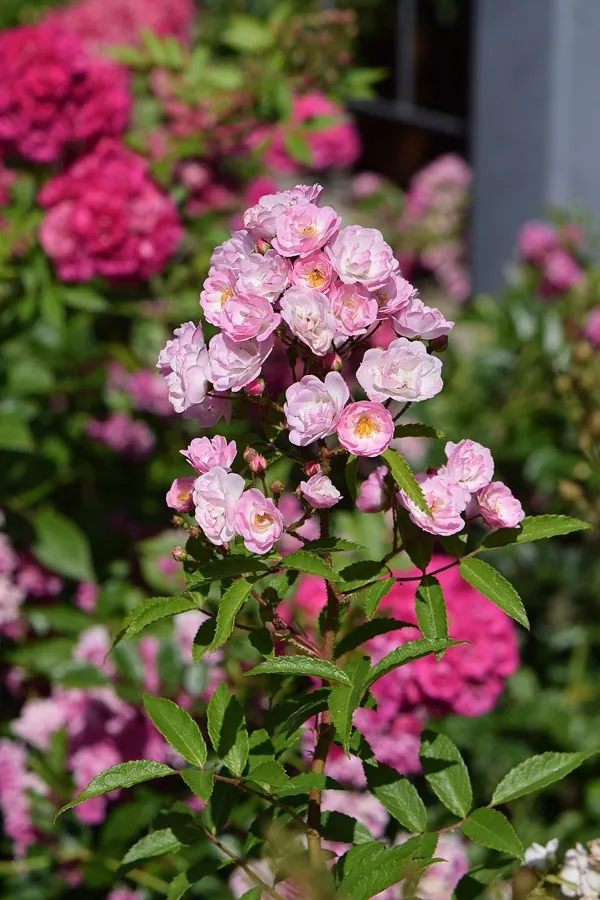
A compact, upright shrub with an airy silhouette — the clusters form a 'pink cloud'
Dimensions
60–100 cm tall × ~80 cm wide
Support
No support needed
Shoots
Strong, straight; they hold the clusters well
Branching
Good, even

Flower

12–16 petals
Bud shape
Small, round, soft pink
Open flower
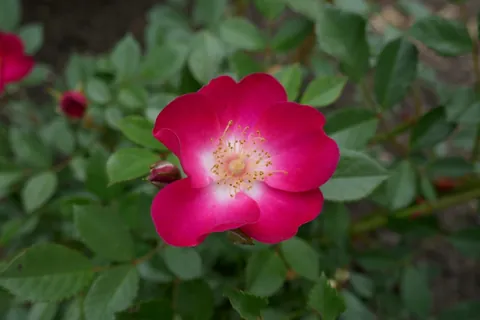
Semi-double, with a conspicuous yellow centre of stamens; the small diameter is made up for by the number of flowers in the cluster
Centre
Bright yellow centre of stamens, contrasting with the soft pink petals
Fullness
Semi-double, 12–16 petals (HMF); Lens describes it as a 'double rosette', so the sources conflict; the HMF figure is taken as the official one
Flower carriage
In pyramidal clusters — the typical Lens Hybrid Musk-form

Fragrance

Light

A light musk scent — a fine scent from Rosa multiflora (the parent line of the Hybrid Musks).

Disease resistance

5 out of 5

Excellent — typical quality of modern Lens-varieties.

Sun

Sun or partial shade

Tolerates some shade — typical of Hybrid Musks.

Thorns

Few
thornlessfewmoderatemanyvery many

Few prickles — typical of Hybrid Musks Lens.

Foliage

Dark green, leathery, healthy.

All characteristics in a table
Group
Hybrid Musk
Breeder
Louis Lens, Belgium
Bud shape
Small, round, soft pink
Open flower
Semi-double, with a conspicuous yellow centre of stamens; the small diameter is made up for by the number of flowers in the cluster
Centre
Bright yellow centre of stamens, contrasting with the soft pink petals
Colour
A medium 'heavenly pink' — stable, without fading to white; the clusters create the effect of 'pink little clouds'
Fullness
Semi-double, 12–16 petals (HMF); Lens describes it as a 'double rosette', so the sources conflict; the HMF figure is taken as the official one
Flower carriage
In pyramidal clusters — the typical Lens Hybrid Musk-form
Flowering
Repeat, very abundant — in flushes through the season
Fragrance
A light musk scent — a fine scent from Rosa multiflora (the parent line of the Hybrid Musks)
Hips
Possible decorative small rose hips
Habit
A compact, upright shrub with an airy silhouette — the clusters form a 'pink cloud'
Branching
Good, even
Shoots
Strong, straight; they hold the clusters well
Thorns
Few prickles — typical of Hybrid Musks Lens.
Dimensions
60–100 cm tall × ~80 cm wide
Support
No support needed
Foliage
Dark green, leathery, healthy
Resistance
Excellent — typical quality of modern Lens-varieties
Variations of the variety
Code LENnedi (also LLX 8926, LENneei); parentage 'Seagull' (Pritchard 1907) × an unnamed seedling; homonym: there is also a 'Heavenly Pink' (JACextra), a floribunda by Jackson&Perkins, which is a different variety

Colour scheme

A medium 'heavenly pink' — stable, without fading to white; the clusters create the effect of 'pink little clouds'

Rose neighbours

Perennials to plant nearby

Neighbouring roses

The Belgian Hybrid Musk dynasty of Lens — a family group in our catalogue:

Companion perennials

English pastel palette:

lavender 'Munstead'geranium 'Wargrave Pink'Stachys byzantina (lamb's ear)lady's mantle (Alchemilla)

Availability worldwide

A Belgian premium variety, mainly available in Europe:

  • 🇪🇺 Europe: high · Lens Roses · Benelux + France
  • 🇺🇸 USA: low · specialist Hybrid Musk nurseries
  • 🇯🇵 Asia: moderate
  • 🇺🇦 Ukraine: low · rare, collections only

More about the variety

Hips
Possible decorative small rose hips
Variations of the variety
Code LENnedi (also LLX 8926, LENneei); parentage 'Seagull' (Pritchard 1907) × an unnamed seedling; homonym: there is also a 'Heavenly Pink' (JACextra), a floribunda by Jackson&Perkins, which is a different variety

How to grow

Where to plant. Natural, romantic flower gardens, pastel borders, themed 'Belgian' groups with other Lens-varieties; it looks lovely in partial shade, a rare quality in roses; paired with Grand-Duc Jean (also Lens, dark carmine), it makes a striking light-dark contrast.

Climate. Down to −23 °C — in northern and central Ukraine with moderate cover; in the south, no cover needed.

Care. Minimal — Hybrid Musks Lens have stood in European gardens for 25+ years without special attention; prune only for hygiene; their outstanding resistance means there is no need for chemicals.

About the name

Name. 'Heavenly Pink' — English for 'sky pink'. A descriptive name that captures the character of the variety: the pyramidal clusters of soft pink flowers look like pink little clouds against the dark green foliage. It follows the standard Lens-practice of 'poetic' names.

Breeding. Bred by Louis Lens (1924–2001), the legendary Belgian breeder, at Lens Roses (Louvier, Belgium). The cross was made in 1989 and the variety was introduced in 1997. Code LENnedi (also LLX 8926, LENneei). Parentage: 'Seagull' (Pritchard 1907, a historic rambler) × an unnamed seedling. After Lens's death (2001) the nursery was carried on by his pupils, Rudy & Ann Velle-Lens (Ann is Louis's granddaughter and the breeder of Grand-Duc Jean, 2010).

Significance. Gold Medal Madrid 1998. The 4th Lens variety in our catalogue. Together with Guirlande d'Amour (1993, white), Bouquet Parfait (1989, cream-pink) and Grand-Duc Jean (2010, dark carmine), it forms a complete Belgian Hybrid Musk-dynasty, a separate thematic group for the handbook. All four varieties carry the LEN prefix, and all are soft, pastel, clustered shrub roses for natural mixed borders. The Lens breeders continued the Pemberton/Bentall line, but with better disease resistance and a wider colour range. It is important not to confuse it with the homonym 'Heavenly Pink' (JACextra), a floribunda by Jackson&Perkins and a completely different variety; in our catalogue it is the Belgian Lens-version.

Frequently asked questions about Heavenly Pink

Does Heavenly Pink need winter protection?

The cultivar’s reference temperature is −23 °C (USDA zone 6b–9b). Overwintering depends on the conditions. In Ukraine with moderate cover.

How many times a season does Heavenly Pink flower?

Repeat, very abundant — in flushes through the season.

How big does Heavenly Pink grow?

60–100 cm tall, about 80 cm wide.

Which diseases affect Heavenly Pink?

Overall resistance: 5 out of 5. Excellent; typical quality of Lens-varieties.

How much sun does Heavenly Pink need?

Sun or partial shade; tolerates some shade — typical of Hybrid Musks.

What does Heavenly Pink smell like?

A light musk scent — a fine scent from Rosa multiflora (the parent line of the Hybrid Musks).

Gardeners' photos and reviews

My climate

Choose a reference temperature to compare with the cultivar’s data. This is not an overwintering forecast or advice on winter protection; consider wind, moisture and the duration of frost.

Regional data are generalised. USDA describes average annual extreme minima, not a forecast; the values in the list are rounded. Check the conditions at your site. More information: Roses in Ukraine's climate.