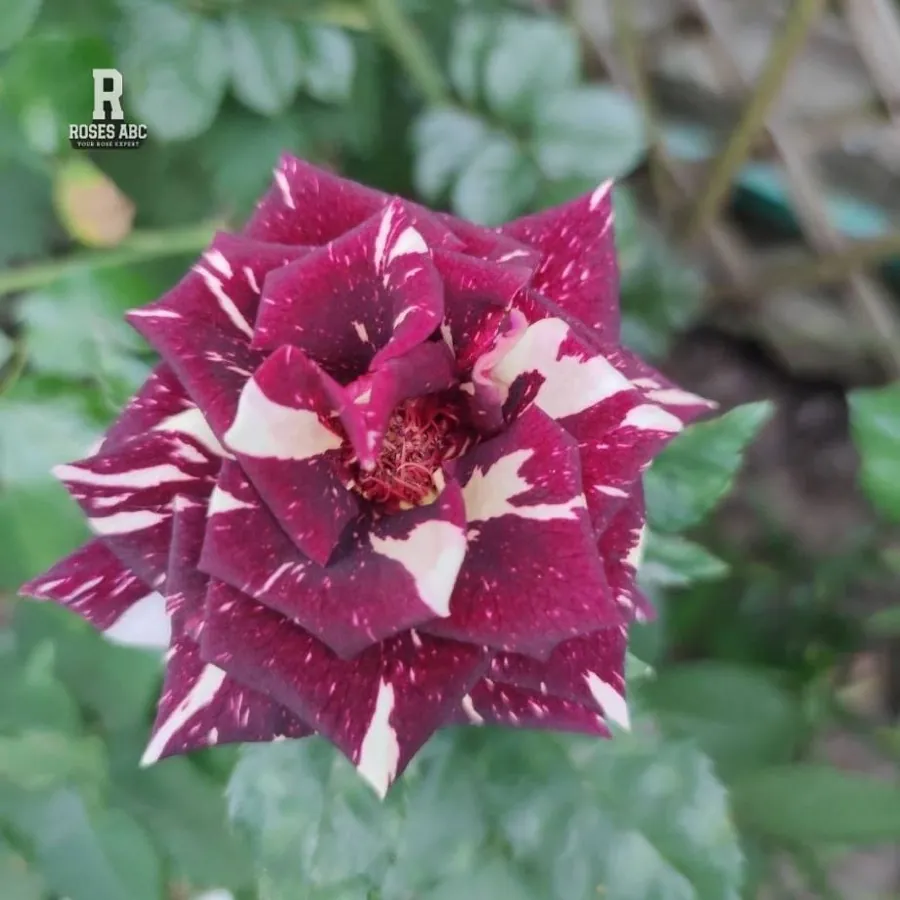
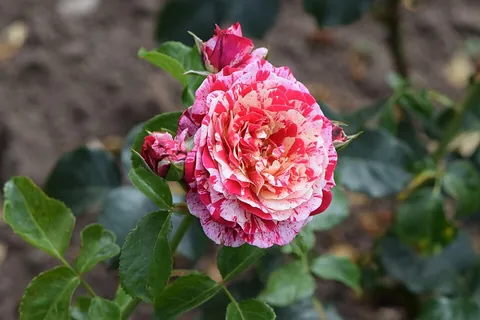





Hocus Pocus, close-up of the flower
Back to catalogue
FloribundaW. Kordes' Söhne, 2000Yellow

Hocus Pocus

🎩 bud sport of Black Beauty (KORfleur, Kordes 1991) · parent [[abracadabra|Abracadabra]] (KORhocsel) · unstable — may revert.

Variety profile

Flowering

Repeat, in flushes through the season

Winter hardiness

−23 °C

USDA zone 6. In Ukraine with moderate cover.

Compare reference temperatures

Plant size

50–60 × 40 cm
person 170 cm50–60 cm
Habit
Compact, upright floribunda bush
Dimensions
50–60 cm tall × 40 cm wide (compact); per RosesABC up to 80–90 cm in a warm climate
Support
No support needed
Shoots
Strong, straight; they hold the clusters well
Branching
Good

Flower

6–7 cm
Bud shape
Round-oval, dark wine-red with yellow dots
Open flower
Cupped and double, with characteristic irregular stripes and flecks; diameter 6–7 cm
Centre
Dense dark wine-red centre with yellow stamens
Fullness
Double, 30–40 petals
Flower carriage
In small clusters of 3–5 per stem

Fragrance

Barely noticeable

Barely noticeable — the variety's main value is its pattern, not its scent.

Disease resistance

3 out of 5

Moderate — not awarded by ADR; typical quality of striped or mutation-derived varieties.

Sun

Full sun to show the 'magic' of the stripes

Foliage

Dark green, glossy.

All characteristics in a table
Group
Floribunda
Breeder
W. Kordes' Söhne, Germany, 2000
Bud shape
Round-oval, dark wine-red with yellow dots
Open flower
Cupped and double, with characteristic irregular stripes and flecks; diameter 6–7 cm
Centre
Dense dark wine-red centre with yellow stamens
Colour
A 'magical' pattern: a dark wine-red (burgundy) background with irregular yellow or cream stripes and flecks. Each flower is unique and the pattern never repeats; on one bush, flowers with more or fewer stripes appear at the same time
Fullness
Double, 30–40 petals
Flower carriage
In small clusters of 3–5 per stem
Flowering
Repeat, in flushes through the season
Fragrance
Barely noticeable — the variety's main value is its pattern, not its scent
Hips
Not documented as decorative
Habit
Compact, upright floribunda bush
Branching
Good
Shoots
Strong, straight; they hold the clusters well
Number of thorns
Moderate — the variety is neither almost thornless nor heavily prickly
Dimensions
50–60 cm tall × 40 cm wide (compact); per RosesABC up to 80–90 cm in a warm climate
Support
No support needed
Foliage
Dark green, glossy
Resistance
Moderate — not awarded by ADR; typical quality of striped or mutation-derived varieties
What makes it special
The striped colouring can be unstable: some shoots occasionally revert to dark red with no yellow stripes

Colour scheme

A 'magical' pattern: a dark wine-red (burgundy) background with irregular yellow or cream stripes and flecks. Each flower is unique and the pattern never repeats; on one bush, flowers with more or fewer stripes appear at the same time

Rose neighbours

Perennials to plant nearby

Rose neighbours

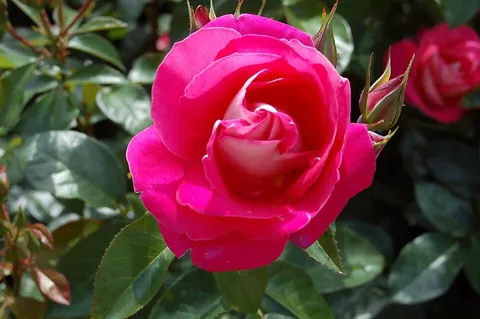
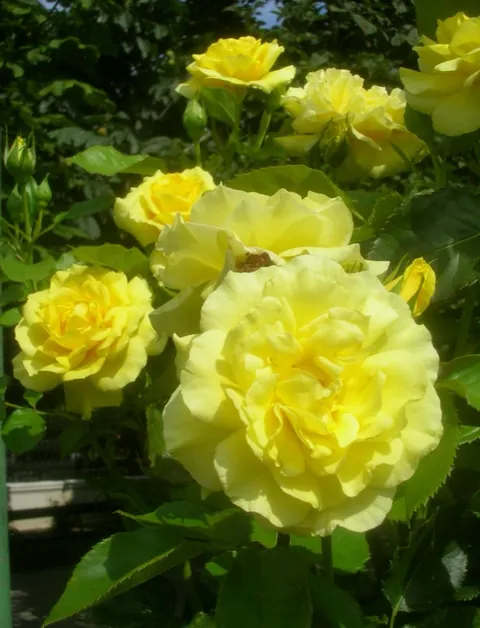
One related striped rose keeps the theme going, while the bicolour, yellow and soft-pink ones change the colour and character of the flower.

Companion perennials

Calm purple, silver and lime plants make a background that does not compete with the striped flower.

  • Lavender 'Hidcote'. Colour accent: lavender.
  • Lamb's ears (Stachys byzantina). Colour accent: silver.
  • Salvia 'Caradonna'. Colour accent: purple.
  • Lady's mantle (Alchemilla mollis). Colour accent: lime-green.

More about the variety

Hips
Not documented as decorative
What makes it special
The striped colouring can be unstable: some shoots occasionally revert to dark red with no yellow stripes

How to grow

Where to plant. Themed 'magic' flower beds, containers on a terrace (where the unique patterns show up close), striking groups of 2–3 bushes; lovely paired with Abracadabra (its daughter), an evolution of colour within one family.

Climate. Down to −23 °C — in Ukraine with moderate cover in the northern regions; in the south, no cover needed.

Care. Classic floribunda — prune in spring by ⅓; remove shoots that have reverted to the dark red Black Beauty (without yellow stripes), otherwise the 'magic' will disappear; standard seasonal disease prevention.

About the name

Name. 'Hocus Pocus' — a magic formula, the traditional phrase in conjurers' incantations (possibly from the Latin church phrase 'Hoc est corpus'). The name conveys the 'magical' character of the variety perfectly: on one bush, flowers with different patterns appear at the same time, each as if 'conjured' separately. The Ukrainian equivalents are 'fokus-pokus' or 'abrakadabra' (the variety's daughter is called Abracadabra).

Breeding. Bred by W. Kordes' Söhne, Sparrieshoop, Germany, in 2000. Code KORpocus (the exact form with a standard -c-, not -k-). CLARIFICATION: Hocus Pocus is a sport mutation of Black Beauty (KORfleur, Kordes 1991, a dark wine-red floribunda). In other words, Hocus Pocus arose spontaneously on a Black Beauty bush as a shoot with stripes instead of a single colour. Kordes breeders isolated this shoot and propagated it as a new variety.

Significance. Hocus Pocus – Abracadabra is a chain of mutations at Kordes. A year later (2001) Kordes isolated a second sport mutation, this time from Hocus Pocus, and named it Abracadabra (KORhocsel); it has even more yellow stripes, which are brighter (claret plus pure lemon). This is a classic example of a mutation cascade at Kordes: Black Beauty – Hocus Pocus – Abracadabra. All three varieties are unstable and can revert to the parent dark red colour (without stripes). Therefore, when pruning, you must REMOVE shoots that have reverted to a single colour, or the variety will 'disappear' from the bush. ADR Hocus Pocus did not receive an award.

Frequently asked questions about Hocus Pocus

Does Hocus Pocus need winter protection?

The cultivar’s reference temperature is −23 °C (USDA zone 6). Overwintering depends on the conditions. In Ukraine with moderate cover.

How many times a season does Hocus Pocus flower?

Repeat, in flushes through the season.

How big does Hocus Pocus grow?

50–60 cm tall, about 40 cm wide.

Which diseases affect Hocus Pocus?

Overall resistance: 3 out of 5. Moderate; not awarded by ADR.

How much sun does Hocus Pocus need?

Sun; full sun to show the 'magic' of the stripes.

What does Hocus Pocus smell like?

Barely noticeable — the variety's main value is its pattern, not its scent.

Gardeners' photos and reviews

My climate

Choose a reference temperature to compare with the cultivar’s data. This is not an overwintering forecast or advice on winter protection; consider wind, moisture and the duration of frost.

Regional data are generalised. USDA describes average annual extreme minima, not a forecast; the values in the list are rounded. Check the conditions at your site. More information: Roses in Ukraine's climate.