



Back to catalogue
FloribundaAlain Meilland & Michèle Meilland-Richardier; Meilland, 2000Bicolour

Jubilé du Prince de Monaco

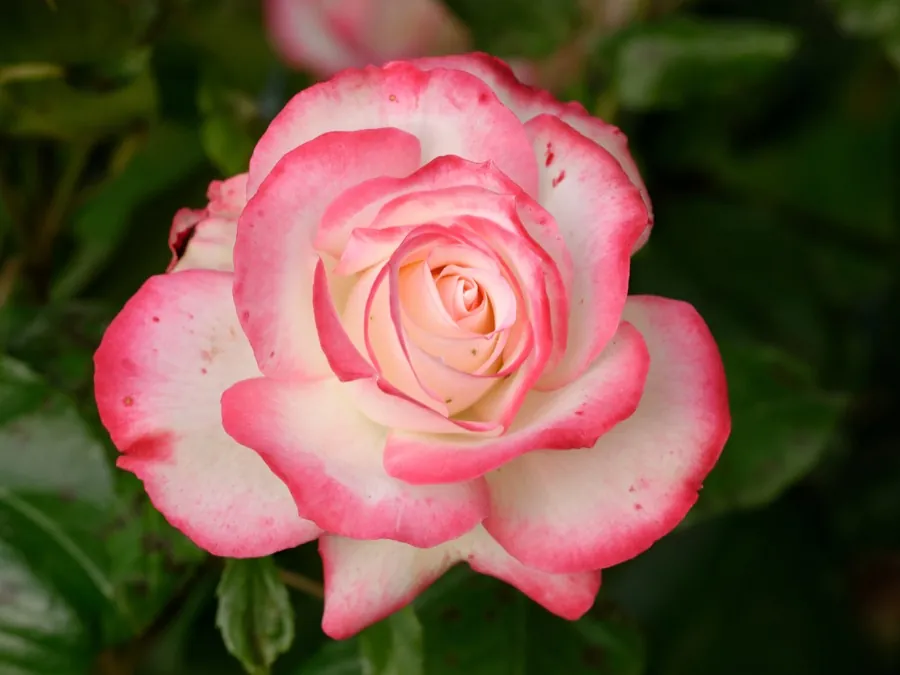
AARS 2003 (as Cherry Parfait in the USA) plus 5 awards; white-and-crimson bicolour (Monaco flag); disease resistance 5/5; named for Rainier III (NOT Albert II!) on the 50th anniversary of his reign.

Roses de la famille Grimaldi

Variety profile

Flowering

Repeat flowering

Continuous from spring until the frosts. Months are approximate, for the climate of Ukraine.

Awards

AARS 2003

USA (as Cherry Parfait) · Gold Buenos Aires + Silver Madrid 2000 · Bronze Genoa 2001 · Golden Rose USA 2006

Winter hardiness

−20 °C

USDA zone 6b. In Ukraine zones 5b–6 with light winter protection.

Compare reference temperatures

Plant size

70–90 × 70–80 cm
person 170 cm70–90 cm
Habit
Compact upright bush — ideal for a formal border
Dimensions
70–90 × 70–80 cm
Support
No support needed
Shoots
Strong, straight, hold the large flowers well
Branching
Good

Flower

9–10 cm
Bud shape
Round-oval, with the crimson edge already visible
Open flower
Broad cup-shaped, with a sharp white-and-crimson 'two-colour flag'; the colours do not blend
Centre
Creamy white, with a faint yellowish tint that fades to pure white as it opens
Fullness
Fully double, 35–40 petals
Flower carriage
Large flowers in small clusters of 2–5 — like a Hybrid Tea, but with the abundance of a Floribunda

Fragrance

Faint; sweetish

Faint, sweetish scent — the variety's main strength is its looks, not its fragrance.

Disease resistance

5 out of 5

5/5 — especially to powdery mildew and black spot.

Sun

Full sun

The white-and-crimson contrast is at its clearest.

Thorns

Moderate
thornlessfewmoderatemanyvery many

Moderate number, typical of modern Meilland roses.

Foliage

Dark green, glossy, leathery — an extra decorative effect.

Other names

Cherry Parfait, Fire & Ice, Saint Petersburg Testimonial, Blumenstadt Tulln
All characteristics in a table
Group
Floribunda
Breeder
Alain Meilland & Michèle Meilland-Richardier; Meilland, France, 2000
Bud shape
Round-oval, with the crimson edge already visible
Open flower
Broad cup-shaped, with a sharp white-and-crimson 'two-colour flag'; the colours do not blend
Centre
Creamy white, with a faint yellowish tint that fades to pure white as it opens
Colour
A unique bicolour, the 'Monaco flag': a creamy-white to pale yellow petal field with a broad ruby-red to vermilion edge; the boundary is sharp and the colours are stable. As the flower opens, the yellowish centre fades to white, while the red edge stays and even widens.
Fullness
Fully double, 35–40 petals
Flower carriage
Large flowers in small clusters of 2–5 — like a Hybrid Tea, but with the abundance of a Floribunda
Flowering
Continuous from spring until the frosts
Fragrance
Faint, sweetish scent — the variety's main strength is its looks, not its fragrance
Hips
Not documented
Habit
Compact upright bush — ideal for a formal border
Branching
Good
Shoots
Strong, straight, hold the large flowers well
Thorns
Moderate number, typical of modern Meilland roses.
Dimensions
70–90 × 70–80 cm
Support
No support needed
Foliage
Dark green, glossy, leathery — an extra decorative effect
Resistance
5/5 — especially to powdery mildew and black spot
Variations of the variety
Code MEIsponge; US PP 12,802 (2002); parentage 'Jacqueline Nebout' × ('Tamango' × 'Matangi'); synonyms Cherry Parfait® (USA), Fire & Ice (Australia), Saint Petersburg Testimonial® (Russia), Blumenstadt Tulln (Austria)

Colour scheme

A unique bicolour, the 'Monaco flag': a creamy-white to pale yellow petal field with a broad ruby-red to vermilion edge; the boundary is sharp and the colours are stable. As the flower opens, the yellowish centre fades to white, while the red edge stays and even widens.

Rose neighbours

Perennials to plant nearby

Neighbouring roses

Bicolours and pure whites — the 'contrasting flags' family:

Companion perennials

Soft violet and silver accents — they soften the contrast:

lavendercatmintlamb's eargypsophila

Availability worldwide

One of the most famous bicolours of the XXI century, widely grown:

  • 🇫🇷 France: high · Meilland
  • 🇺🇸 USA: high · as Cherry Parfait · AARS
  • 🇦🇺 Australia: high · as Fire & Ice
  • 🇺🇦 Ukraine: moderate · through European nurseries

More about the variety

Hips
Not documented
Variations of the variety
Code MEIsponge; US PP 12,802 (2002); parentage 'Jacqueline Nebout' × ('Tamango' × 'Matangi'); synonyms Cherry Parfait® (USA), Fire & Ice (Australia), Saint Petersburg Testimonial® (Russia), Blumenstadt Tulln (Austria)

How to grow

Where to plant. Formal borders, mono-bicolour groups, containers on a terrace, at an entrance; widely planted in the Princess Grace Rose Garden in Monaco, the model use for showcase spots.

Climate. To −20 °C; in Ukraine: the south without winter protection, the centre and north with light winter protection.

Care. Classic floribunda — spring pruning to 4–6 buds; removing spent blooms encourages new flushes; needs almost no disease prevention (health 5/5).

About the name

Name. The rose is named after Prince Rainier III of Monaco (Rainier III, 1923–2005), for the 50th anniversary of his reign (1949–1999). Presented during the celebrations on 9 May 1999. IMPORTANT: the name is often mistakenly linked to his son, Albert II — this is wrong. The variety is dedicated to Rainier III himself. The flower's colours reproduce the red-and-white flag of the Principality of Monaco — this is the visual signature.

Breeding. Bred by Alain Meilland and Michèle Meilland-Richardier (Meilland International, Provence, France), 2000. Code MEIsponge. US Patent PP 12,802 (23.07.2002). Parentage: 'Jacqueline Nebout' (seed parent) × ('Tamango' × 'Matangi') (pollen parent). It belongs to the Meilland thematic collection 'Roses de la famille Grimaldi', a series dedicated to Monaco's ruling dynasty.

Significance. AARS 2003 (as Cherry Parfait in the USA) — our 8th AARS-rose in the catalogue. Also: Gold Buenos Aires + Silver Madrid 2000; Bronze Genoa 2001; Golden Rose Rose Hill USA 2006. One of the best-known bicolour floribundas of the XXI century. In the USA, under the trade name 'Cherry Parfait', it is often not linked to the European MEIsponge — it is the same variety. Do not confuse it with 'Jubilé Princesse de Monaco' / 'Princesse de Monaco' (MEImagarmic, 1981), also a white-and-pink Meilland bicolour; that is a different variety, in memory of Grace Kelly.

Frequently asked questions about Jubilé du Prince de Monaco

Does Jubilé du Prince de Monaco need winter protection?

The cultivar’s reference temperature is −20 °C (USDA zone 6b). Overwintering depends on the conditions. In Ukraine zones 5b–6 with light winter protection.

How many times a season does Jubilé du Prince de Monaco flower?

Continuous from spring until the frosts.

How big does Jubilé du Prince de Monaco grow?

70–90 cm tall, 70–80 cm wide.

Which diseases affect Jubilé du Prince de Monaco?

Overall resistance: 5 out of 5. Outstanding; especially to powdery mildew and black spot.

How much sun does Jubilé du Prince de Monaco need?

Sun; full sun; the white-and-crimson contrast is at its clearest.

What does Jubilé du Prince de Monaco smell like?

Faint, sweetish scent — the variety's main strength is its looks, not its fragrance.

Gardeners' photos and reviews

My climate

Choose a reference temperature to compare with the cultivar’s data. This is not an overwintering forecast or advice on winter protection; consider wind, moisture and the duration of frost.

Regional data are generalised. USDA describes average annual extreme minima, not a forecast; the values in the list are rounded. Check the conditions at your site. More information: Roses in Ukraine's climate.