


Back to catalogue
Hybrid TeaMathias Tantau Jr.; Rosen Tantau, 1970Yellow

Landora

Pure yellow that does not fade — a unique trait; Gold Tokyo 1971 + Gold NZ 1973 + Gold Gifu; over 50 years in commercial circulation (rare for HTs); known as Sunblest in the UK/USA.

Daughter of King's Ransom

Variety profile

Flowering

Repeat-flowering with pauses

Awards

3 golds

Gold Tokyo 1971 · Gold NZ 1973 · Gold Gifu (Japan)

Winter hardiness

−23 °C

USDA zone 5b–6. In Ukraine it overwinters well across the whole country.

Compare reference temperatures

Plant size

80–120 × 60–80 cm
person 170 cm80–120 cm
Habit
Upright, compact — the classic HT benchmark
Dimensions
80–120 × 60–80 cm
Support
No support needed
Shoots
Sturdy, straight, hold large flowers well
Branching
Good

Flower

10–13 cm
Bud shape
Elongated, high-centred, deep yellow
Open flower
Classic high-centred HT benchmark — large, 10–13 cm, symmetrical, exhibition quality
Centre
Tightly packed, pure yellow
Fullness
Double, 35–45 petals
Flower carriage
Singly on a long stem — typical HT

Fragrance

Light; fruity + apricot

Light — fruity with apricot notes.

Disease resistance

4 out of 5
Black spotmoderatePowdery mildewmoderateRustmoderate

3–4/5 — good against powdery mildew, rust and botrytis; moderate against black spot.

Sun

Full sun

The yellow pigment is exceptionally stable.

Thorns

Moderate
thornlessfewmoderatemanyvery many

Medium number, typical of classic HTs of the 1970s.

Foliage

Dark green, leathery.

All characteristics in a table
Group
Hybrid Tea
Breeder
Mathias Tantau Jr.; Rosen Tantau, Germany, 1970
Bud shape
Elongated, high-centred, deep yellow
Open flower
Classic high-centred HT benchmark — large, 10–13 cm, symmetrical, exhibition quality
Centre
Tightly packed, pure yellow
Colour
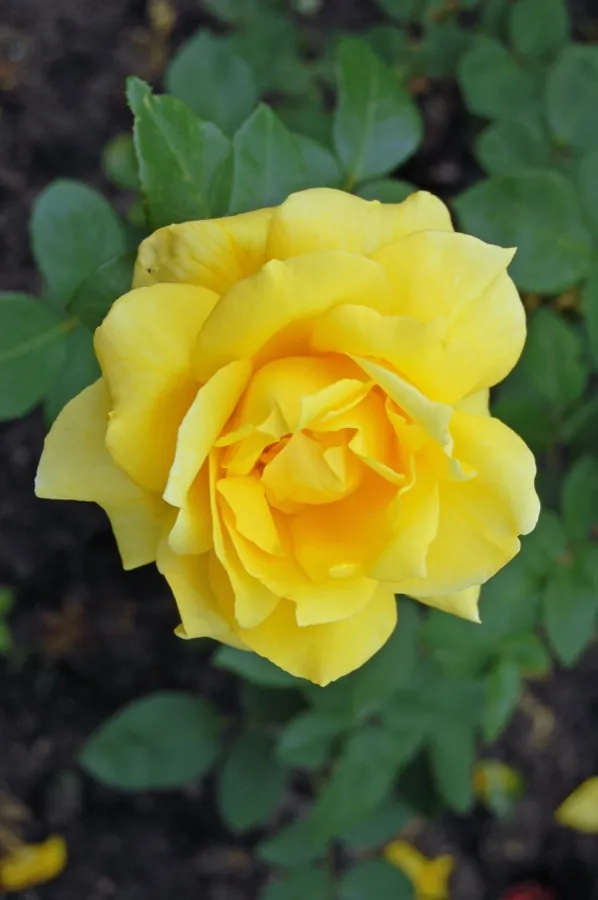
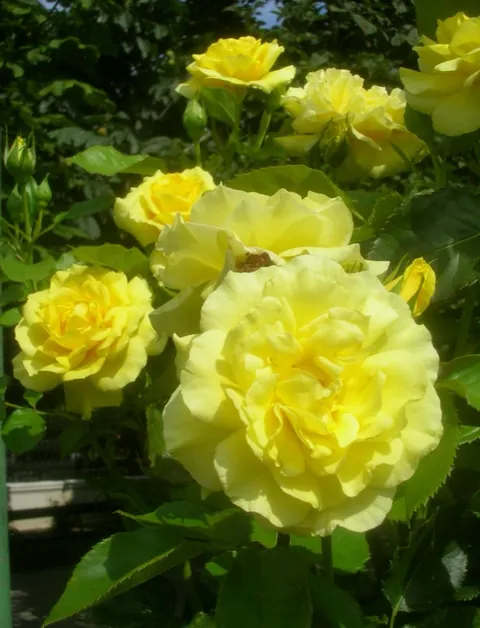
Clear, saturated yellow, even across the petal — no red or pink tints, no ombré. The colour almost never fades in the sun — a rare trait among yellow HTs of the 1970s (most fade to cream).
Fullness
Double, 35–45 petals
Flower carriage
Singly on a long stem — typical HT
Flowering
Repeat-flowering with pauses
Fragrance
Light — fruity with apricot notes
Hips
Not documented
Habit
Upright, compact — the classic HT benchmark
Branching
Good
Shoots
Sturdy, straight, hold large flowers well
Thorns
Medium number, typical of classic HTs of the 1970s.
Dimensions
80–120 × 60–80 cm
Support
No support needed
Foliage
Dark green, leathery
Resistance
3–4/5 — good against powdery mildew, rust and botrytis; moderate against black spot
Variations of the variety
Correct code TANdro (NOT TANdora — often mistaken per the HMF/ICRA register); parentage seedling × King's Ransom (Morey 1961); many trade names: Sunblest (UK/USA — the main one), Tania (Spain), Landora (Germany, Eastern Europe)

Colour scheme

Clear, saturated yellow, even across the petal — no red or pink tints, no ombré. The colour almost never fades in the sun — a rare trait among yellow HTs of the 1970s (most fade to cream).

Rose neighbours

Perennials to plant nearby

Rose neighbours

Classic yellow family in the catalogue — two WFRS HoF + AARS:

Companion perennials

Cool blue-violet family — sets off the pure yellow:

lavenderdelphiniumlamb's ear (Stachys byzantina)lady's mantle (Alchemilla mollis)

Availability worldwide

A classic HT, 50+ years old, with different names by region:

  • 🇩🇪 Germany: high · as Landora
  • 🇬🇧 UK/🇺🇸 USA: high · as Sunblest
  • 🇪🇸 Spain: high · as Tania
  • 🇺🇦 Ukraine: moderate · known in collections as Landora

More about the variety

Hips
Not documented
Variations of the variety
Correct code TANdro (NOT TANdora — often mistaken per the HMF/ICRA register); parentage seedling × King's Ransom (Morey 1961); many trade names: Sunblest (UK/USA — the main one), Tania (Spain), Landora (Germany, Eastern Europe)

How to grow

Where to plant. Classic HT beds, mono-yellow borders, formal groups; ideal as a specimen or for cutting (long stems, stable colour); a duo with Friesia as 'two yellow generations' (HT 1970 + FL 1973).

Climate. Down to −23 °C — overwinters well across the whole of Ukraine; the south without winter protection, the centre and north with moderate protection.

Care. Classic HT — prune in spring to 3–5 buds; removing spent blooms encourages new flushes; seasonal prevention of black spot.

About the name

Name. 'Landora' — an invented, melodious female name with no specific model (Tantau often gave varieties such names). Synonym 'Sunblest' (UK/USA) — literally 'blessed by the sun', a hint at the stable yellow colour that does not fade.

Breeding. Bred by Mathias Tantau Jr. at Rosen Tantau (Uetersen, Germany), 1970, registered 1971. Correct code TANdro (NOT TANdora — often mistaken; the short code TANdro per the HMF/ICRA register). Parentage: unknown seedling of Tantau × King's Ransom (Morey 1961). A common error: parentage given as 'Colour Wonder' — that is a different Tantau rose, not Landora.

Significance. A classic pure-yellow HT of the 1970s, a benchmark for stable yellow pigment. 3 gold medals: Gold Medal Japan (Tokyo) 1971, Gold Star of the South Pacific (New Zealand) 1973, Gold Medal Gifu (Japan). The RNRS Gold Medal 1972 is often cited but is not documented. Over 50 years in commercial circulation — rare for HTs; most HTs of the 1970s have long since disappeared. It belongs to the family of pure-yellow HTs with benchmark colour stability — alongside King's Ransom (its parent) and the Mister Lincoln-era. Do not confuse with Landlust (KORtemma, Kordes 2008, another yellow Floribunda).

Frequently asked questions about Landora

Does Landora need winter protection?

The cultivar’s reference temperature is −23 °C (USDA zone 5b–6). Overwintering depends on the conditions. In Ukraine it overwinters well across the whole country.

How many times a season does Landora flower?

Repeat-flowering with pauses.

How big does Landora grow?

80–120 cm tall, 60–80 cm wide.

Which diseases affect Landora?

Overall resistance: 4 out of 5. 3–4 / 5; good against powdery mildew, rust, botrytis; moderate against black spot.

How much sun does Landora need?

Sun; full sun; the yellow pigment is exceptionally stable.

What does Landora smell like?

Light — fruity with apricot notes.

Gardeners' photos and reviews

My climate

Choose a reference temperature to compare with the cultivar’s data. This is not an overwintering forecast or advice on winter protection; consider wind, moisture and the duration of frost.

Regional data are generalised. USDA describes average annual extreme minima, not a forecast; the values in the list are rounded. Check the conditions at your site. More information: Roses in Ukraine's climate.