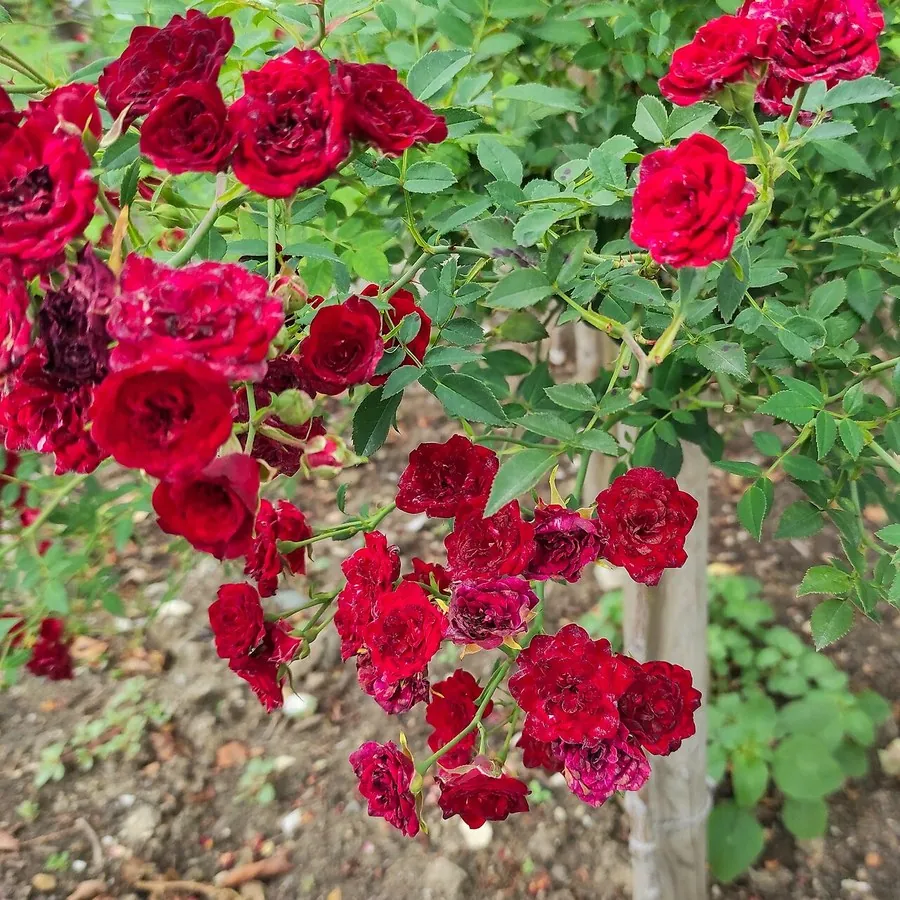
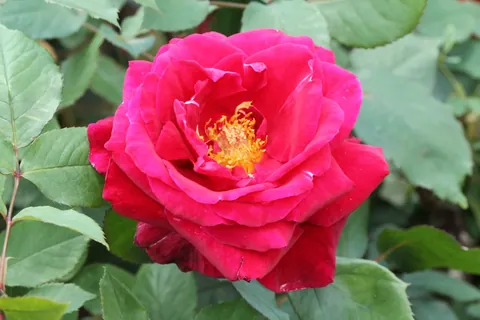
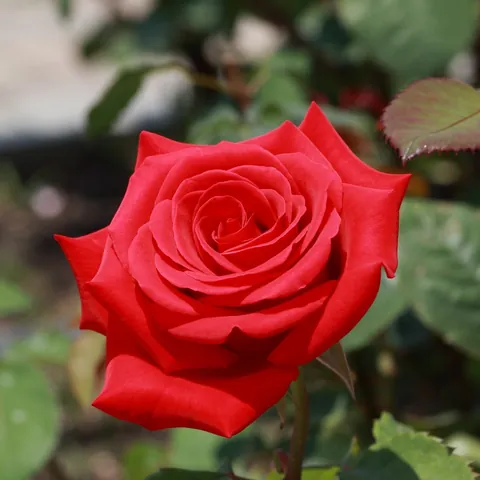
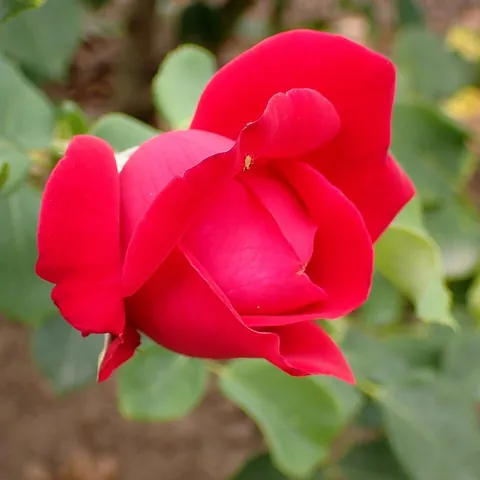




Red Cascade, close-up of the flower
Photo: Jana Sekyrová, CC BY-SA 4.0
Back to catalogue
Miniature climber / cascading groundcoverRalph S. Moore; Sequoia Nursery, 1976Red

Red Cascade

Rich dark red — a continuous cascade of small flowers on flexible canes 1.8–2.5 m long, on a bush only 30–45 cm high; ARS Award of Excellence 1976; a versatile plant: a climber on a low support, a cascade from a hanging pot, or a dense groundcover carpet.

Breeding no. 82-68-5

Variety profile

Flowering

Repeat-flowering, abundant

Awards

ARS AoE 1976

Award of Excellence · US patent PP 3,962

Winter hardiness

−26 °C

USDA zone 5b. About −26 °C; Ukraine: light winter protection. ≈ −26 °C · Ukraine: light cover.

Compare reference temperatures

Plant size

30–45 cm
person 170 cm30–45 cm
Habit
Trailing, cascading — the flexible long shoots sprawl or hang down
Dimensions
Only 30–45 cm high, with shoots 1.8–2.5 m long
Support
For a cascade, a low support is enough; as a groundcover, it needs no support
Shoots
Flexible, 1.8–2.5 m long
Branching
Abundant side-branching — forms a continuous groundcover carpet

Flower

≈ 2.5 cm

26–40 petals.

Bud shape
Small, round, deep dark red
Open flower
Fully double, small rosette, about 2.5 cm in diameter
Fullness
26–40 petals (full)
Flower carriage
Solitary or in small clusters

Fragrance

Light

Sun

Full sun

Fading: no data.

Thorns

Moderate
thornlessfewmoderatemanyvery many

No data on the number of thorns — the mark is set at the midpoint by convention.

Foliage

Small.

All characteristics in a table
Group
Miniature climber / cascading groundcover
Breeder
Ralph S. Moore; Sequoia Nursery, USA, 1976
Bud shape
Small, round, deep dark red
Open flower
Fully double, small rosette, about 2.5 cm in diameter
Colour
Rich dark red (crimson); no data on sun fading
Fullness
26–40 petals (full)
Flower carriage
Solitary or in small clusters
Flowering
Repeat-flowering, abundant
Fragrance
Light
Hips
No data
Habit
Trailing, cascading — the flexible long shoots sprawl or hang down
Branching
Abundant side-branching — forms a continuous groundcover carpet
Shoots
Flexible, 1.8–2.5 m long
Thorns
No data on the number of thorns — the mark is set at the midpoint by convention.
Dimensions
Only 30–45 cm high, with shoots 1.8–2.5 m long
Support
For a cascade, a low support is enough; as a groundcover, it needs no support
Foliage
Small
Resistance
High — leaf spot and powdery mildew rarely trouble it
Variations of the variety
Code MOORcap (breeding no. 82-68-5). Parents: seedling 0-47-19 (Rosa wichuraiana × Floradora) × Magic Dragon; a triploid variety

Colour scheme

Rich dark red (crimson); no data on sun fading

Rose neighbours

Perennials to plant nearby

Neighbouring roses

One colour family of rich red shades:

Companion perennials

Blue, lilac and silver neighbours set off the red:

lavendercatmint (Nepeta)lamb's ears (Stachys)gypsophila

Variety features

What sets Red Cascade apart among climbers and ground-cover roses:

MOORcapcascading from containersground-coverrepeat-flowering

More about the variety

Hips
No data
Variations of the variety
Code MOORcap (breeding no. 82-68-5). Parents: seedling 0-47-19 (Rosa wichuraiana × Floradora) × Magic Dragon; a triploid variety

How to grow

Where to plant. On a low support or a retaining wall — as a miniature climber; in a hanging basket or on a raised spot, so that the canes hang down in a cascade; on a slope or at the front edge of a border — as a dense groundcover carpet.

Climate. USDA 5b–10b (about −26 °C); in cold regions, including Ukraine, light winter protection is needed.

Care. Full sun; thanks to its high resistance to leaf spot and powdery mildew, treatments are rarely needed; in spring, shorten old canes to encourage new growth.

About the name

Name. 'Red Cascade' — for the way it grows in a cascade: the flexible shoots hang down in an unbroken stream of tiny red flowers.

Breeding. Bred by Ralph S. Moore at the Sequoia Nursery (California, USA); obtained in 1968, introduced in 1976 under the code MOORcap (breeding no. 82-68-5).

Significance. A versatile variety — a miniature climber on a low support, a cascade from a hanging pot, or a dense groundcover carpet of countless small red flowers. Awarded the ARS Award of Excellence (1976) and protected by US Patent PP 3,962.

Frequently asked questions about Red Cascade

Does Red Cascade need winter protection?

The cultivar’s reference temperature is −26 °C (USDA zone 5b). Overwintering depends on the conditions. About −26 °C; Ukraine: light winter protection.

How many times a season does Red Cascade flower?

Repeat-flowering, abundant.

How big does Red Cascade grow?

30–45 cm tall.

How much sun does Red Cascade need?

Full sun; fading: no data.

What does Red Cascade smell like?

Light.

Gardeners' photos and reviews

My climate

Choose a reference temperature to compare with the cultivar’s data. This is not an overwintering forecast or advice on winter protection; consider wind, moisture and the duration of frost.

Regional data are generalised. USDA describes average annual extreme minima, not a forecast; the values in the list are rounded. Check the conditions at your site. More information: Roses in Ukraine's climate.