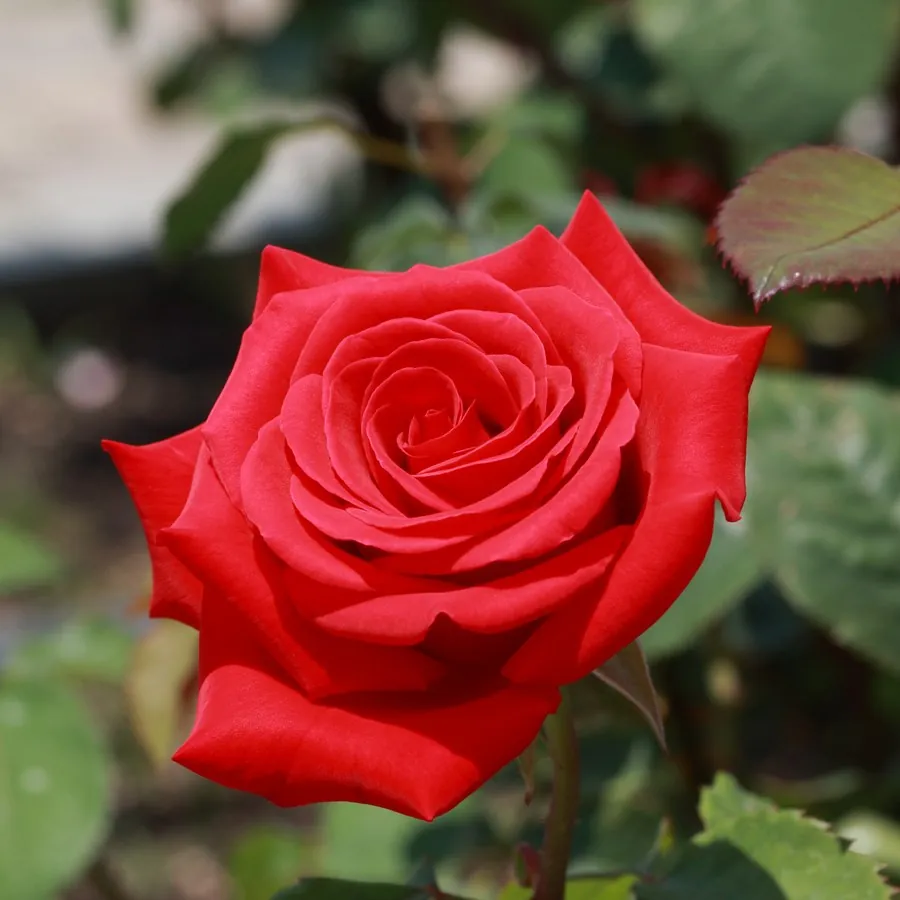

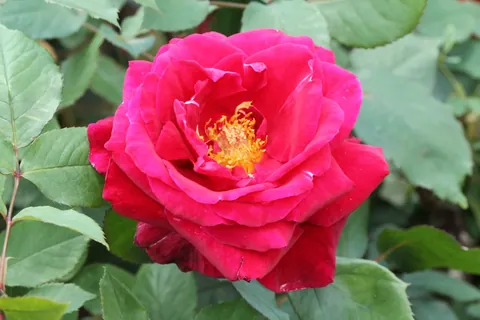
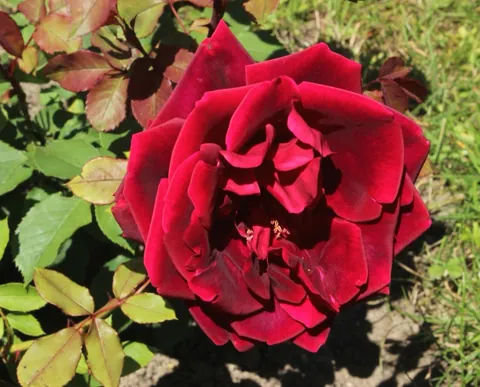





Kardinal, close-up of the flower
Photo: Laitche, CC BY 3.0
Back to catalogue
Hybrid Tea; cut-flower / florist's rose (and for the garden)Reimer Kordes; KordesRed

Kardinal

A bright crimson cut-flower variety (scarlet / cardinal red); a high-centred goblet-shaped flower on a long, strong stem; very disease-resistant; bred for cutting, but it also grows well in the garden.

'Kardinal' = 'Kardinal 85' — one variety

Variety profile

Flowering

Repeat-flowering in flushes; comes into bloom early

Plant size

120–125 × 80 cm
person 170 cm120–125 cm
Habit
Upright, vertical bush
Dimensions
Up to 120–125 × ≈ 80 cm
Support
Usually not needed — the upright bush holds its shape on its own
Shoots
Long, strong stems with solitary flowers — valuable for cutting
Branching
No data

Flower

11–12 cm
Bud shape
Classic elongated, high-centred bud, bright crimson
Open flower
High-centred, goblet-shaped — a show-HT form; diameter 11–12 cm
Centre
Tightly rolled high centre — a typical cut-flower form
Fullness
30–35 petals
Flower carriage
Solitary flowers, on long strong stems — ideal for cutting

Fragrance

Weak, barely noticeable

Weak, barely noticeable. Typical of cut-flower varieties in which a strong scent is deliberately not a priority (for longer vase life).

Disease resistance

5 out of 5
Powdery mildewresistant

Very resistant, 4–5/5, especially to powdery mildew.

Sun

Repeat flowering in flushes

Comes into bloom early.

Thorns

Moderate
thornlessfewmoderatemanyvery many

The bush is upright, with thorns.

Foliage

No data.

All characteristics in a table
Group
Hybrid Tea; cut-flower / florist's rose (and for the garden)
Breeder
Reimer Kordes; Kordes, Germany
Bud shape
Classic elongated, high-centred bud, bright crimson
Open flower
High-centred, goblet-shaped — a show-HT form; diameter 11–12 cm
Centre
Tightly rolled high centre — a typical cut-flower form
Colour
Bright crimson red ('scarlet / cardinal red'). After a few days the colour shifts to raspberry-pink — fresh and faded flowers on the bush differ noticeably in shade
Fullness
30–35 petals
Flower carriage
Solitary flowers, on long strong stems — ideal for cutting
Flowering
Repeat-flowering in flushes; comes into bloom early
Fragrance
Weak, barely noticeable. Typical of cut-flower varieties in which a strong scent is deliberately not a priority (for longer vase life)
Hips
No data
Habit
Upright, vertical bush
Branching
No data
Shoots
Long, strong stems with solitary flowers — valuable for cutting
Thorns
The bush is upright, with thorns.
Dimensions
Up to 120–125 × ≈ 80 cm
Support
Usually not needed — the upright bush holds its shape on its own
Foliage
No data
Resistance
Very resistant, 4–5/5, especially to powdery mildew
Variations of the variety
'Kardinal' and 'Kardinal 85' are ONE variety. The name 'Kardinal' was already taken by an older variety, Krause 1933, so Kordes registered the novelty as 'Kardinal 85'. Do not confuse it with Kardinal Krause 1933. Breeding code KORlingo, patent PP5846

Colour scheme

Bright crimson red ('scarlet / cardinal red'). After a few days the colour shifts to raspberry-pink — fresh and faded flowers on the bush differ noticeably in shade

Rose neighbours

Perennials to plant nearby

Neighbouring roses

Classic bright and crimson red Hybrid Teas — the red family:

Companion perennials

Blue, silver and white — a cool contrast to the crimson:

catmintlamb's eargypsophilasalvia

Family ties

A notable influence on the breeding of red Hybrid Teas:

🌹 Mother of the famous variety Timeless🧬 Parents: Flamingo × seedling

More about the variety

Hips
No data
Variations of the variety
'Kardinal' and 'Kardinal 85' are ONE variety. The name 'Kardinal' was already taken by an older variety, Krause 1933, so Kordes registered the novelty as 'Kardinal 85'. Do not confuse it with Kardinal Krause 1933. Breeding code KORlingo, patent PP5846

How to grow

Where to plant. First and foremost a cut-flower / florist's variety — long, strong stems with solitary flowers are ideal for a bouquet. But it also grows well in the garden: an upright bush up to 120–125 cm holds its shape on its own and usually needs no support. A sunny spot and fertile soil — as for an ordinary Hybrid Tea. The bright red accent works best with cool neighbours — blue, silver and white perennials.

Climate. USDA 6 (per Ukrainian/European data) to 7b (per HelpMeFind), ≈ −18…−23 °C. In Ukraine it needs winter cover; in a container, cover is essential. Blooms repeatedly, in flushes, and comes into bloom early.

Care. Very disease-resistant (4–5/5), especially to powdery mildew — which noticeably simplifies care compared with many older red HTs.

About the name

Name. 'Kardinal' — from the cardinal-red (crimson) colour of the flower.

Breeding. Bred by Reimer Kordes at the Kordes house (Germany), introduced in 1985/1986. Breeding code KORlingo, patent PP5846. Parents: Flamingo × seedling. 'Kardinal' and 'Kardinal 85' are the same variety: the name 'Kardinal' was already taken by an older variety, Kardinal (Krause, 1933), so Kordes registered the novelty as 'Kardinal 85'. Do not confuse the two varieties.

Significance. One of the characteristic bright crimson cut-flower hybrid teas from Kordes in the 1980s. It is the well-known 'mother' of the variety Timeless. According to the available data it has no major official awards (ADR/AARS) — only amateur show distinctions; in form it is a commercial florist's rose rather than an 'award-winning' variety, and it also grows quite successfully in the garden.

Frequently asked questions about Kardinal

How many times a season does Kardinal flower?

Repeat-flowering in flushes; comes into bloom early.

How big does Kardinal grow?

120–125 cm tall, about 80 cm wide.

Which diseases affect Kardinal?

Overall resistance: 5 out of 5. 4–5 / 5; very resistant, especially to powdery mildew.

How much sun does Kardinal need?

Sun; repeat flowering in flushes; comes into bloom early.

What does Kardinal smell like?

Weak, barely noticeable. Typical of cut-flower varieties in which a strong scent is deliberately not a priority (for longer vase life).

Gardeners' photos and reviews

My climate

Choose a reference temperature to compare with the cultivar’s data. This is not an overwintering forecast or advice on winter protection; consider wind, moisture and the duration of frost.

Regional data are generalised. USDA describes average annual extreme minima, not a forecast; the values in the list are rounded. Check the conditions at your site. More information: Roses in Ukraine's climate.