

Back to catalogue
Floribunda; two-tone “chameleon” PoulsenSvend Poulsen; Poulsen Roser A/S, 1958Yellow

Rumba

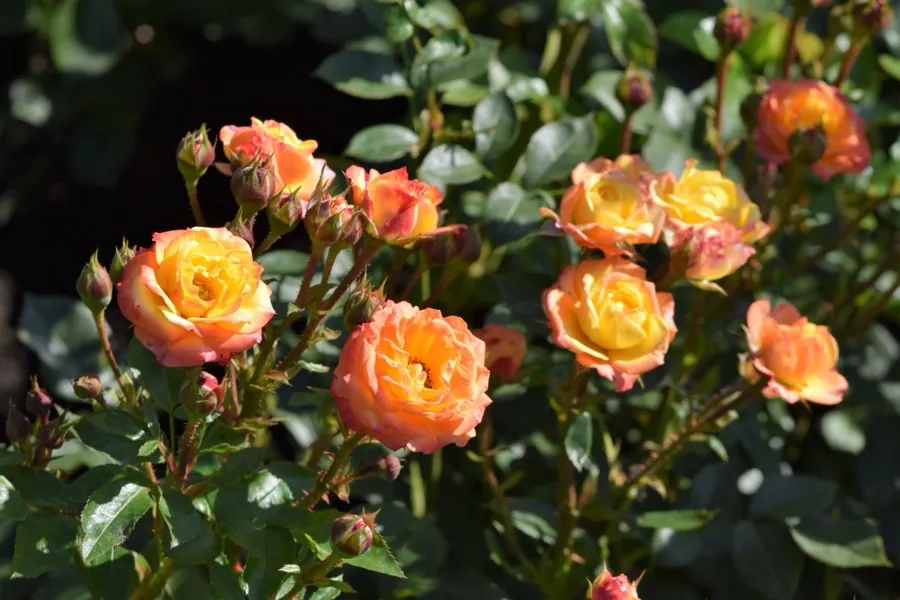
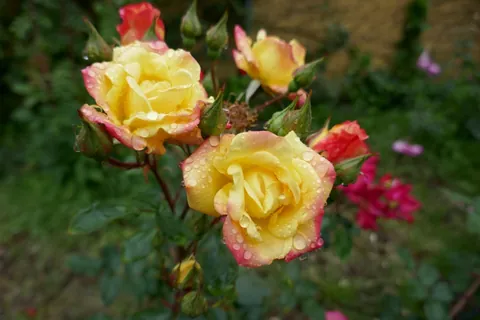
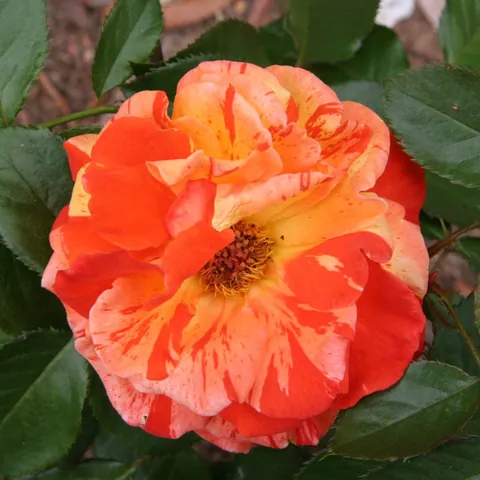
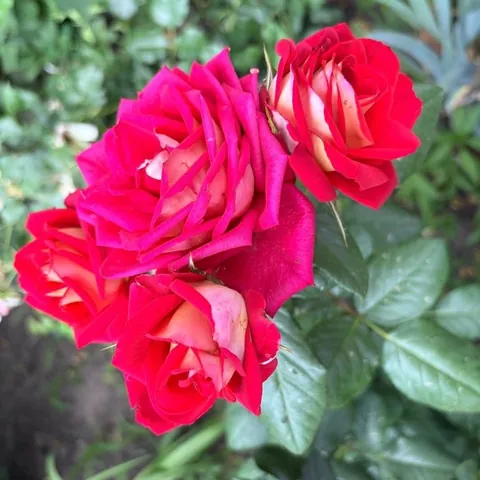
Two-tone “chameleon”: golden-yellow base with a raspberry-red edge; named after the Latin American dance rumba (synonym “Cuba Dance”); the Masquerade parentage — the inherited “chameleon effect” of the classic two-tone variety; NOT an AARS winner (a common myth — none was awarded).

RNRS Certificate of Merit 1959 · 2nd Madrid 1960 · parentage Masquerade

Variety profile

Flowering

Repeat flowering

Repeat-flowering from June to October. Months are approximate, for the climate of Ukraine.

Legacy

RNRS 1959

2nd Madrid 1960 · US PP1919

Winter hardiness

−20 °C

USDA zone 6b–9b. Central/South with cover.

Compare reference temperatures

Plant size

40–70 × 50 cm
person 170 cm40–70 cm
Habit
Low, compact, well branched — a typical Danish Floribunda Poulsen
Dimensions
40–70 cm tall × 50 cm wide — low, ideal for borders
Support
Not needed — self-supporting
Shoots
Medium stiffness
Branching
Well branched

Flower

3–5 cm
Bud shape
Round, with a yellow-orange tint
Open flower
Small full double: 3–5 cm, 35–45 petals, in dense sprays
Centre
Dense, with hidden stamens
Fullness
35–45 petals (full double)
Flower carriage
In sprays of 3–15 flowers — typical for Floribunda

Fragrance

Moderate; spicy

Moderate spicy (spice fragrance) — a rare combination in Floribunda.

Disease resistance

3 out of 5
Black spotmoderate

Good, 3/5 for its age; moderate against black spot; USDA 6b–9b.

Sun

The chameleon effect is brighter in full sun

Thorns

Moderate
thornlessfewmoderatemanyvery many

Medium number of thorns — typical of 1950s Floribundas.

Foliage

Dark green, semi-glossy.

Other names

Cuba Dance, Rhumba
All characteristics in a table
Group
Floribunda; two-tone “chameleon” Poulsen
Breeder
Svend Poulsen; Poulsen Roser A/S, Denmark, 1958
Bud shape
Round, with a yellow-orange tint
Open flower
Small full double: 3–5 cm, 35–45 petals, in dense sprays
Centre
Dense, with hidden stamens
Colour
Two- or three-tone “chameleon”: golden-yellow base with a raspberry-red edge to the petals. The flower opens with a yellow centre, then reddens along the edges — the chameleon effect as in Masquerade
Fullness
35–45 petals (full double)
Flower carriage
In sprays of 3–15 flowers — typical for Floribunda
Flowering
Repeat-flowering from June to October
Fragrance
Moderate spicy (spice fragrance) — a rare combination in Floribunda
Hips
Not documented — usually cut
Habit
Low, compact, well branched — a typical Danish Floribunda Poulsen
Branching
Well branched
Shoots
Medium stiffness
Thorns
Medium number of thorns — typical of 1950s Floribundas.
Dimensions
40–70 cm tall × 50 cm wide — low, ideal for borders
Support
Not needed — self-supporting
Foliage
Dark green, semi-glossy
Resistance
Good, 3/5 for its age; moderate against black spot; USDA 6b–9b
Variations of the variety
Code POULrum. Synonyms: Cuba Dance, Rhumba. Introduced 1958 (Denmark), 1959 (UK), 1961 (Australia), 1962 (USA). Parentage: 'Masquerade' × ('Poulsen's Bedder' × 'Floradora') — the chameleon effect is inherited from Masquerade

Colour scheme

Two- or three-tone “chameleon”: golden-yellow base with a raspberry-red edge to the petals. The flower opens with a yellow centre, then reddens along the edges — the chameleon effect as in Masquerade

Rose neighbours

Perennials to plant nearby

Neighbouring roses

'Chameleon' and the two-tone family:

Perennial companions

A sunny palette with violet accents:

coreopsislavenderStachys (lamb's ears)sedum (stonecrop)

Availability worldwide

A classic, but less common today:

🇩🇰 Denmark: high · Poulsen home country🇪🇺 Europe: moderate · 'retro' segment🇺🇸 USA: moderate🇺🇦 Ukraine: rare · collectors' nurseries

More about the variety

Hips
Not documented — usually cut
Variations of the variety
Code POULrum. Synonyms: Cuba Dance, Rhumba. Introduced 1958 (Denmark), 1959 (UK), 1961 (Australia), 1962 (USA). Parentage: 'Masquerade' × ('Poulsen's Bedder' × 'Floradora') — the chameleon effect is inherited from Masquerade

How to grow

Where to plant. In low borders, thanks to its height of 40–70 cm; in “carnival” beds alongside Masquerade; in a “Latin American” corner of the garden as a tribute to the dance.

Climate. Central/South Ukraine with cover (USDA 6b); copes well with summer heat.

Care. Full sun; moderate disease prevention; feed 2× per season; prune ⅓ in spring.

About the name

Name. “Rumba” — from the Latin American dance rumba, which originates in Cuba (hence the synonym “Cuba Dance”). The name conveys the “fiery” yellow-red character of the variety, its colours shifting like a passionate dance. The poetic Danish tradition of Poulsen naming varieties after dances and music (Rumba, Tango).

Breeding. Bred by Svend Poulsen at Poulsen Roser A/S (Denmark), one of the leading Scandinavian rose nurseries. Code POULrum. Introduced 1958 in Denmark, 1959 (UK), 1961 (Australia), 1962 (USA). Parentage: 'Masquerade' × ('Poulsen's Bedder' × 'Floradora'). From its mother, Masquerade (Boerner 1949), it received its characteristic yellow-orange-red colouring with a transition — the “chameleon effect”.

Significance. RNRS Certificate of Merit 1959 + Trial Ground Certificate 1959 (UK) + 2nd Certificate Madrid 1960. US Plant Patent PP1919 (1960). An important correction: information about an AARS 1963 is NOT confirmed (a common myth in catalogues). In 1963 the AARS winners were Royal Highness, Tropicana and King's Ransom — not Rumba. There is also no information about Portland/Geneva/Belfast Gold in reliable sources. A classic example of mid-twentieth-century Danish breeding. Its spicy scent is a rare combination in Floribunda. Today it is less common and is valued by collectors as a typical example of the “Masquerade family” of varieties.

Frequently asked questions about Rumba

Does Rumba need winter protection?

The cultivar’s reference temperature is −20 °C (USDA zone 6b–9b). Overwintering depends on the conditions. Central/South with cover.

How many times a season does Rumba flower?

Repeat-flowering from June to October.

How big does Rumba grow?

40–70 cm tall, about 50 cm wide.

Which diseases affect Rumba?

Overall resistance: 3 out of 5. Good for its age; moderate against black spot.

How much sun does Rumba need?

Sun; the chameleon effect is brighter in full sun.

What does Rumba smell like?

Moderate spicy (spice fragrance) — a rare combination in Floribunda.

Gardeners' photos and reviews

My climate

Choose a reference temperature to compare with the cultivar’s data. This is not an overwintering forecast or advice on winter protection; consider wind, moisture and the duration of frost.

Regional data are generalised. USDA describes average annual extreme minima, not a forecast; the values in the list are rounded. Check the conditions at your site. More information: Roses in Ukraine's climate.