


Back to catalogue
Floribunda; garden roseEugene S. Boerner; Jackson & Perkins, 1949Yellow

Masquerade

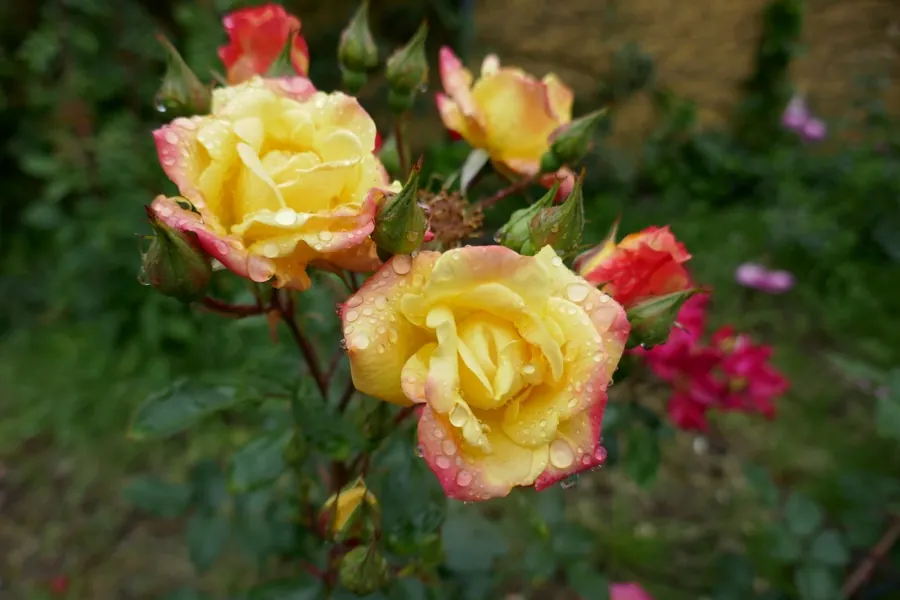
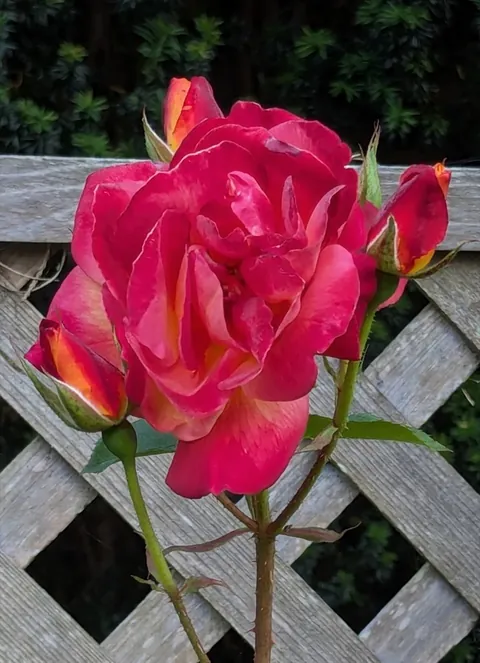
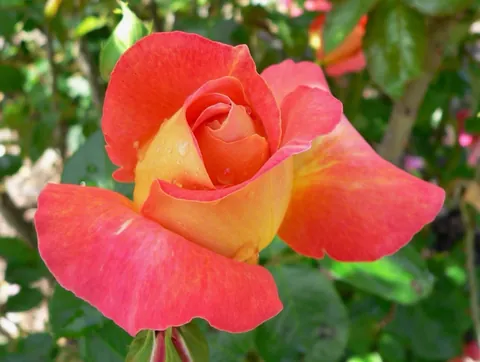
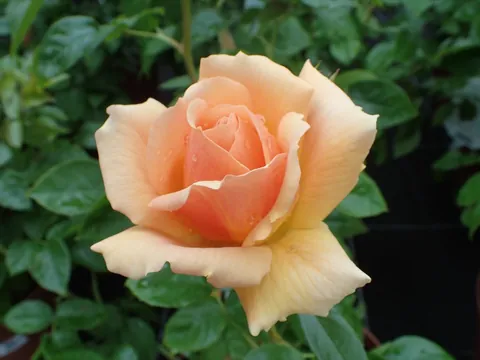
The famous 'masquerade effect' — 3 colours at once on one bush: canary yellow – coral-pink – dark cherry; RNRS Gold Medal 1952; the founder of a whole line of 'carnival' bicolour roses.

US PP 975 · progenitor of the 'masquerade effect'

Variety profile

Flowering

Repeat flowering

Repeat-flowering, abundant, through the season from June to the first frosts. Months are approximate, for the climate of Ukraine.

Awards

RNRS Gold 1952

NOT an AARS (a common mistake!)

Winter hardiness

−23 °C

USDA zone 5b–9b. All of Ukraine with moderate winter cover.

Compare reference temperatures

Plant size

75–90 × 60–75 cm
person 170 cm75–90 cm
Habit
Upright, bushy, compact, vigorous — a typical Floribunda of the 1940s
Dimensions
75–90 × 60–75 cm; in a mild climate up to 100–120 cm
Support
Does not need support (for the bush form); Climbing Masquerade — a Dillon 1958 sport, needs support
Shoots
Sturdy, straight, medium length
Branching
Good, from the base

Flower

≈ 6 cm

About 17 petals (semi-double; HMF gives a range of 15–20) petals.

Bud shape
Round, canary yellow, golden
Open flower
Semi-double to double, open, with visible stamens; a typical Floribunda XX-century variety
Centre
Warm golden yellow – turning coral-pink over time – dark cherry
Fullness
About 17 petals (semi-double; HMF gives a range of 15–20)
Flower carriage
In large clusters of 5–25 flowers — typical for Floribundas, but the clusters are especially abundant

Fragrance

Light; fruity notes

Light — weak fruity notes; this is NOT a fragrant variety, the emphasis is on colour.

Disease resistance

4 out of 5

Historically 'very disease resistant' — this is a 1949 variety; for a modern garden roughly 3–4/5; needs watching for black spot in wet seasons.

Sun

Full sun to bring out the 'masquerade effect'

Thorns

Moderate
thornlessfewmoderatemanyvery many

Average number of thorns, typical of Floribundas.

Foliage

Dark green, leathery, glossy.

All characteristics in a table
Group
Floribunda; garden rose
Breeder
Eugene S. Boerner; Jackson & Perkins, USA, 1949
Bud shape
Round, canary yellow, golden
Open flower
Semi-double to double, open, with visible stamens; a typical Floribunda XX-century variety
Centre
Warm golden yellow – turning coral-pink over time – dark cherry
Colour
The famous 'masquerade effect': 3 stages on one bush: 1⃣ bud / young flower: canary yellow, golden 2⃣ open flower: salmon / coral-pink with a yellow centre 3⃣ ageing flower: dark cherry, crimson-red. Yellow, pink and red are visible together in one cluster.
Fullness
About 17 petals (semi-double; HMF gives a range of 15–20)
Flower carriage
In large clusters of 5–25 flowers — typical for Floribundas, but the clusters are especially abundant
Flowering
Repeat-flowering, abundant, through the season from June to the first frosts
Fragrance
Light — weak fruity notes; this is NOT a fragrant variety, the emphasis is on colour
Hips
Produces rose hips — unusual for most Floribundas
Habit
Upright, bushy, compact, vigorous — a typical Floribunda of the 1940s
Branching
Good, from the base
Shoots
Sturdy, straight, medium length
Thorns
Average number of thorns, typical of Floribundas.
Dimensions
75–90 × 60–75 cm; in a mild climate up to 100–120 cm
Support
Does not need support (for the bush form); Climbing Masquerade — a Dillon 1958 sport, needs support
Foliage
Dark green, leathery, glossy
Resistance
Historically 'very disease resistant' — this is a 1949 variety; for a modern garden roughly 3–4/5; needs watching for black spot in wet seasons
Variations of the variety
US PP 975 (29 August 1950 — one of the earliest rose patents in the USA). Sport: Climbing Masquerade (Dillon 1958) — a climber up to 3 m × 2 m, the same flowers, repeat-flowering. Parentage: 'Goldilocks' (FL Boerner 1945) × 'Holiday' (FL Boerner 1948) — both parents are also Boerner roses

Colour scheme

The famous 'masquerade effect': 3 stages on one bush: 1⃣ bud / young flower: canary yellow, golden 2⃣ open flower: salmon / coral-pink with a yellow centre 3⃣ ageing flower: dark cherry, crimson-red. Yellow, pink and red are visible at the same time in one cluster.

Rose neighbours

Perennials to plant nearby

Neighbouring roses

'Carnival' family — multicolour and tricolour varieties in the Masquerade legacy:

Companion perennials

A warm 'autumn' family — it brings out the 3-phase palette:

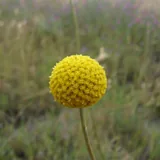
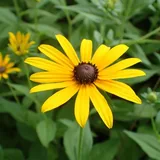
craspediarudbeckiasage (Salvia)soft lady's mantle (Alchemilla)

Availability worldwide

A classic from 1949 — still in nursery catalogues after 75+ years:

🇬🇧 UK: high · Peter Beales, Trevor White🇦🇺 Australia: high · Hazlewood🇺🇸 USA: moderate · via intermediaries🇺🇦 Ukraine: moderate · as a 'classic'

More about the variety

Hips
Produces rose hips — unusual for most Floribundas
Variations of the variety
US PP 975 (29 August 1950 — one of the earliest rose patents in the USA). Sport: Climbing Masquerade (Dillon 1958) — a climber up to 3 m × 2 m, the same flowers, repeat-flowering. Parentage: 'Goldilocks' (FL Boerner 1945) × 'Holiday' (FL Boerner 1948) — both parents are also Boerner roses

How to grow

Where to plant. As a specimen for a bright effect (3 colours at once); a mixed border in warm tones; the front of a compact bush (75–90 cm). Climbing-form Dillon 1958 — for arches and pergolas (3 m).

Climate. To −23 °C — all of Ukraine with moderate winter cover; the south without cover. USDA 5b–9b.

Care. Classic Floribunda — spring pruning; do not remove spent flowers — this spoils the 'masquerade effect' (the red flowers are part of the charm); seasonal protection against black spot.

About the name

Name. 'Masquerade' — 'masquerade ball', from the Italian 'mascherata' — a carnival with masks. The idea of the name: the flowers on one bush 'wear different masks' at the same time — a golden bud, a pink young flower, a red old one. This is the 'masquerade effect' — the phenomenon of a gradual colour change without wilting, which Boerner fixed genetically in this very variety.

Breeding. Bred by Eugene S. Boerner at Jackson & Perkins Co. (USA), released in 1949. Introduced to Australia by Hazlewood Bros., 1952. US PP 975 from 29 August 1950 — one of the earliest patented rose varieties in the USA. Parentage: 'Goldilocks' (FL Boerner 1945) × 'Holiday' (FL Boerner 1948) — both parents are also Boerner roses. Eugene Sydnor Boerner (1893–1966) — the 'father of modern Floribundas', a J&P breeder, who received 11 AARS awards over his career (but NOT for this variety).

Significance. RNRS Gold Medal 1952 (Royal National Rose Society UK) — confirmed. IMPORTANT CORRECTION: many online descriptions wrongly credit it with an AARS — Masquerade was NOT an AARS winner; Boerner received 11 AARS over his career, but this particular variety was not among them. It started a whole line of 'carnival' roses — later Masquerade-type varieties came from it (Joseph's Coat 1964, Charisma — related in concept). The 'masquerade effect' as a term in rose breeding is the same phenomenon that Boerner fixed genetically in this variety. Climbing Masquerade (Dillon 1958) — a climbing sport, now more popular than the bush form on the UK market. A replacement for the non-existent 'Mini Baby Masquerade' (the 11th phantom in our catalogue) — Mini Baby Masquerade does not exist; Baby Masquerade (Tantau 1955) is a miniature version, also a separate variety. Here we took the original 1949 progenitor. The 2nd Boerner work in our catalogue (alongside Aloha 1949 — also Boerner, also 1949).

Frequently asked questions about Masquerade

Does Masquerade need winter protection?

The cultivar’s reference temperature is −23 °C (USDA zone 5b–9b). Overwintering depends on the conditions. All of Ukraine with moderate winter cover.

How many times a season does Masquerade flower?

Repeat-flowering, abundant, through the season from June to the first frosts.

How big does Masquerade grow?

75–90 cm tall, 60–75 cm wide.

Which diseases affect Masquerade?

Overall resistance: 4 out of 5. 3–4 / 5; historically 'very disease resistant'; now moderately good.

How much sun does Masquerade need?

Sun; full sun to bring out the 'masquerade effect'.

What does Masquerade smell like?

Light — weak fruity notes; this is NOT a fragrant variety, the emphasis is on colour.

Gardeners' photos and reviews

My climate

Choose a reference temperature to compare with the cultivar’s data. This is not an overwintering forecast or advice on winter protection; consider wind, moisture and the duration of frost.

Regional data are generalised. USDA describes average annual extreme minima, not a forecast; the values in the list are rounded. Check the conditions at your site. More information: Roses in Ukraine's climate.