


Back to catalogue
Shrub / Bodendecker; yellow ground-hugging 'parasol'Hans-Jürgen Evers; Rosen TantauYellow

Sonnenschirm

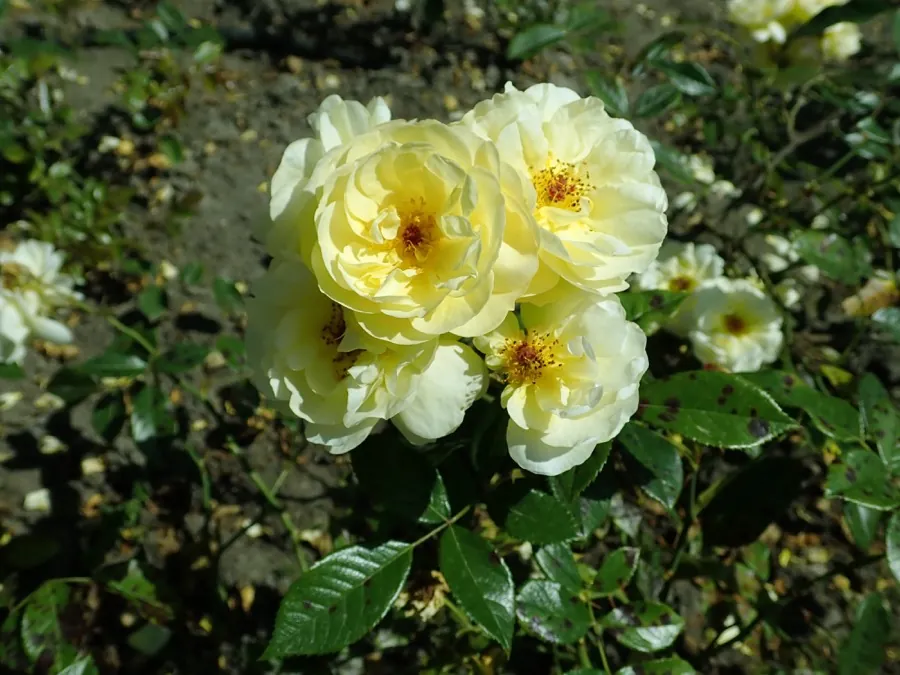
Lemon-yellow groundcover with a rounded 'parasol' crown; President's International Trophy RNRS 1995 (UK); self-cleaning — it sheds spent flowers by itself and needs no deadheading; bred by Hans-Jürgen Evers (Tantau), the same breeder who created Santana.

President's International Trophy (RNRS UK) 1995 · one of the early self-cleaning roses

Variety profile

Flowering

Generous repeat flowering — and 'self-cleaning': spent petals drop off by themselves, so the bush does not look untidy

Legacy

PIT 1995

+ self-cleaning

Winter hardiness

−23 °C

USDA zone 6b. Central Ukraine, with mulch on high ground.

Compare reference temperatures

Plant size

50–80 × 70–150 cm
person 170 cm50–80 cm
Habit
'parasol': a rounded, spreading crown wider than it is tall — hence the name Sonnenschirm
Dimensions
50–80 cm tall × 70–150 cm wide — spreads to 1.5 m, staying low like a 'parasol'
Support
Not needed — self-supporting
Shoots
Flexible, trailing over the ground
Branching
Densely branched, with horizontal, arching shoots

Flower

≈ 7 cm

25-33 petals.

Bud shape
Round, golden
Open flower
Semi-double, cupped: ~7 cm, 25–33 petals
Centre
Stamens visible when open
Fullness
25–33 petals (semi-double)
Flower carriage
In large clusters — creates a sunny yellow carpet

Fragrance

None or very light

None or very light — typical of landscape self-cleaning varieties.

Disease resistance

3 out of 5

Moderate, 3/5; susceptible to leaf spotting — needs a sunny, airy spot. USDA 6b — central Ukraine, no winter protection in low spots under snow; on high ground, a light mulch.

Sun

Sun and good air circulation

Thorns

Few
thornlessfewmoderatemanyvery many

Few prickles — typical of Tantau's landscape groundcover roses.

Foliage

Dark green, semi-glossy.

All characteristics in a table
Group
Shrub / Bodendecker; yellow ground-hugging 'parasol'
Breeder
Hans-Jürgen Evers; Rosen Tantau, Germany
Bud shape
Round, golden
Open flower
Semi-double, cupped: ~7 cm, 25–33 petals
Centre
Stamens visible when open
Colour
Bright lemon-yellow; fades a little in the heat, richer golden in autumn
Fullness
25–33 petals (semi-double)
Flower carriage
In large clusters — creates a sunny yellow carpet
Flowering
Generous repeat flowering — and 'self-cleaning': spent petals drop off by themselves, so the bush does not look untidy
Fragrance
None or very light — typical of landscape self-cleaning varieties
Hips
Not formed — energy goes into repeat flowering
Habit
'parasol': a rounded, spreading crown wider than it is tall — hence the name Sonnenschirm
Branching
Densely branched, with horizontal, arching shoots
Shoots
Flexible, trailing over the ground
Thorns
Few prickles — typical of Tantau's landscape groundcover roses.
Dimensions
50–80 cm tall × 70–150 cm wide — spreads to 1.5 m, staying low like a 'parasol'
Support
Not needed — self-supporting
Foliage
Dark green, semi-glossy
Resistance
Moderate, 3/5; susceptible to leaf spotting — needs a sunny, airy spot. USDA 6b — central Ukraine, no winter protection in low spots under snow; on high ground, a light mulch
Variations of the variety
Code TANmirsch. Bred 1988, commercial introduction around 1993 through Rosen Tantau. Breeder: Hans-Jürgen Evers — the same breeder who later created Tantau's iconic ADR-varieties. Do not confuse with KORparas or other yellow groundcover roses from Kordes — Tantau Sonnenschirm is the only variety with this name

Colour scheme

Bright lemon-yellow; fades a little in the heat, richer golden in autumn

Rose neighbours

Perennials to plant nearby

Neighbouring roses

Yellow genealogy + white contrasts — a sunny mixed border:

Perennial companions

Purple-blue contrasts — they bring out the yellow:

lavendersalviaornamental grassessedum

Availability worldwide

Classic Tantau ground-cover rose with PIT certificate:

🇩🇪 Germany: high · home country🇬🇧 UK: high · via PIT 1995🇪🇺 Europe: high🇺🇦 Ukraine: moderate

More about the variety

Hips
Not formed — energy goes into repeat flowering
Variations of the variety
Code TANmirsch. Bred 1988, commercial introduction around 1993 through Rosen Tantau. Breeder: Hans-Jürgen Evers — the same breeder who later created Tantau's iconic ADR-varieties. Do not confuse with KORparas or other yellow groundcover roses from Kordes — Tantau Sonnenschirm is the only variety with this name

How to grow

Where to plant. In groups at the front of a bed; along paths as a low yellow edging; on slopes to hold the soil; in mixed borders as a 'sunny' lower layer; its self-cleaning habit makes it ideal for public spaces — it needs no deadheading.

Climate. Central Ukraine, no winter protection in low-lying spots; on high ground, a light mulch (USDA 6b); in southern regions, morning watering is important (to prevent spotting).

Care. Minimal — sun and good air circulation; prune with secateurs once every 2–3 years; feed 1–2× per season; no deadheading needed thanks to its self-cleaning quality.

About the name

Name. 'Sonnenschirm' = 'Parasol, sunshade' (German). The name describes the rounded, spreading crown of the bush, which resembles a parasol above the ground. The lemon-yellow colour of the flower and its 'parasol' shape are like the bright summer sun over a veranda.

Breeding. Bred by Hans-Jürgen Evers at Rosen Tantau (Uetersen, Germany). Code TANmirsch. Bred 1988, commercial introduction around 1993. Parentage: undisclosed seedlings from the breeder's private collection. Hans-Jürgen Evers is the same breeder who created the iconic Santana (1985) for Tantau and later the ADR-varieties.

Significance. President's International Trophy RNRS 1995 — a prestigious British award from the Royal National Rose Society. One of the early 'self-cleaning' roses of its era: spent petals drop off by themselves, and the bush looks tidy without intervention. This is a property that Tantau later scaled up across its whole landscape series. The 'parasol' crown is a rare form among modern roses, spreading two to three times wider than it is tall. The lemon-yellow colour is a neutral yellow that does not fade to white, unlike many modern yellows. It does not appear on the official ADR list — do not confuse it with other yellow Tantau roses (Bienenweide Gelb, etc.). Susceptible to leaf spotting — it needs a sunny spot with good air circulation.

Frequently asked questions about Sonnenschirm

Does Sonnenschirm need winter protection?

The cultivar’s reference temperature is −23 °C (USDA zone 6b). Overwintering depends on the conditions. Central Ukraine, with mulch on high ground.

How many times a season does Sonnenschirm flower?

Generous repeat flowering — and 'self-cleaning': spent petals drop off by themselves, so the bush does not look untidy.

How big does Sonnenschirm grow?

50–80 cm tall, 70–150 cm wide.

Which diseases affect Sonnenschirm?

Overall resistance: 3 out of 5. Needs sun and air circulation; spotting is possible.

How much sun does Sonnenschirm need?

Sun; sun and good air circulation.

What does Sonnenschirm smell like?

None or very light — typical of landscape self-cleaning varieties.

Gardeners' photos and reviews

My climate

Choose a reference temperature to compare with the cultivar’s data. This is not an overwintering forecast or advice on winter protection; consider wind, moisture and the duration of frost.

Regional data are generalised. USDA describes average annual extreme minima, not a forecast; the values in the list are rounded. Check the conditions at your site. More information: Roses in Ukraine's climate.