



Back to catalogue
Gallica; old garden roseLilac and purple

Charles de Mills

Synonyms: Charles Wills; Bizarre Triomphant; one of the most ornamental historic Gallica varieties.

Old Garden Rose · Provins · WFRS Old Rose Hall of Fame 2015

Variety profile

Flowering

Once-flowering

Once-flowering — a powerful burst lasting 4–6 weeks in late spring/early summer. Months are approximate, for the climate of Ukraine.

Awards

WFRS HoF 2015

Old Rose Hall of Fame · RHS AGM

Winter hardiness

−34 °C

USDA zone 4–8. Ideal for all of Ukraine, including the coldest regions.

Compare reference temperatures

Plant size

100–150 × 120–150 cm
person 170 cm100–150 cm
Habit
Upright, but the flexible stems bend heavily under the weight of the flowers — needs light support
Dimensions
100–150 cm tall × 120–150 cm wide
Support
Light support is advisable — the shoots droop heavily under the weight of the full rosettes; a ring support or a light trellis helps keep the shape
Shoots
Flexible, not very stiff; on own roots it may produce suckers (root shoots)
Branching
Moderate; the bush becomes dense with age

Flower

10–12 cm
Bud shape
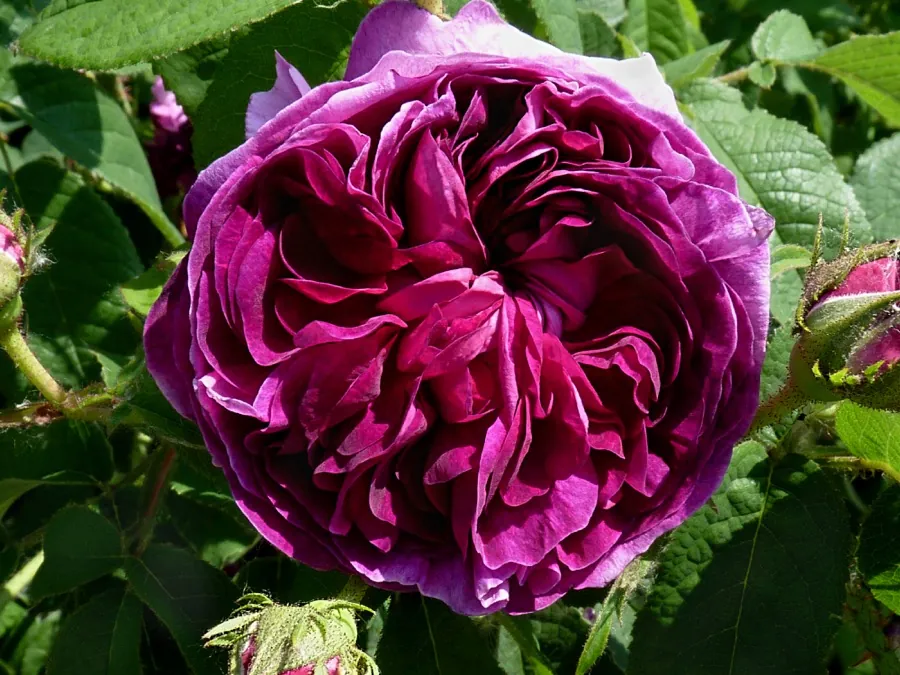
Rounded, dark cherry with a purple tint
Open flower
Quartered and flat, as if cut with a knife ('cut-quartered'); diameter 10–12 cm
Centre
Deep rosette with petals folded into squares; occasionally a green 'eye' shows through
Fullness
Very double — 80–200 petals (according to different sources)
Flower carriage
Mostly large flowers borne singly on each stem

Fragrance

Strong

Strong, classic Damask-Gallica — rich, honey-sweet, with musky and fruity notes.

Disease resistance

4 out of 5
Black spotresistantPowdery mildewresistantRustresistant

Very hardy; resistant to black spot; rarely affected by powdery mildew; resistant to rust.

Sun

Sun or part shade

The only one of the five that tolerates partial shade well; the colour is brighter in sun.

Thorns

Few
thornlessfewmoderatemanyvery many

Almost thornless — an unusual advantage for a Gallica.

Foliage

Matt green, somewhat coarse, with the typical Gallica texture.

All characteristics in a table
Group
Gallica; old garden rose
Bud shape
Rounded, dark cherry with a purple tint
Open flower
Quartered and flat, as if cut with a knife ('cut-quartered'); diameter 10–12 cm
Centre
Deep rosette with petals folded into squares; occasionally a green 'eye' shows through
Colour
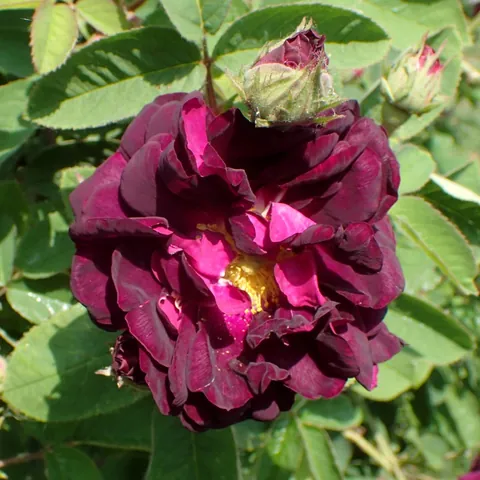
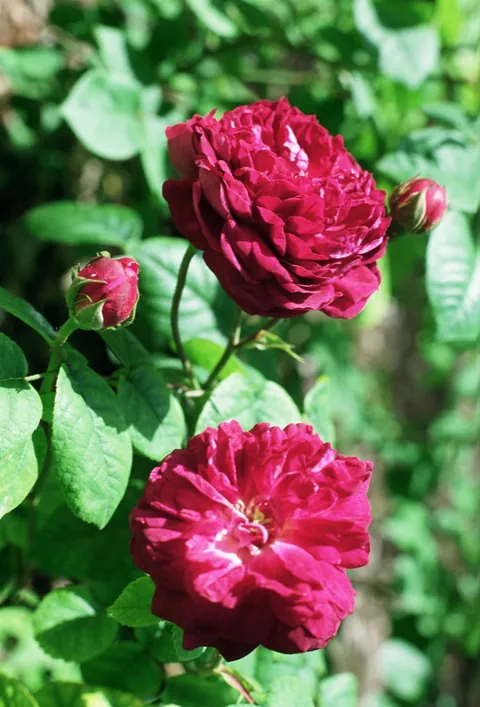
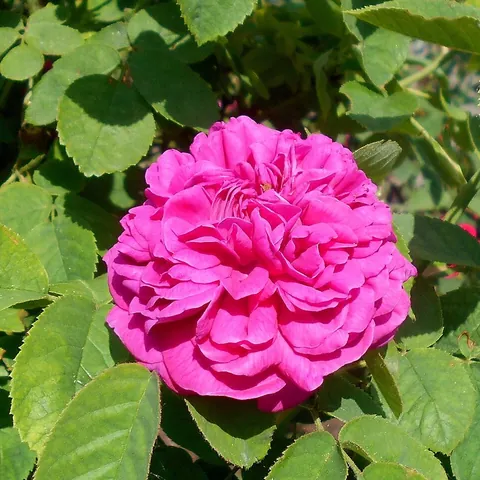
One of the darkest of the Gallicas — deep purple-crimson; with age it turns mauve, plum-violet with a purple-grey tint
Fullness
Very double — 80–200 petals (according to different sources)
Flower carriage
Mostly large flowers borne singly on each stem
Flowering
Once-flowering — a powerful burst lasting 4–6 weeks in late spring/early summer
Fragrance
Strong, classic Damask-Gallica — rich, honey-sweet, with musky and fruity notes
Hips
Produces small dark red hips, but rarely because of the high doubleness
Habit
Upright, but the flexible stems bend heavily under the weight of the flowers — needs light support
Branching
Moderate; the bush becomes dense with age
Shoots
Flexible, not very stiff; on own roots it may produce suckers (root shoots)
Thorns
Almost thornless — an unusual advantage for a Gallica.
Dimensions
100–150 cm tall × 120–150 cm wide
Support
Light support is advisable — the shoots droop heavily under the weight of the full rosettes; a ring support or a light trellis helps keep the shape
Foliage
Matt green, somewhat coarse, with the typical Gallica texture
Resistance
Very hardy; resistant to black spot; rarely affected by powdery mildew; resistant to rust
Variations of the variety
Often confused with 'Cardinal de Richelieu' and 'Tuscany Superb' — these are different Gallicas with a similar colour range

Colour scheme

One of the darkest of the Gallicas — deep purple-crimson; with age it turns mauve, plum-violet with a purple-grey tint

Rose neighbours

Perennials to plant nearby

Neighbouring roses

Other old garden roses in a rich wine-purple palette — for a romantic historic garden:

Companion perennials

Soft yellowish and white tones — to lighten the dark purple mass of the rose:

soft lady's mantle (Alchemilla)white foxglovewoodland sagecatmint

Contrasting accents

Silver foliage and white flowers — to 'lighten' the dark purple:

white dittany (Dictamnus albus)white phloxartemisia 'Powis Castle'gypsophila

More about the variety

Hips
Produces small dark red hips, but rarely because of the high doubleness
Variations of the variety
Often confused with 'Cardinal de Richelieu' and 'Tuscany Superb' — these are different Gallicas with a similar colour range

How to grow

Where to plant. Historic gardens, monastery gardens, the centre of a romantic border; one of the few roses that copes well with partial shade under trees.

Climate. To −34 °C — ideal for all of Ukraine's climate zones, including the Sumy and Chernihiv regions and the Carpathians. Needs no winter cover.

Care. Minimal — old Gallica varieties are naturally sturdy. Only sanitary pruning after flowering; formative pruning is not needed. Remove suckers on own-root plants.

About the name

Name. Probably a distortion of the surname of the Englishman Charles Mills, who acquired the variety in France. Alternative version: a reference to some patron (person not identified).

Breeding. Breeder unknown — probably of Dutch origin. First mention in the Dresden catalogue of 1786; the name 'Charles de Mills' is recorded from 1844–1845. The often-cited year '1746' is a legend, not documented. Belongs to the Gallica group (Provins rose) — the oldest cultivated class of roses.

Significance. WFRS Old Rose Hall of Fame 2015 — worldwide recognition among old roses. One of the best-known and most ornamental historic varieties. Celebrated in the XIX century by Gertrude Jekyll and William Robinson. Often cited as a symbol of old-fashioned gardening. Holds the RHS Award of Garden Merit. Grown in monastery gardens for centuries before that.

Frequently asked questions about Charles de Mills

Does Charles de Mills need winter protection?

The cultivar’s reference temperature is −34 °C (USDA zone 4–8). Overwintering depends on the conditions.

How many times a season does Charles de Mills flower?

Once-flowering — a powerful burst lasting 4–6 weeks in late spring/early summer.

How big does Charles de Mills grow?

100–150 cm tall, 120–150 cm wide.

Which diseases affect Charles de Mills?

Overall resistance: 4 out of 5. Typical Gallica resistance; resistant to black spot, occasionally affected by powdery mildew.

How much sun does Charles de Mills need?

Sun or part shade; the only one of the five that tolerates partial shade well; the colour is brighter in sun.

What does Charles de Mills smell like?

Strong, classic Damask-Gallica — rich, honey-sweet, with musky and fruity notes.

Gardeners' photos and reviews

My climate

Choose a reference temperature to compare with the cultivar’s data. This is not an overwintering forecast or advice on winter protection; consider wind, moisture and the duration of frost.

Regional data are generalised. USDA describes average annual extreme minima, not a forecast; the values in the list are rounded. Check the conditions at your site. More information: Roses in Ukraine's climate.