



Back to catalogue
English Shrub Rose / English Musk Rose; ideal symmetrical rosetteDavid Austin; David Austin RosesWhite and cream

Tranquillity

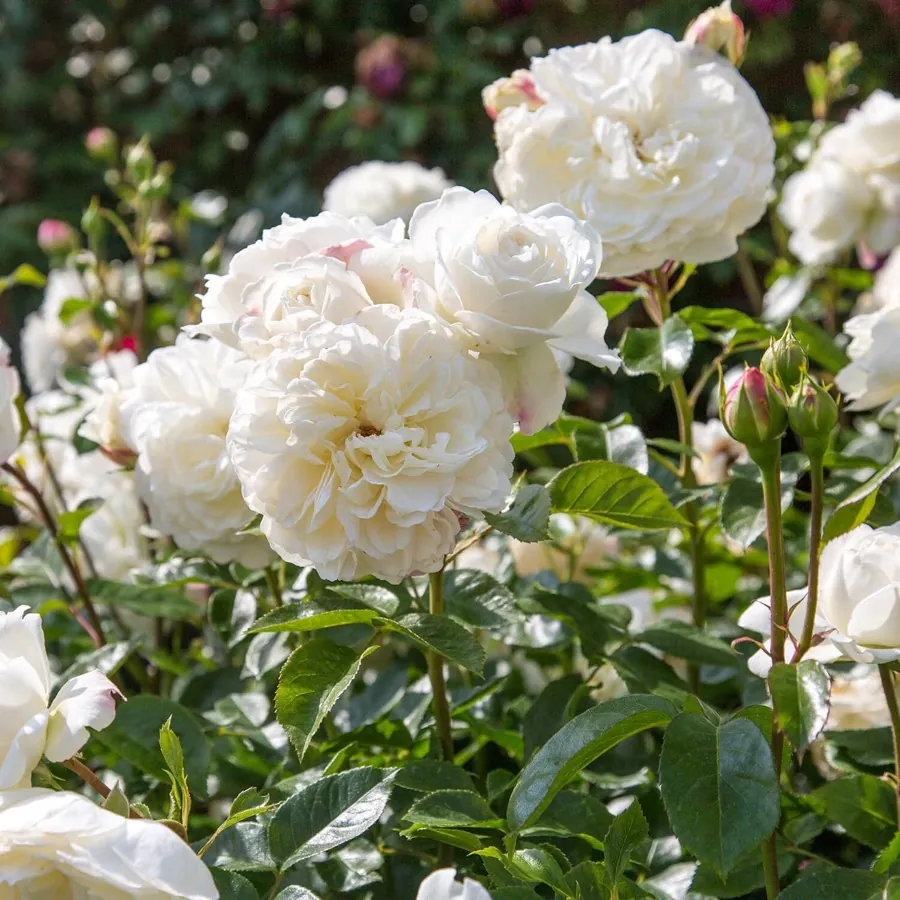
Buds with a soft yellow tint — pure white flowers with an ideal symmetrical rosette; belongs to the English Musk Roses Austin series, which the breeder regarded as the “most perfect in flower form” of all English Roses; every petal lies geometrically even — an “almost flawless example of symmetry”; fragrance — fruity with notes of apple.

US Patent PP25063 · English Musk Roses series — Austin's 'most perfect form'

Variety profile

Flowering

Repeat flowering

Generous repeat flowering from June to October. Months are approximate, for the climate of Ukraine.

Legacy

English Musk

Austin's 'most perfect form'

Winter hardiness

−29 °C

USDA zone 5-11. RHS H6; Ukraine with light protection. RHS H6 · Ukraine with light winter protection.

Compare reference temperatures

Plant size

120 × 90 cm
person 170 cm120 cm
Habit
Upright, compact — typical English Musk Rose
Dimensions
~120 × 90 cm (4 ft × 4 ft) — compact, for small beds and borders
Support
Not needed — self-supporting
Shoots
Medium stiffness
Branching
Well branched

Flower

≈ 9 cm

~110 petals (very full, HMF — “41+”) petals.

Bud shape
Round, with a soft yellow tint — a characteristic contrast
Open flower
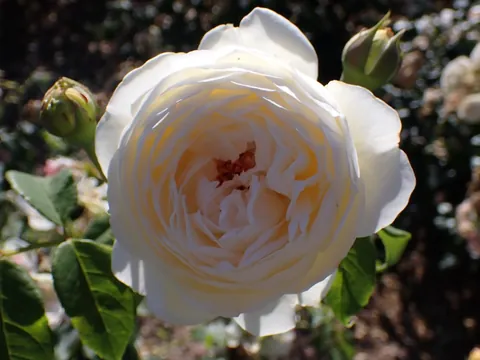
Ideal symmetrical rosette: ~9 cm (3.5″), ~110 petals. Austin considered this variety an “almost flawless” example of symmetry — every petal lies geometrically even
Centre
Tightly closed, with symmetrically folded inner petals
Fullness
~110 petals (very full, HMF — “41+”)
Flower carriage
Singly or in small clusters

Fragrance

Light; fruity with apple

Light, fruity with a note of apple. Confirmed by David Austin and HMF. NOT grape — this is a common myth in secondary catalogues.

Disease resistance

4 out of 5

Good 4/5 — typical of modern English Musk Roses. USDA 5-11, RHS H6 (−20…−15 °C) — in Ukraine it overwinters with light protection.

Sun

Full sun

Thorns

Few
thornlessfewmoderatemanyvery many

Almost thornless — a rarity for Austins.

Foliage

Dark green, semi-glossy.

All characteristics in a table
Group
English Shrub Rose / English Musk Rose; ideal symmetrical rosette
Breeder
David Austin; David Austin Roses, United Kingdom
Bud shape
Round, with a soft yellow tint — a characteristic contrast
Open flower
Ideal symmetrical rosette: ~9 cm (3.5″), ~110 petals. Austin considered this variety an “almost flawless” example of symmetry — every petal lies geometrically even
Centre
Tightly closed, with symmetrically folded inner petals
Colour
Pure white; the bud has a soft yellow tint — it opens into pure white. Does not yellow or grey at the end of flowering
Fullness
~110 petals (very full, HMF — “41+”)
Flower carriage
Singly or in small clusters
Flowering
Generous repeat flowering from June to October
Fragrance
Light, fruity with a note of apple. Confirmed by David Austin and HMF. NOT grape — this is a common myth in secondary catalogues
Hips
Not documented — typically cut
Habit
Upright, compact — typical English Musk Rose
Branching
Well branched
Shoots
Medium stiffness
Thorns
Almost thornless — a rarity for Austins.
Dimensions
~120 × 90 cm (4 ft × 4 ft) — compact, for small beds and borders
Support
Not needed — self-supporting
Foliage
Dark green, semi-glossy
Resistance
Good 4/5 — typical of modern English Musk Roses. USDA 5-11, RHS H6 (−20…−15 °C) — in Ukraine it overwinters with light protection
Variations of the variety
Code AUSnoble. US Patent PP25063. Bred 2004, introduced in the UK in 2012. Parentage: not disclosed — two unnamed seedlings. Belongs to the English Musk Roses, a subgroup of Austin that the breeder regarded as the “most perfect in flower form”

Colour scheme

Pure white; the bud has a soft yellow tint — it opens into pure white. Does not yellow or grey at the end of flowering

Rose neighbours

Perennials to plant nearby

Neighbouring roses

White roses for a moonlit or white garden:

Perennial companions

A classic palette for a white garden in the Sissinghurst style:

lavenderhostalady's mantle (Alchemilla)salvia

Availability worldwide

A modern Austin from 2012:

🇬🇧 UK: high · home country🇺🇸 USA: high🇪🇺 Europe: moderate🇺🇦 Ukraine: rare · via collector nurseries

More about the variety

Hips
Not documented — typically cut
Variations of the variety
Code AUSnoble. US Patent PP25063. Bred 2004, introduced in the UK in 2012. Parentage: not disclosed — two unnamed seedlings. Belongs to the English Musk Roses, a subgroup of Austin that the breeder regarded as the “most perfect in flower form”

How to grow

Where to plant. In a white or moon garden in the style of Sissinghurst (Vita Sackville-West); as the front of a mixed border; in small beds thanks to its compact size; beside a bench for its gentle fruity fragrance; in damp places do not overcrowd the planting.

Climate. Ukraine with light winter protection (USDA 5-11, RHS H6); tolerates summer heat well.

Care. Full sun; moderate prevention; feed 2–3× per season; prune ⅓ in spring; do not overcrowd the planting, so that air can circulate.

About the name

Name. “Tranquillity” = “Peace, tranquillity” (English). David Austin remarks briefly: “We are confident that with pure white flowers this variety lives up to its name”. A descriptive name that conveys the impression of white symmetrical rosettes, which evoke a sense of inner calm. Breeder: bred by David Austin at David Austin Roses (Albrighton, Shropshire, UK). Code AUSnoble. US Patent PP25063. Bred 2004, introduced in the UK in 2012. Parentage: not disclosed — two unnamed seedlings. Belongs to the English Musk Roses, a subgroup of Austin that the breeder regarded as the “most perfect in flower form” of all English Roses.

Significance. An “almost flawless example of a symmetrical rosette”, in Austin's own words. Tranquillity was created as a standard of formal perfection: every petal lies geometrically even. About 110 petals in a classic rosette form. A pure white colour with soft yellow buds — a two-phase visual effect. A Fruity-apple fragrance — a rare note of freshness for white varieties. Almost thornless — a rarity for Austins. The English Musk Roses series — Austin singled out this group as its own “peak of form”. No official awards — neither RHS AGM, ADR nor AARS (HMF states directly: “No awards known for this Plant”). Tranquillity is valued primarily for its form, not for competition achievements.

Frequently asked questions about Tranquillity

Does Tranquillity need winter protection?

The cultivar’s reference temperature is −29 °C (USDA zone 5−11). Overwintering depends on the conditions. RHS H6; Ukraine with light protection.

How many times a season does Tranquillity flower?

Generous repeat flowering from June to October.

How big does Tranquillity grow?

About 120 cm tall, about 90 cm wide.

Which diseases affect Tranquillity?

Overall resistance: 4 out of 5. Good; typical of English Musk Roses.

How much sun does Tranquillity need?

Sun; full sun.

What does Tranquillity smell like?

Light, fruity with a note of apple. Confirmed by David Austin and HMF. NOT grape — this is a common myth in secondary catalogues.

Gardeners' photos and reviews

My climate

Choose a reference temperature to compare with the cultivar’s data. This is not an overwintering forecast or advice on winter protection; consider wind, moisture and the duration of frost.

Regional data are generalised. USDA describes average annual extreme minima, not a forecast; the values in the list are rounded. Check the conditions at your site. More information: Roses in Ukraine's climate.