


About the name
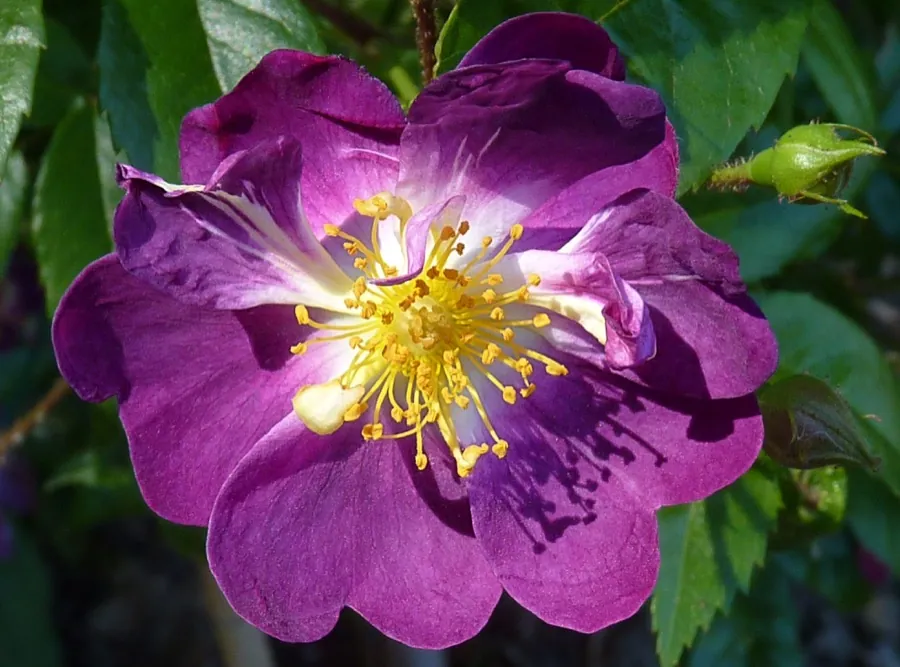
Name. 'Veilchenblau', meaning 'violet-blue' in German (Veilchen = violet, blau = blue). A poetic German name that precisely describes the variety's unique colour, the closest to blue in the 1900s (true 'blue' roses did not exist then, and Veilchenblau was the nearest approximation). Synonyms in other countries: 'Blue Rambler', 'Blue Rosalie', 'Bleu-Violet', 'Violet Blue'.
Breeding. Bred by Hermann Kiese (Germany, the same breeder as Wartburg, 1910). Introduced 1909 through J.C. Schmidt (Erfurt, Germany); in Australia, 1910. Parentage: 'Crimson Rambler' (Turner, by 1893) × 'Souvenir de Brod' / 'Erinnerung an Brod' (Geschwind 1884). The period 1906-1910 was the golden age of German Multiflora-ramblers: Tausendschön (1906), Goldfinch (1907), Veilchenblau (1909), Wartburg (1910).
Significance. THE BEST-KNOWN 'VIOLET' RAMBLER OF THE 1900s, the historic benchmark for 'blue' in roses before 'Reine des Violettes' appeared in the rambler class. RHS Award of Garden Merit 1993. A unique three-phase colour change: carmine bud, dark violet with a white centre and yellow stamens, then greyish mauve at the end. All the phases appear on the bush at once. 117 years in cultivation (1909-2026). Almost thornless, a rarity among ramblers, and safe for fences beside paths. Tolerates part shade, a rarity among ramblers and roses in general. USDA 4b: all of Ukraine without cover. A unique fragrance of apple + lily of the valley, a rare combination. Hermann Kiese: the same breeder as Wartburg (1910); the German rambler era was created by the Schmidt-Kiese creative tandem. Once-flowering, typical of Multiflora ramblers of that time.