


About the name
Name. 'Rosa mundi' — Latin for 'rose of the world'. According to legend, it is named after Rosamund (Rosamonde) Clifford (c. 1140–1176), the mistress of King Henry II of England, 'Fair Rosamund'. The name itself was probably given in reference to the epithet of the Virgin Mary, 'rosa mundi'. A link with the tragic romance of medieval England.
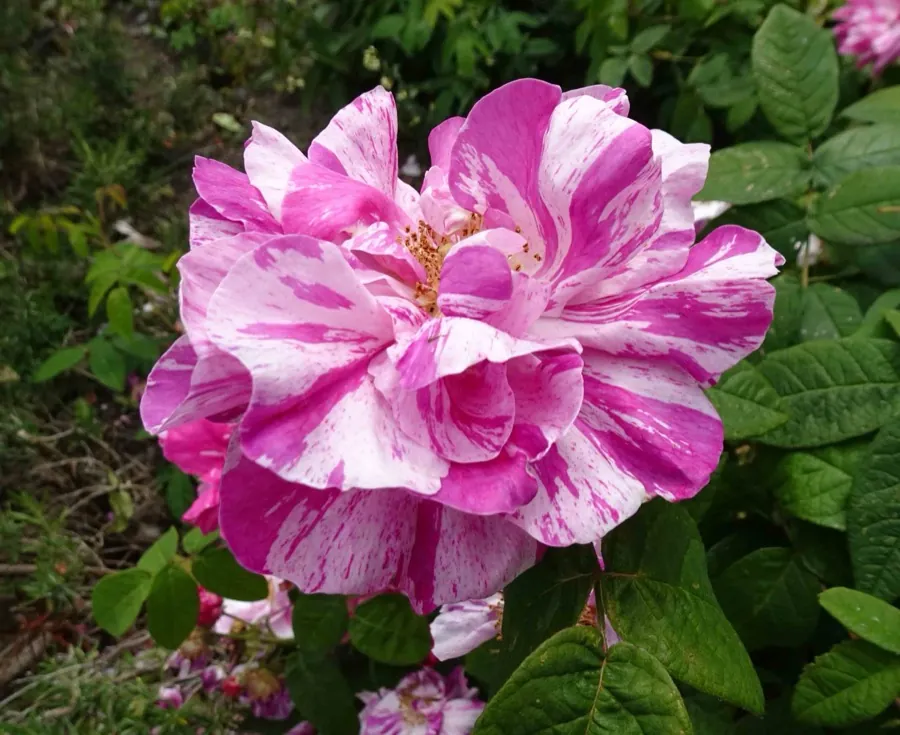
Breeding. A spontaneous sport of R. gallica officinalis — a mutation that arose in nature, without human intervention. Documented from 1581, and mentioned by Brunfels (1532) — one of the oldest documented striped rose varieties in Europe. The breeder is unknown — it is a find of nature that has been kept in cultivation for 5+ centuries. Occasionally flowers on one bush 'revert' to pure pink — a return to the parent Officinalis (a normal phenomenon for sports).
Significance. WFRS Old Rose Hall of Fame 2009 — worldwide recognition among old roses. RHS Award of Garden Merit. One of the oldest striped varieties — the parent of all 'striped' roses (Variegata di Bologna, Honorine de Brabant and other Bourbon-striped roses that appeared 200+ years later). A symbol of medieval England — mentioned in historical texts from the twelfth century. Every flower is unique — the stripe pattern never repeats, like a snowflake.