



Back to catalogue
Large-Flowered Climber; orange-red Kordes climberW. Kordes' Söhne, 1987Apricot and orange

Salita

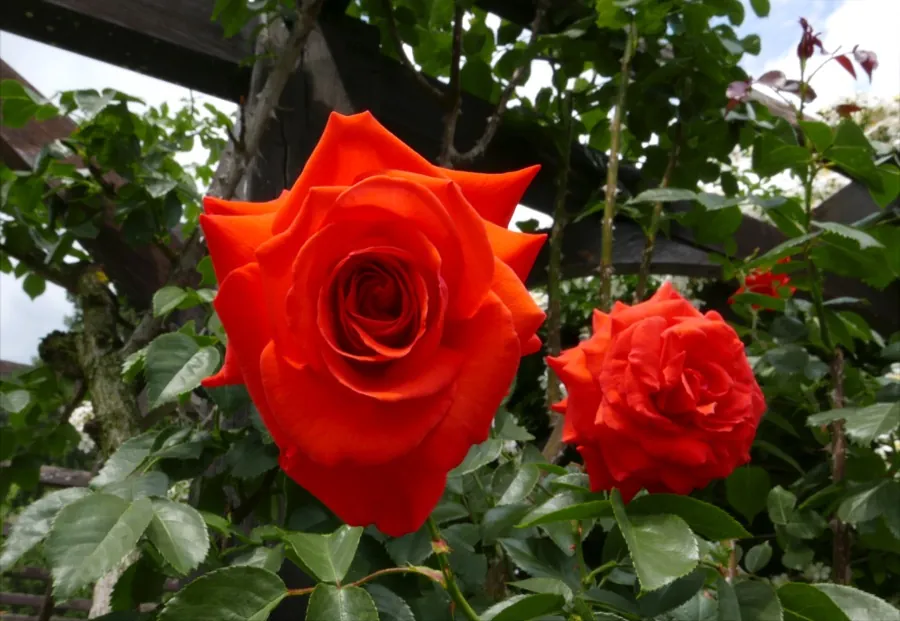
A warm orange-red climber — in 1987 Kordes introduced a new warm-red colour into its climber collection with Salita; Italian salita = “ascent, rise, slope” — a name for a climber that climbs upward; HMF rating “EXCELLENT-”, with 32 “favourite” votes.

1987 — the first warm orange-red in Kordes' climber range

Variety profile

Flowering

Repeat flowering

Repeat-flowering from June to October. Months are approximate, for the climate of Ukraine.

Legacy

The first warm-red

Kordes 1987 climber

Winter hardiness

−23 °C

USDA zone 6b. Central with cover; without cover in the South.

Compare reference temperatures

Plant size

200–300 × 120–150 cm
person 170 cm200–300 cm
Habit
Upright, moderately tall climber
Dimensions
200–300 cm tall × 120–150 cm wide — a medium climber for pillars, low arches and balcony walls
Support
Needs a support: pillar, low arch, netting; forms well vertically thanks to its sturdy shoots
Shoots
Sturdy, holds its flowers well
Branching
Well branched

Flower

8-9 cm
Bud shape
Elongated, orange-red
Open flower
Full double, cupped: 8–9 cm, 26–40 petals
Centre
Dense — the petals cover the stamens
Fullness
26–40 petals (full)
Flower carriage
In small clusters of 2–5 flowers

Fragrance

Absent or very light

Absent or very light — the breeder's priority was colour and bush shape.

Disease resistance

4 out of 5

High, 4/5 against disease — typical of classic Kordes climbers of that period. USDA 6b — in Ukraine Central with light cover, South without cover.

Sun

Full sun

Thorns

Moderate
thornlessfewmoderatemanyvery many

Medium number of thorns — typical of Kordes climbers.

Foliage

Dark green, glossy.

All characteristics in a table
Group
Large-Flowered Climber; orange-red Kordes climber
Breeder
W. Kordes' Söhne, Germany, 1987
Bud shape
Elongated, orange-red
Open flower
Full double, cupped: 8–9 cm, 26–40 petals
Centre
Dense — the petals cover the stamens
Colour
Warm orange-red (warm-red) — a new colour for Kordes climbers at the time. Not the “cold” classic red of Sympathie, but an orange-warm tone
Fullness
26–40 petals (full)
Flower carriage
In small clusters of 2–5 flowers
Flowering
Repeat-flowering from June to October
Fragrance
Absent or very light — the breeder's priority was colour and bush shape
Hips
Not documented — usually cut
Habit
Upright, moderately tall climber
Branching
Well branched
Shoots
Sturdy, holds its flowers well
Thorns
Medium number of thorns — typical of Kordes climbers.
Dimensions
200–300 cm tall × 120–150 cm wide — a medium climber for pillars, low arches and balcony walls
Support
Needs a support: pillar, low arch, netting; forms well vertically thanks to its sturdy shoots
Foliage
Dark green, glossy
Resistance
High, 4/5 against disease — typical of classic Kordes climbers of that period. USDA 6b — in Ukraine Central with light cover, South without cover
Variations of the variety
Code KORmorlet. Introduced 1987 via W. Kordes' Söhne. Parentage not published by Kordes. Some secondary catalogues wrongly give the year as 2006 — the true year of introduction is 1987. No major official awards (ADR, AARS, RHS AGM), but an HMF rating of “EXCELLENT-” with 32 “favourite” votes

Colour scheme

Warm orange-red (warm-red) — a new colour for Kordes climbers at the time. Not the “cold” classic red of Sympathie, but an orange-warm tone

Rose neighbours

Perennials to plant nearby

Neighbouring roses

Contrast climbers — for architectural compositions:

Perennial companions

Contrast palette — violet-silver tones set off the warm-red:

lavenderCoreopsisStachys (lamb's ears)catmint

Availability worldwide

A classic Kordes climber of the '80s:

🇩🇪 Germany: high · home country🇪🇺 Europe: high🇺🇸 USA: moderate🇺🇦 Ukraine: high · through landscape nurseries

More about the variety

Hips
Not documented — usually cut
Variations of the variety
Code KORmorlet. Introduced 1987 via W. Kordes' Söhne. Parentage not published by Kordes. Some secondary catalogues wrongly give the year as 2006 — the true year of introduction is 1987. No major official awards (ADR, AARS, RHS AGM), but an HMF rating of “EXCELLENT-” with 32 “favourite” votes

How to grow

Where to plant. On a pillar or a low arch as a “warm” vertical accent; on a balcony or terrace wall; as an accent in a mixed border with pastel neighbours; on an obelisk in a small garden.

Climate. Central Ukraine with light cover (USDA 6b); South without cover; copes well with summer heat.

Care. Full sun; moderate disease prevention; feed 2–3× per season; prune weak shoots in spring, keeping the main framework shoots.

About the name

Name. “Salita” = “ascent, rise, slope” (Italian). An ideal name for a climber that “rises” upward. Typical of the Kordes-style tradition of giving climbers Italian or geographic names (Rosarium Uetersen, Lavinia, etc.).

Breeding. Bred by W. Kordes' Söhne (Sparrieshoop, Germany). Code KORmorlet. Introduced 1987. Parentage not published by Kordes. Some secondary catalogues wrongly give the year as 2006 — the true year of introduction is 1987.

Significance. The first warm-red colour in Kordes' climber collection — in 1987 Kordes introduced an entirely new palette into its climbers with Salita. Until then their climbers were either pink or classic red shades. A classic medium climber, suitable for most garden situations (pillar, low arch, obelisk). High disease resistance, 4/5, typical of Kordes breeding. Scent absent or light — the breeder's priority was colour and bush shape, not fragrance. No major official awards (ADR, AARS, RHS AGM), but it has popular recognition through the HMF rating “EXCELLENT-” with 32 “favourite” votes.

Frequently asked questions about Salita

Does Salita need winter protection?

The cultivar’s reference temperature is −23 °C (USDA zone 6b). Overwintering depends on the conditions. Central with cover; without cover in the South.

How many times a season does Salita flower?

Repeat-flowering from June to October.

How big does Salita grow?

200–300 cm tall, 120–150 cm wide.

Which diseases affect Salita?

Overall resistance: 4 out of 5. High — typical of classic Kordes climbers.

How much sun does Salita need?

Sun; full sun.

What does Salita smell like?

Absent or very light — the breeder's priority was colour and bush shape.

Gardeners' photos and reviews

My climate

Choose a reference temperature to compare with the cultivar’s data. This is not an overwintering forecast or advice on winter protection; consider wind, moisture and the duration of frost.

Regional data are generalised. USDA describes average annual extreme minima, not a forecast; the values in the list are rounded. Check the conditions at your site. More information: Roses in Ukraine's climate.