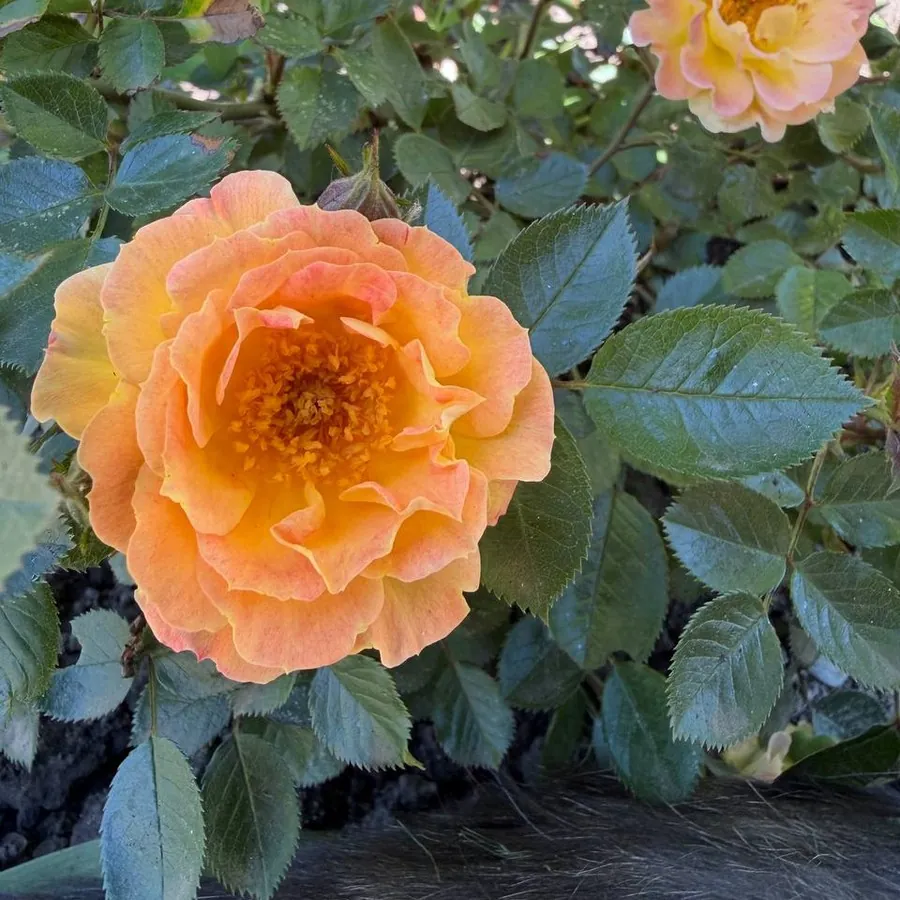
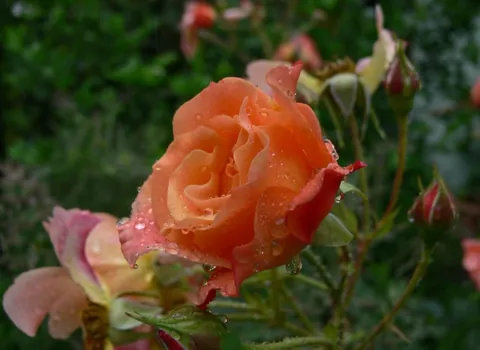
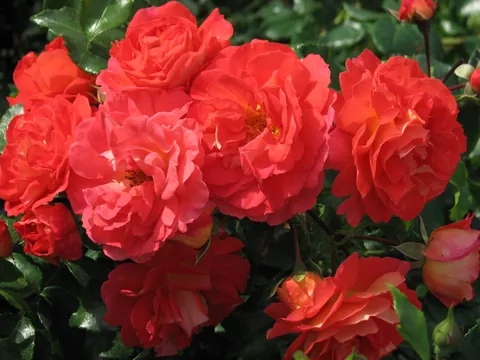
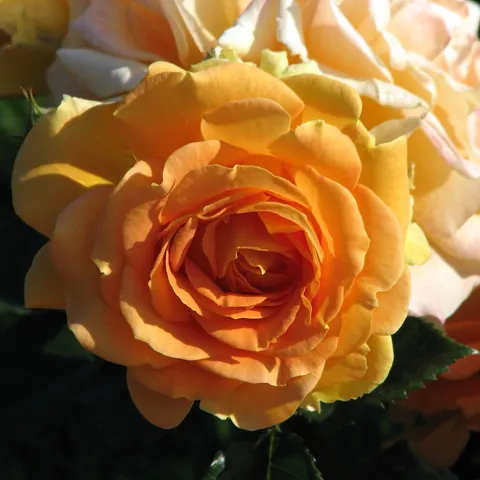
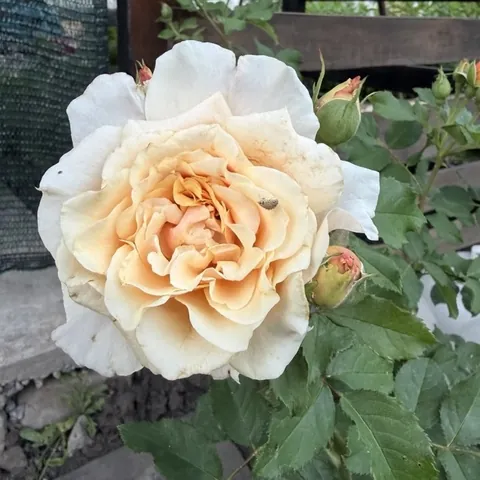


Bessy, close-up of the flower
Photo: Nataliia (own garden)
Back to catalogue
Groundcover; shrub roseInterplant, 1997Bicolour

Bessy

Bessy®; main feature — as it fades, the flower pales towards pink-peach, so fresh orange and faded pink blooms stand together in one cluster: the bush looks two-coloured; it tolerates heat, but the colour fades in the sun.

Interplant · on HelpMeFind a shrub, in Europe sold as a ground-cover rose

Variety profile

Flowering

Repeat, in flushes

In waves, from June to October — and on until the first frosts. Months are approximate, for the climate of Ukraine.

Awards

None

Not tested by ADR · no independent trials

Winter hardiness

−20 °C

Steppe and Forest-Steppe: no cover needed · north (5b–6a): sensible light cover.

Compare reference temperatures

Plant size

40–60 × 40–100 cm
person 170 cm40–60 cm
Habit
Broad, spreading — often wider than tall; the shoots hang slightly
Dimensions
40–60 cm × 40–100 cm; plant 3–4 bushes per m². Gardeners often see it outgrow its label — up to 60–70 cm. But there is no climbing form of Bessy: if someone offers 'climbing Bessy', it is not this variety.
Support
Needs no support — it is a ground cover; the bush holds itself up
Shoots
Flexible, arching, sloping downwards
Branching
Vigorous; the bush quickly closes into a cover

Flower

4–6 cm
Bud shape
Small, round, golden-yellow with an orange tint
Open flower
Cup-shaped, then opening almost flat, stamens open; diameter 4–6 cm (sources differ: 4–5 cm at garten-de, 4–6 cm at Lubera, 5–10 cm at Horstmann — we take 4–6 as the most often repeated figure)
Centre
Open, with visible stamens — the flower 'looks' upwards
Fullness
Semi-double — all sources agree; ≈16–30 petals (there is no reliable exact figure)
Flower carriage
In clusters, several flowers per stem

Fragrance

Barely noticeable

Almost not perceptible. Horstmann gives 0 out of 5, HelpMeFind writes “poor”, Lubera — “delicate, pleasant”. So if there is a scent, it is right at the edge of perception: there is no point going up to it and sniffing — the variety wins on colour. Tales of a “strawberry scent” circulate from commercial descriptions — no source confirms this.

Disease resistance

3 out of 5

3/5 according to Horstmann. The nurseries unanimously write “healthy, sturdy”, but there are no independent trials — the variety has not been through ADR. On HelpMeFind there is an “excellent” rating, but it is the voice of one person and carries no weight.

Sun

Tolerates heat — the foliage is sturdy

But the flower colour fades in the sun.

Thorns

Moderate
thornlessfewmoderatemanyvery many

To be honest: the sources give no precise data on Bessy's prickliness — neither the nurseries nor HelpMeFind. 'Moderate' here is a typical class label, not a measured fact.

Foliage

Dense, thick; this is what gives the variety its ability to cope calmly with a hot summer.

All characteristics in a table
Group
Groundcover; shrub rose
Breeder
Interplant, Netherlands, 1997
Bud shape
Small, round, golden-yellow with an orange tint
Open flower
Cup-shaped, then opening almost flat, stamens open; diameter 4–6 cm (sources differ: 4–5 cm at garten-de, 4–6 cm at Lubera, 5–10 cm at Horstmann — we take 4–6 as the most often repeated figure)
Centre
Open, with visible stamens — the flower 'looks' upwards
Colour
Golden orange, apricot. The variety's main feature: as it fades, the flower pales towards pink-peach, and one cluster holds fresh orange and faded pink blooms at the same time — the bush looks two-coloured. The colour fades in the sun.
Fullness
Semi-double — all sources agree; ≈16–30 petals (there is no reliable exact figure)
Flower carriage
In clusters, several flowers per stem
Flowering
In waves, from June to October — and on until the first frosts
Fragrance
Almost not perceptible. Horstmann gives 0 out of 5, HelpMeFind writes “poor”, Lubera — “delicate, pleasant”. So if there is a scent, it is right at the edge of perception: there is no point going up to it and sniffing — the variety wins on colour. Tales of a “strawberry scent” circulate from commercial descriptions — no source confirms this.
Hips
Forms hips — in autumn the bush is decorated with fruit
Rain resistance
No data — the HelpMeFind field is empty, and the nurseries say nothing about rain.
Habit
Broad, spreading — often wider than tall; the shoots hang slightly
Branching
Vigorous; the bush quickly closes into a cover
Shoots
Flexible, arching, sloping downwards
Thorns
To be honest: the sources give no precise data on Bessy's prickliness — neither the nurseries nor HelpMeFind. 'Moderate' here is a typical class label, not a measured fact.
Dimensions
40–60 cm × 40–100 cm; plant 3–4 bushes per m². Gardeners often see it outgrow its label — up to 60–70 cm. But there is no climbing form of Bessy: if someone offers 'climbing Bessy', it is not this variety.
Support
Needs no support — it is a ground cover; the bush holds itself up
Foliage
Dense, thick; this is what gives the variety its ability to cope calmly with a hot summer
Resistance
3/5 according to Horstmann. The nurseries unanimously write “healthy, sturdy”, but there are no independent trials — the variety has not been through ADR. On HelpMeFind there is an “excellent” rating, but it is the voice of one person and carries no weight.
Variations of the variety
No synonyms; no code name appears in any source; parent forms unknown; patent status unknown

Colour scheme

Golden orange, apricot. The variety's main feature: as it fades, the flower pales towards pink-peach, and one cluster holds fresh orange and faded pink blooms at the same time — the bush looks two-coloured. The colour fades in the sun.

Rose neighbours

Perennials to plant nearby

Neighbouring roses

A warm golden-orange row. Gebrüder Grimm beside it is especially fitting: it too turns pinkish as it fades, so the two bushes pick up the same play of colour.

Perennial companions

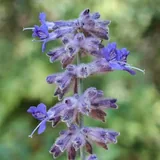
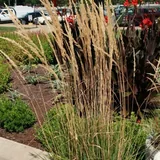
Blue and silver — the quickest way to make orange glow:

Russian sage (Perovskia)catmintlamb's earsornamental grasses

Availability worldwide

The variety lives more in European nurseries than in books:

  • 🇩🇪 Germany: widely available · Horstmann, Lubera, pflanzmich, garten-de
  • 🇳🇱 Netherlands: no longer in Interplant's own catalogue
  • 🇭🇺🇩🇪 Central Europe: common in gardens
  • 🇺🇦 Ukraine: no supply data available

More about the variety

Hips
Forms hips — in autumn the bush is decorated with fruit
Rain resistance
No data — the HelpMeFind field is empty, and the nurseries say nothing about rain.
Variations of the variety
No synonyms; no code name appears in any source; parent forms unknown; patent status unknown

How to grow

Where to plant. Solid drifts and slopes, the front edge of a mixed border, the edge of a path, low ground cover under tall roses — anywhere the bush can spread 40–100 cm wide and let its shoots hang a little. Plant 3–4 bushes per m². The orange works like a lamp here: put blue or silver next to it and the colour will flare. And take the second colour into account: until the end of the flush the bush stands orange-pink at the same time, so it is best to choose neighbours that will not clash with a pink tint.

Climate. Hardy to −20 °C. Steppe and Forest-Steppe — it overwinters in the open; in the north (zones 5b–6a) it is sensible to give light cover. The mark “USDA 6b–9b” on HelpMeFind carries the note “default” — it is an automatic database entry, not a measurement; it is better not to rely on it. Sun and heat: a hot summer does not frighten this variety — the sturdy foliage holds up to the heat, as German nurseries consistently write. But there is a price: the flower colour fades in the sun. If you want a deeper orange, choose a spot with some shade at midday.

Care. Standard for ground cover — spring pruning, mulch. Since the variety has not been through independent trials, do not skip fungal disease prevention: the promises of “healthy and sturdy” here are the seller's words, not the result of a trial.

About the name

Name. Bessy, the trade name — Bessy®; Ukrainian transliteration: Bessi. No synonyms and no code name appear in any source. Where the name came from is unknown. This is a rare case: most roses have a story behind their name — a person, a town, an anniversary. Nobody wrote it down here, and we will not make it up.

Breeding. Interplant Roses B.V., the Netherlands. Year — 1997 (the market release date given by German nurseries: Horstmann, Lubera, pflanzmich, garten-de); HelpMeFind gives 1998. The parent forms and patent status are unknown. Its class is also vague: HelpMeFind writes 'shrub, can be used as ground cover', while German nurseries uniformly sell it as Bodendeckerrose — ground cover.

Meaning. There are no awards — HelpMeFind states directly: “No awards known for this Plant”. It is not on the ADR list either, and that is not surprising: no Interplant rose is listed there at all. The References tab on HelpMeFind is empty — the variety is not in any book. Interplant itself no longer lists it today: the firm has switched to cut roses. So Bessy is a variety without an official biography, which survives in gardens: 17 votes for 'favourite' on HelpMeFind, photos from Budapest from 2008 and from south-west Germany from 2010. It is widespread in Central Europe — and it lives on simply because people like it.

Frequently asked questions about Bessy

Does Bessy need winter protection?

The cultivar’s reference temperature is −20 °C. Overwintering depends on the conditions.

How many times a season does Bessy flower?

In waves, from June to October — and on until the first frosts.

How big does Bessy grow?

40–60 cm tall, 40–100 cm wide.

Which diseases affect Bessy?

Overall resistance: 3 out of 5. Rating from the Horstmann nursery; 'healthy, sturdy' according to sellers' words; there are no independent trials.

How much sun does Bessy need?

Sun; tolerates heat — the foliage is sturdy; but the flower colour fades in the sun.

What does Bessy smell like?

Almost not perceptible. Horstmann gives 0 out of 5, HelpMeFind writes “poor”, Lubera — “delicate, pleasant”. So if there is a scent, it is right at the edge of perception: there is no point going up to it and sniffing — the variety wins on colour. Tales of a “strawberry scent” circulate from commercial descriptions — no source confirms this.

Gardeners' photos and reviews

My climate

Choose a reference temperature to compare with the cultivar’s data. This is not an overwintering forecast or advice on winter protection; consider wind, moisture and the duration of frost.

Regional data are generalised. USDA describes average annual extreme minima, not a forecast; the values in the list are rounded. Check the conditions at your site. More information: Roses in Ukraine's climate.