

Back to catalogue
Shrub / Climbing Shrub; a benchmark of toughness, on sale for 60 yearsReimer Kordes; W. Kordes' Söhne, 1969Apricot and orange

Westerland

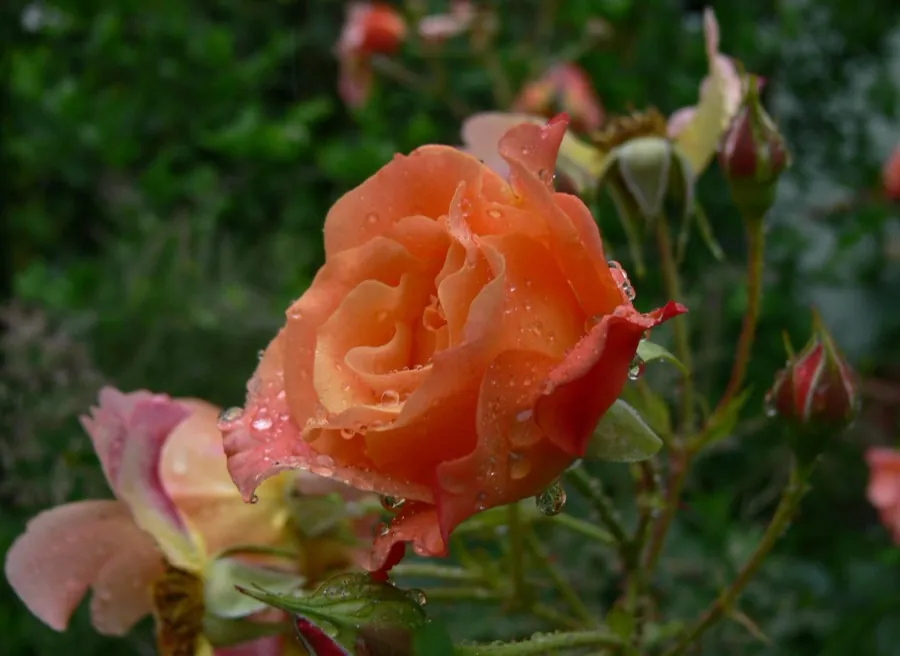
Golden apricot-orange with a yellow reverse: a rich 'western' palette; ADR 1974 + RHS AGM 1993, a rare two-sided recognition from Germany and the UK; named after Westerland, Germany's main seaside resort on the island of Sylt; 5/5 resistance, a benchmark of toughness, on sale for 60 years.

ADR 1974 + RHS AGM 1993 + NZ Fragrance Award 1973

Variety profile

Flowering

Repeat, in flushes

Very generous repeat flowering in flushes from June to October. Months are approximate, for the climate of Ukraine.

Legacy

ADR 74 + AGM 93

60 years at the top

Winter hardiness

−29 °C

USDA zone 5-9. RHS H6; all of Ukraine.

Compare reference temperatures

Plant size

150–250 × 100–150 cm
person 170 cm150–250 cm
Habit
A large shrub or small climber; it grows both as a bush and as a semi-climber
Dimensions
150-250 cm tall × 100-150 cm wide (per RHS); in gardens often 150-200 × 80-100. Can be formed as a bush or as a small climber
Support
Not needed as a shrub; for heights of 200+ cm a light support or wall is advisable
Shoots
Strong, holding large trusses of flowers
Branching
Well branched, powerful

Flower

≈ 10 cm

20 petals.

Bud shape
Round, dark orange
Open flower
Cupped, ruffled (wavy cup): about 10 cm, about 20 petals (double)
Centre
Stamens visible when open
Fullness
About 20 petals (double)
Flower carriage
In dense clusters; a solid orange 'burst' across the bush

Fragrance

Strong; spicy (spice); NZ Fragrance 1973

Strong, spicy (spice fragrance): New Zealand Fragrance Award 1973. Noticeable from a distance.

Disease resistance

5 out of 5

A benchmark, 5/5: one of the healthiest Kordes-type varieties of all time. USDA 5-9, RHS H6 (down to −20 °C): all of Ukraine without cover, including the east, centre and north; give it space and protection from strong wind.

Sun

Full sun

Thorns

Moderate
thornlessfewmoderatemanyvery many

Average number of thorns; typical for Kordes-type shrubs.

Foliage

Glossy dark green, very healthy; legendary health.

Other names

KORlawe, Kordes' Rose Westerland
All characteristics in a table
Group
Shrub / Climbing Shrub; a benchmark of toughness, on sale for 60 years
Breeder
Reimer Kordes; W. Kordes' Söhne, Germany, 1969
Bud shape
Round, dark orange
Open flower
Cupped, ruffled (wavy cup): about 10 cm, about 20 petals (double)
Centre
Stamens visible when open
Colour
Golden apricot-orange with a yellow reverse to the petal: the rich 'western' palette, like a sunset over the sea. It does not fade in the heat
Fullness
About 20 petals (double)
Flower carriage
In dense clusters; a solid orange 'burst' across the bush
Flowering
Very generous repeat flowering in flushes from June to October
Fragrance
Strong, spicy (spice fragrance): New Zealand Fragrance Award 1973. Noticeable from a distance
Hips
Not documented; usually cut
Habit
A large shrub or small climber; it grows both as a bush and as a semi-climber
Branching
Well branched, powerful
Shoots
Strong, holding large trusses of flowers
Thorns
Average number of thorns; typical for Kordes-type shrubs.
Dimensions
150-250 cm tall × 100-150 cm wide (per RHS); in gardens often 150-200 × 80-100. Can be formed as a bush or as a small climber
Support
Not needed as a shrub; for heights of 200+ cm a light support or wall is advisable
Foliage
Glossy dark green, very healthy; legendary health
Resistance
A benchmark, 5/5: one of the healthiest Kordes-type varieties of all time. USDA 5-9, RHS H6 (down to −20 °C): all of Ukraine without cover, including the east, centre and north; give it space and protection from strong wind
Variations of the variety
Code KORwest (synonyms KORlawe, Kordes' Rose Westerland). Introduced 1969 through W. Kordes' Söhne. Breeder: Reimer Kordes. Parentage: 'Friedrich Wörlein' (Kordes 1963) × 'Circus' (Swim 1955)

Colour scheme

Golden apricot-orange with a yellow reverse to the petal: the rich 'western' palette, like a sunset over the sea. It does not fade in the heat

Rose neighbours

Perennials to plant nearby

Neighbouring roses

Warm shrubs and HTs — for a 'sunny' corner:

Companion perennials

A sunny palette with purple-silver accents:

coreopsislavenderstachyssedum

Availability worldwide

⭐⭐⭐ One of Europe's best-known shrub roses for 60+ years:

🇩🇪 Germany: very high · home, ADR🇬🇧 UK: very high · RHS AGM 1993🇪🇺 Europe: very high🇺🇦 Ukraine: high · classic for parks

More about the variety

Hips
Not documented; usually cut
Variations of the variety
Code KORwest (synonyms KORlawe, Kordes' Rose Westerland). Introduced 1969 through W. Kordes' Söhne. Breeder: Reimer Kordes. Parentage: 'Friedrich Wörlein' (Kordes 1963) × 'Circus' (Swim 1955)

How to grow

Where to plant. As a 'burst of colour' accent in a bed, thanks to its rich palette; as a small climber on a wall; in a sunny mixed border; along tall borders; by a bench, for its strong spicy fragrance.

Climate. All of Ukraine without cover (USDA 5-9, RHS H6, down to −20 °C); tolerates summer heat well without fading.

Care. Minimal; full sun; 5/5 resistance, so no chemical treatments; feeding 2× per season; pruning ⅓ in spring; give it space and protection from strong wind.

About the name

Name. 'Westerland', after the seaside resort town of Westerland on the island of Sylt in the North Sea. Sylt is Germany's main seaside resort, known for its beaches, dunes and the era of 'German Cannes'. A poetic name: the golden-orange palette recalls a sunset over the sea at Westerland.

Breeding. Bred by Reimer Kordes at W. Kordes' Söhne (Sparrieshoop, Germany). Code KORwest. Introduced 1969. Parentage: 'Friedrich Wörlein' (Kordes 1963) × 'Circus' (Swim 1955).

Significance. ADR 1974 (Allgemeine Deutsche Rosenneuheitenprüfung, the main German award for robustness). RHS Award of Garden Merit 1993 (confirmed by rhs.org.uk). NZ Certificate of Merit 1973 + NZ Fragrance Award 1973. One of the few varieties to receive the ADR (Germany) and the AGM (UK) at once, a rare two-sided recognition 19 years after its ADR. Almost 60 years on sale, it is still a benchmark of toughness, alongside Iceberg, Bonica and Knock Out. Legendarily healthy foliage, 5/5, without chemical treatments. Does not fade in the sun, a rarity for orange roses. Hardy throughout Ukraine without cover: a record winter hardiness for an orange shrub.

Frequently asked questions about Westerland

Does Westerland need winter protection?

The cultivar’s reference temperature is −29 °C (USDA zone 5−9). Overwintering depends on the conditions. RHS H6; all of Ukraine.

How many times a season does Westerland flower?

Very generous repeat flowering in flushes from June to October.

How big does Westerland grow?

150–250 cm tall, 100–150 cm wide.

Which diseases affect Westerland?

Overall resistance: 5 out of 5. A benchmark; legendarily healthy foliage.

How much sun does Westerland need?

Sun; full sun.

What does Westerland smell like?

Strong, spicy (spice fragrance): New Zealand Fragrance Award 1973. Noticeable from a distance.

Gardeners' photos and reviews

My climate

Choose a reference temperature to compare with the cultivar’s data. This is not an overwintering forecast or advice on winter protection; consider wind, moisture and the duration of frost.

Regional data are generalised. USDA describes average annual extreme minima, not a forecast; the values in the list are rounded. Check the conditions at your site. More information: Roses in Ukraine's climate.