




Back to catalogue
RugosaSchaum & Van Tol; Boskoop, 1905Lilac and purple

Hansa

One of the hardiest Rugosas in the world; exceptionally winter-hardy (USDA 3); a classic 'old rose' scent with notes of clove.

Hybrid Rugosa · 120+ years in cultivation

Variety profile

Flowering

Repeat, in flushes through the season, but the first flush is the most abundant

Awards

Boskoop 2007

Great Selection of Plants · 120+ years in commercial catalogues

Winter hardiness

−40 °C

USDA zone 3. All of Ukraine without cover; legendary in Canada. No winter cover needed anywhere in Ukraine · legendary Canada.

Compare reference temperatures

Plant size

150–215 × 120–215 cm
person 170 cm150–215 cm
Habit
A broad, spreading shrub with upright canes; ideal for an impenetrable hedge
Dimensions
150–215 cm tall × 120–215 cm wide
Support
No support needed
Shoots
Strong, straight, with the dense Rugosa-type down
Branching
Very good, with a powerful framework

Flower

≈ 8 cm

Semi-double to double, 25–35 petals (HMF); sources disagree: RosesABC gives 16–25, others up to 45. HMF is taken as the official figure petals.

Bud shape
Round-oval, dark purplish pink
Open flower
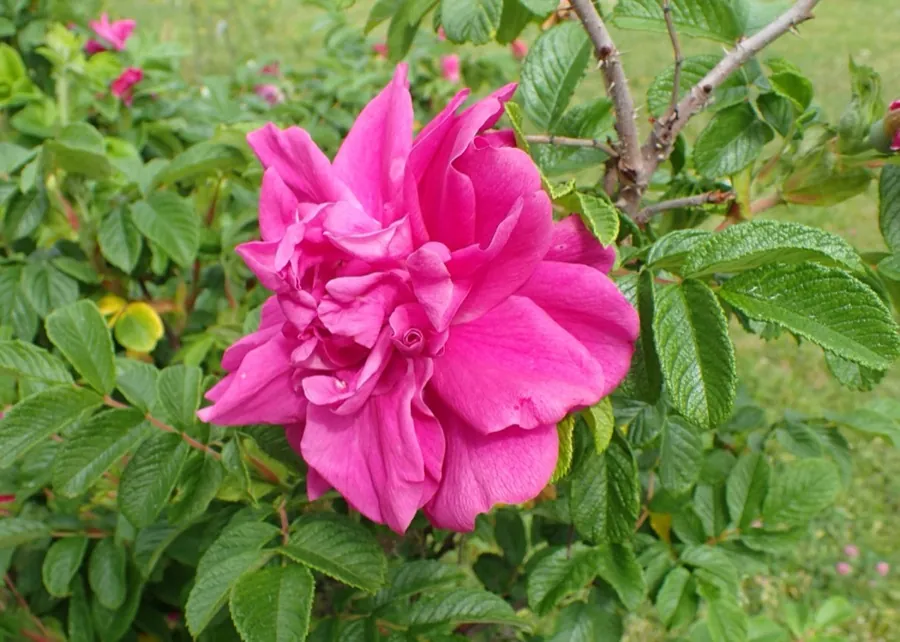
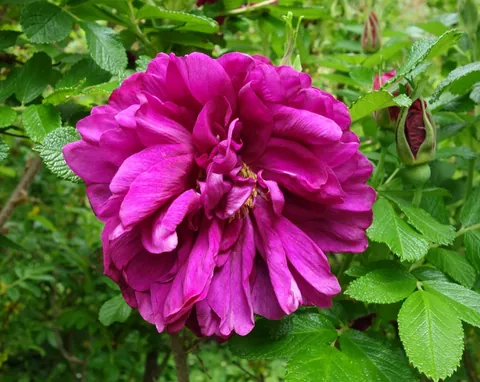
Semi-double classic Rugosa-rosette with a prominent yellow centre of stamens; diameter ~8 cm
Centre
Bright yellow centre of stamens, contrasting with the purplish-pink petals
Fullness
Semi-double to double, 25–35 petals (HMF); sources disagree: RosesABC gives 16–25, others up to 45. HMF is taken as the official figure
Flower carriage
Singly or in small clusters

Fragrance

Strong

A strong classic 'old rose' scent with notes of spice and clove — the benchmark of Rugosa-fragrance.

Disease resistance

5 out of 5

Excellent — the Rugosa-line has 'iron health'; it is almost never ill and needs no chemicals; it tolerates salty soils well, which is why it is popular on coasts.

Sun

Sun or partial shade

Tolerates some shade — typical of Rugosa.

Thorns

Very many
thornlessfewmoderatemanyvery many

Very many prickles — typical of Rugosa, which makes the shrub ideal as a barrier.

Foliage

Characteristically wrinkled dark green (which is where 'rugosa', meaning 'wrinkled', comes from) — healthy; in autumn it turns golden yellow.

All characteristics in a table
Group
Rugosa
Breeder
Schaum & Van Tol; Boskoop, Netherlands, 1905
Bud shape
Round-oval, dark purplish pink
Open flower
Semi-double classic Rugosa-rosette with a prominent yellow centre of stamens; diameter ~8 cm
Centre
Bright yellow centre of stamens, contrasting with the purplish-pink petals
Colour
Dark purplish-pink magenta — a deep, saturated tone with no maroon or orange undertone
Fullness
Semi-double to double, 25–35 petals (HMF); sources disagree: RosesABC gives 16–25, others up to 45. HMF is taken as the official figure
Flower carriage
Singly or in small clusters
Flowering
Repeat, in flushes through the season, but the first flush is the most abundant
Fragrance
A strong classic 'old rose' scent with notes of spice and clove — the benchmark of Rugosa-fragrance
Hips
Large decorative red-orange rose hips in autumn — a second 'season' for the variety; they can be gathered for tea or jam
Habit
A broad, spreading shrub with upright canes; ideal for an impenetrable hedge
Branching
Very good, with a powerful framework
Shoots
Strong, straight, with the dense Rugosa-type down
Thorns
Very many prickles — typical of Rugosa, which makes the shrub ideal as a barrier.
Dimensions
150–215 cm tall × 120–215 cm wide
Support
No support needed
Foliage
Characteristically wrinkled dark green (which is where 'rugosa', meaning 'wrinkled', comes from) — healthy; in autumn it turns golden yellow
Resistance
Excellent — the Rugosa-line has 'iron health'; it is almost never ill and needs no chemicals; it tolerates salty soils well, which is why it is popular on coasts
Variations of the variety
Full name Rosa rugosa 'Hansa'; parentage not public (a commercial secret of 1905)

Colour scheme

Dark purplish-pink magenta — a deep, saturated tone with no maroon or orange undertone

Rose neighbours

Perennials to plant nearby

Neighbouring roses

The natural Rugosa family + related Hybrid Musks:

Companion perennials

Violet-silver natural accents:

lavender 'Hidcote'Stachys byzantina (lamb's ear)lady's mantle (Alchemilla)catmint (Nepeta) 'Walker's Low'

Availability worldwide

A classic Rugosa, available in every climate zone:

  • 🇪🇺 Europe: HIGH · 120+ years in commercial catalogues
  • 🇺🇸 USA: HIGH · top Rugosa in the cold states
  • 🇯🇵 Asia: high · Japan reveres Rugosa as 'hamanasu'
  • 🇺🇦 Ukraine: HIGH · classic park rose / hedge

More about the variety

Hips
Large decorative red-orange rose hips in autumn — a second 'season' for the variety; they can be gathered for tea or jam
Variations of the variety
Full name Rosa rugosa 'Hansa'; parentage not public (a commercial secret of 1905)

How to grow

Where to plant. Impenetrable hedges, natural parks, the seashore (Rugosa tolerates salty soil well), woodland edges and birch groves. For cold regions it is ideal, with no restrictions; it is one of the few varieties suitable for a dacha that can go for years without care.

Climate. Down to −40 °C — all of Ukraine without cover; legendary in Canada (zone 3), Scandinavia and northern Japan; one of the hardiest roses in the world.

Care. Minimal — Rugosa needs no seasonal pruning, fungicides or complicated watering; sanitary thinning every 3-5 years is enough; rose hips can be collected in autumn for tea.

About the name

Name. 'Hansa' comes from the name of the nursery 'Hansa Nursery' (Schaum & Van Tol) in Boskoop, the Netherlands. 'Hansa' (German Hanse) was the historic trading league of the cities of Northern Europe, XIII–XVII centuries (Lübeck, Hamburg, Bremen, Rostock, Gdańsk, Riga, Tallinn and others); the name was popular in Dutch and German commercial brands of the early twentieth century. In Slavic languages the variety is read as 'Hansa'.

Breeding. Bred by the Dutch nursery Schaum & Van Tol in Boskoop (the centre of the Dutch nursery business since the seventeenth century), in 1905. It belongs to the Hybrid Rugosa group: hybrids of the classic Japanese rose Rosa rugosa with European garden roses of the late nineteenth century. The parentage is not published, which was standard practice for commercial breeders of that time.

Significance. One of the hardiest Rugosa-varieties in the world, with more than 120 years in the commercial catalogue without a break. The earlier working notes contained a hypothesis about an RHS AGM, which is not confirmed in the current RHS list. Confirmed award: 'Great Selection of Plants' 2007 (Boskoop), a Dutch trade recognition. USDA 3 — hardiness is practically unrated; legendary in Canada (planted along highways as a decorative hedge), Scandinavia and northern Japan. The scent of Hansa is the benchmark of the classic 'old rose', which twentieth-century perfumers used to recreate the 'rose in grandmother's garden'. The rose hips are large and sweet, traditionally used for tea and jam (vitamin C).

Frequently asked questions about Hansa

Does Hansa need winter protection?

The cultivar’s reference temperature is −40 °C (USDA zone 3). Overwintering depends on the conditions. All of Ukraine without cover; legendary in Canada.

How many times a season does Hansa flower?

Repeat, in flushes through the season, but the first flush is the most abundant.

How big does Hansa grow?

150–215 cm tall, 120–215 cm wide.

Which diseases affect Hansa?

Overall resistance: 5 out of 5. Excellent; the Rugosa-line has 'iron health'.

How much sun does Hansa need?

Sun or partial shade; tolerates some shade — typical of Rugosa.

What does Hansa smell like?

A strong classic 'old rose' scent with notes of spice and clove — the benchmark of Rugosa-fragrance.

Gardeners' photos and reviews

My climate

Choose a reference temperature to compare with the cultivar’s data. This is not an overwintering forecast or advice on winter protection; consider wind, moisture and the duration of frost.

Regional data are generalised. USDA describes average annual extreme minima, not a forecast; the values in the list are rounded. Check the conditions at your site. More information: Roses in Ukraine's climate.